Attractions and Places To See around Island - Top 20
Best attractions and places to see around Island include a variety of historical and religious sites, alongside picturesque settlements and notable man-made structures. The region offers opportunities to explore significant architectural masterpieces and locations with deep historical roots. Visitors can discover a blend of cultural heritage and scenic points of interest.
Best attractions and places to see around Island
- The most popular attractions is Avallon, a settlement and historical site known for its unique church architecture. This pretty town on a hill features a church with ribbed vaults and Romanesque cornices.
- Another must-see spot is Cordelle Chapel, a religious building and historical site. This small Romanesque chapel marks the place where Saint Bernard preached the Second Crusade and was the site of France's first Franciscan monastery.
- Visitors also love Notre-Dame Church of Saint-Père, a religious building and man-made monument. This 13th-century church is considered a masterpiece of Burgundy Flamboyant style, featuring a 50-meter-high bell tower.
- Island is known for its religious buildings, historical sites, and settlements. The region offers a variety of attractions to see and explore, from ancient churches to charming towns.
- The attractions around Island are appreciated by the komoot community, with more than 175 upvotes and 96 photos shared by visitors.
Last updated: May 9, 2026
Basilica of Saint Mary Magdalene in Vézelay
Highlight • Religious Site
Translated by Google •
Tip by

Notre-Dame Church of Saint-Père
Highlight • Religious Site
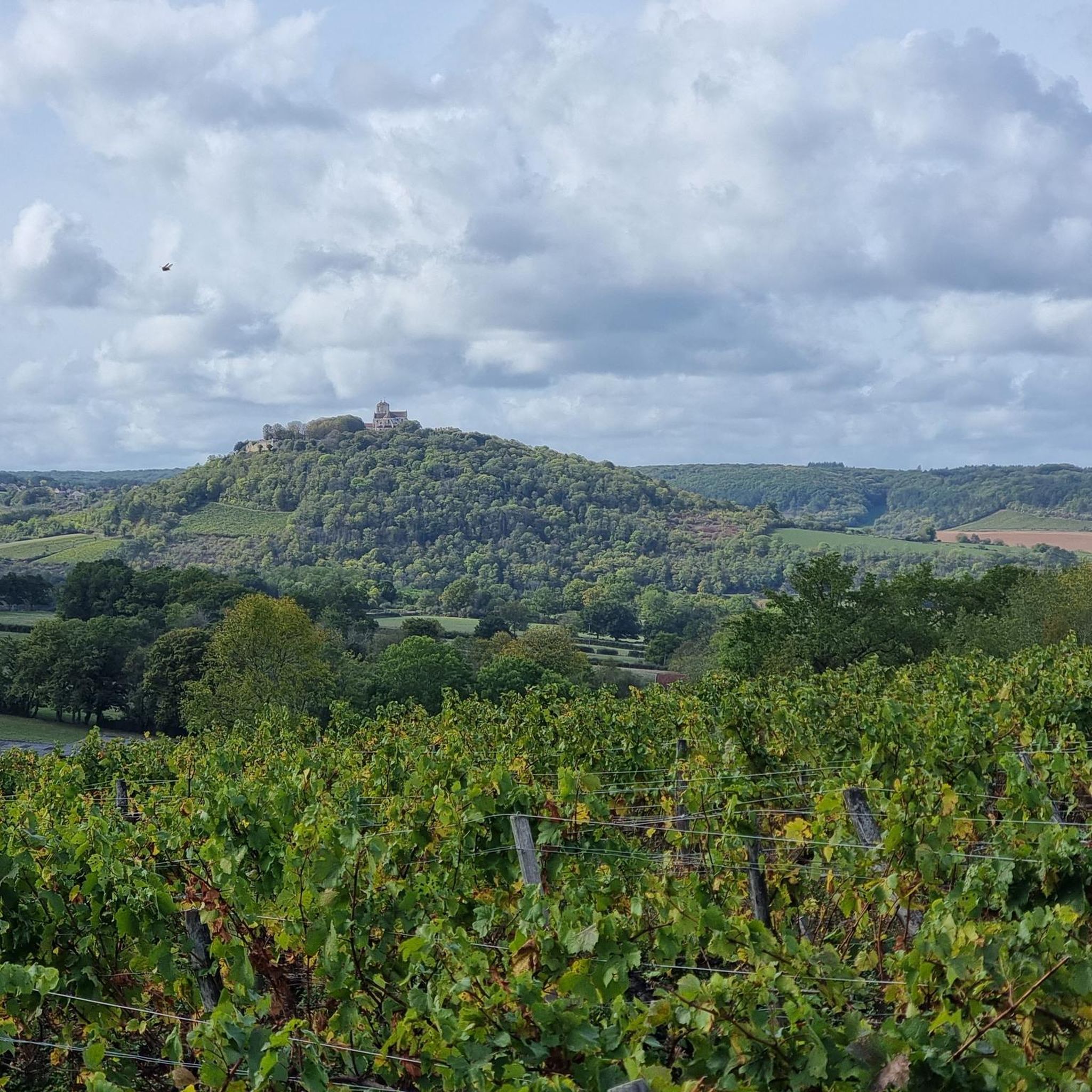
The Église Notre-Dame de Saint-Père church is built in Burgundy Flamboyant style and is considered a masterpiece of this Late Gothic style. The three-nave church with its 50-meter-high bell tower was built in the 13th century and has been listed as a monument historique since 1840. The two chapels were in the 14./15. and the narthex added in the 15th century. The iconography of the church is not very enlightening, but inside you can find the rather worn-out portrait of a Geizkragens, which keeps his purse hanging around his neck. He is flanked on both sides by a dragon that seems to bite his ears off. This symbol can be seen quite ambiguously: The man turns deaf, although he certainly had the means to help (egoism) or the man is so fixated on his belongings that he forgets to protect himself - himself something good to do (greed as obsessive-compulsive disorder). The richest is the open narthex. For more than two centuries, sculptors were able to realize their ideas and stonemasons could prove their skill in craftsmanship. Upon entering the covered narthex you can see on the right two statuettes in half relief, which are to represent Girart de Roussillon and his wife Berthe or his daughter Eve. They are considered the founders of the former abbey of Saint-Père.
Probably the church (former abbey) had a function as the last stop in the pilgrimage to the tomb of St. Mary Magdalene in Vézelay.
Translated by Google •
Tip by

Sign up now to discover places like this
Get recommendations on the best single tracks, peaks, & plenty of other exciting outdoor places.
Sign up for free
Cordelle Chapel
Highlight • Religious Site
The 17th-century southern porch is what remains of a Franciscan church.
The site of La Cordelle, at the foot of the Eternal Hill towards Asquins, marks the place where Saint Bernard preached the Second Crusade in 1146. The Romanesque chapel was built in the mid-12th century by the Abbot of Vézelay in memory of this great historical event. It is also the site of the first Franciscan monastery in France, founded around the chapel in 1217. Long forgotten, the chapel is once again inhabited by the Franciscans and is open to visitors.
Translated by Google •
Tip by

Avallon
Highlight • Settlement
This is composed of a central nave flanked by two side aisles. You will notice the difference in level of almost 3 meters between the portal and the choir. The height of the pillars as well as the cord which surmounts them follow, like the floor of the church, the slope of the rocky spur on which it is built.
The current organ was built in 1850 by the Grenoble maker Nicolas Chambry, in a classical style from the 16th and 18th centuries. At the same time, a new musical universe is emerging for organists and Avallon is joining in...
When you leave, don't forget to go to the apse of the Collegiate Church to admire the Romanesque cornices whose sculpted modillions (sculpted architectural element supporting a cornice) are interesting.
Source: “The Frog Circuit”
Translated by Google •
Tip by

Saint Martin Church
Highlight • Other
If during the French Revolution the building served as a remand center, barracks or factory, in 1804, it resumed its religious function and became the second parish church of Avallon under the name of Saint-Martin Church.
In 1829, the bell tower was transferred from the roof of the Ladies Chapel to that of the current nave. Proving too small as a parish church, the building underwent major transformations in 1850...
In 1840, Father MUARO, founder of the Abbey of Pierre-qui-Vire, then parish priest of Saint-Martin, installed the reliquary of Saint-Clement, the shrine and the Main Altar.
Despite all these construction restarts, the whole Church remains homogeneous, recalling the vaults of Saint-Vorles in Châtillon-sur-Seine or that of the Abbey of Fontenay-près-Montbard,
(Extracts from bulletin n°3 of the “Friends of old AVALLON”)
Translated by Google •
Tip by
Sign up for free to discover even more attractions around Island.
Sign up for free
Already have an account?
Start today with a free account
Your next adventure awaits.
Login or Signup
Tips from the Community

This church, dedicated to the Holy Cross (Latin: "Santa Croce"), derives its patronage from the cross on which Jesus Christ died. The veneration of the Holy Cross is largely based on Saint Helena, the mother of Emperor Constantine the Great (who, after his victory at the Milvian Bridge in Rome, recognized Christianity as a religion and ended the long period of persecution with the Edict of Toleration of Milan in 312). She made a pilgrimage to the Holy Land (Israel/Palestine) in the early fourth century and brought numerous relics back to Europe, including the "True Cross," on which Jesus Christ was crucified. Helena is therefore often depicted with a cross as an attribute. The Church celebrates the Feast of the Discovery, public presentation, and veneration of the Holy Cross—called the "Exaltation of the Holy Cross"—on September 14th.
0
0


Very worthwhile visit to this beautiful church
1
0

Very small chapel with a Franciscan monastery. The monastery was only returned a few years ago. The monks are trying to rebuild the monastery through a project
1
0

The town of Avallon is home to very old monuments such as the Saint-Lazare church which is in front of you and a little further on the Clock Tower. The city center is very pleasant with its squares and fountains, and its very beautiful Maison des Sires de Domecy. By heading towards Quarré-les-Tombes you will see several islands located on the course of the Cousin, as well as remarkable old bridges spanning it. The statue of the famous Avallon frog, which you will not fail to see, was sculpted in Châtillonnais stone by Yvan Baudoin.
0
0
Saint Martin, to whom the church in Avallon is dedicated, is - along with Saint Nicholas - probably one of the most popular saints of all. The memorial day of the former officer in the Roman army is November 11th. On the night after the famous “parting of the coat,” when he leaves half of his army cloak to a freezing beggar, Jesus Christ appears to him in a dream. He then converted to Christianity and was later elected bishop of Tours (France) - initially against his will.
0
0

A true jewel of Burgundian Gothic art, the church of Saint Père sous Vézelay deserves a moment of attention. Built from the 13th to the 15th century and dedicated to the Virgin, it only became a parish church in the 16th century, succeeding the old Saint Pierre church which gave its name to the village and whose ruins can still be seen at the exit. south of the village. The 13th century bell tower, elegant and airy, 50m high, is visible for miles around. In the middle of the 19th century, the building was in a very advanced state of disrepair. However, Prosper Mérimée describes it as "a gothic cathedral in miniature". Viollet-le-Duc, then 26 years old, fell in love with the church of Saint Père, the restoration of which he launched in 1841. He worked until 1844 on the choir, the chapels and the nave. and in 1868, ends with the bell tower. However, due to a lack of resources, he practically does not intervene on the porch (or narthex). This part, which is the most striking because it evokes real stone lacework, was then restored by Boeswilwald between 1888 and 1889.
0
0
Frequently Asked Questions
What types of historical sites can I explore around Island?
The region is rich in historical sites. You can visit the Cordelle Chapel, a Romanesque chapel marking where Saint Bernard preached the Second Crusade and the site of France's first Franciscan monastery. The settlement of Avallon itself is a historical site with unique church architecture and Romanesque cornices. Additionally, the Notre-Dame Church of Saint-Père is a 13th-century masterpiece of Burgundy Flamboyant style with deep historical roots.
Are there any notable religious buildings to visit?
Yes, religious architecture is a significant feature of the area. Beyond the Cordelle Chapel and the church in Avallon, you can explore the impressive Notre-Dame Church of Saint-Père, known for its 50-meter-high bell tower. Also, the Saint Martin Church in Avallon, originally a 17th-century convent chapel, offers a glimpse into the region's ecclesiastical history.
What man-made monuments are worth seeing?
The region features several interesting man-made structures. The Notre-Dame Church of Saint-Père is considered a significant man-made monument due to its architectural style. Another notable site is the Crescent Dam, a gravity dam built between 1929 and 1932 to regulate the Yonne and Seine rivers and produce electricity.
Are there family-friendly attractions around Island?
Absolutely! The settlement of Avallon is considered family-friendly, offering a charming town to explore. The Notre-Dame Church of Saint-Père is also suitable for families, providing an educational and visually engaging experience.
What outdoor activities can I do near these attractions?
The area around Island offers various outdoor activities. You can find numerous hiking trails, such as 'The Cousin Valley — between Avallon and Pontaubert' or the 'Avallon Clock Tower' loops. For running enthusiasts, there are routes like the 'Avallon rampart loop'. Cyclists can enjoy road cycling routes, including 'Les rochers du Saussois & la Route Forestiere du Fay'. You can find more details on these activities in the respective guides for hiking, running, and road cycling around Island.
Are there any natural features or scenic viewpoints?
While the region is primarily known for its historical and architectural sites, the Crescent Dam creates a large reservoir, offering scenic views of the lake and surrounding landscape. The dam itself is situated in a picturesque setting, contributing to the natural beauty of the area.
What do visitors enjoy most about the attractions around Island?
Visitors frequently praise the architectural beauty and historical significance of the sites. For instance, the Notre-Dame Church of Saint-Père is described as 'simply impressive and amazing' and a 'masterpiece' of Late Gothic style. The Avallon settlement is appreciated as a 'really pretty town on a hill' with unique church features like ribbed vaults and Romanesque cornices.
Can I find places for walking or hiking near the attractions?
Yes, the area is well-suited for walking and hiking. You can explore trails like 'The Cousin Valley' which is a moderate 8 km hike between Avallon and Pontaubert in the Morvan Regional Natural Park. There are also several loops around Avallon, such as the 'Avallon Clock Tower' loop, offering varying distances and difficulties. More options are available in the Hiking around Island guide.
What is the significance of the <a href="https://www.komoot.com/highlight/3596993" target="_blank" rel="noopener">Cordelle Chapel</a>?
The Cordelle Chapel holds significant historical and religious importance. It marks the exact spot where Saint Bernard preached the Second Crusade in 1146. Furthermore, it was the site of the first Franciscan monastery established in France around 1217, making it a pivotal location in French religious history.
What is unique about the architecture of the church in <a href="https://www.komoot.com/highlight/5524282" target="_blank" rel="noopener">Avallon</a>?
The church in Avallon is notable for its ribbed vaults that end in a dome shape. Its design also uniquely adapts to the terrain, with a difference in level of almost 3 meters between the portal and the choir, following the slope of the rocky spur it's built upon. Visitors also admire the Romanesque cornices with sculpted modillions on the apse.
How was the <a href="https://www.komoot.com/highlight/4561592" target="_blank" rel="noopener">Crescent Dam</a> constructed and what is its purpose?
The Crescent Dam was built between 1929 and 1932. It's a gravity dam, 330 meters long and 37 meters high, designed to regulate the waters of the Yonne and Seine rivers to prevent flooding in Paris. It also generates electricity. Interestingly, part of its financing came from war reparations after World War I, which is why many of its mechanisms are German-made.
Are there any specific tips for visiting the <a href="https://www.komoot.com/highlight/3384297" target="_blank" rel="noopener">Notre-Dame Church of Saint-Père</a>?
When visiting the Notre-Dame Church of Saint-Père, take note of its incredible porch and the overall Burgundy Flamboyant style, which is considered a masterpiece of Late Gothic architecture. Inside, look for the rather worn-out portrait of a 'Geizkragens' (miser) flanked by dragons, which offers an interesting, albeit ambiguous, piece of iconography. The open narthex is particularly rich in sculptural detail, showcasing the skill of sculptors and stonemasons over two centuries.

Get inspired with the komoot mobile app


Explore more
Still not found the Highlight you’re looking for? See guides of the top attractions in other regions:
