The best road cycling routes around Chauvigny-Du-Perche
4.7
(21)
314
riders
46
rides
Road cycling routes around Chauvigny-Du-Perche are situated within the picturesque Centre-Loire Valley region, bordering the Perche Regional Natural Park. This area features a diverse terrain characterized by "bocage" countryside with hedged fields, lush green valleys, and ancient forests. Cyclists can expect varied elevation changes, ranging from gentle paths to more significant climbs, offering panoramic views across the landscape. The region provides a well-developed infrastructure for cycling, making it suitable for road cyclists seeking both scenic beauty and varied challenges.
Best…
Last updated: July 15, 2026
9
riders
Moderate road ride. Good fitness required. Mostly well-paved surfaces and easy to ride.
4.0
(2)
12
riders
44.1km
01:57
320m
320m
Moderate road ride. Good fitness required. Mostly well-paved surfaces and easy to ride.

Sign up for free
6
riders
64.6km
02:45
360m
360m
Moderate road ride. Good fitness required. Mostly well-paved surfaces and easy to ride.
3
riders
28.7km
01:17
210m
210m
Easy road ride. Great for any fitness level. Mostly well-paved surfaces and easy to ride.
5
riders
17.4km
00:49
140m
140m
Easy road ride. Great for any fitness level. Mostly well-paved surfaces and easy to ride.
Get access to more routes and recommendations from other explorers.
Sign up for free
Already have an account?
Our route recommendations are based on thousands of hikes, rides, and runs completed by other people on komoot.
Start today with a free account
Your next adventure awaits.
Login or Signup

Tips from the Community

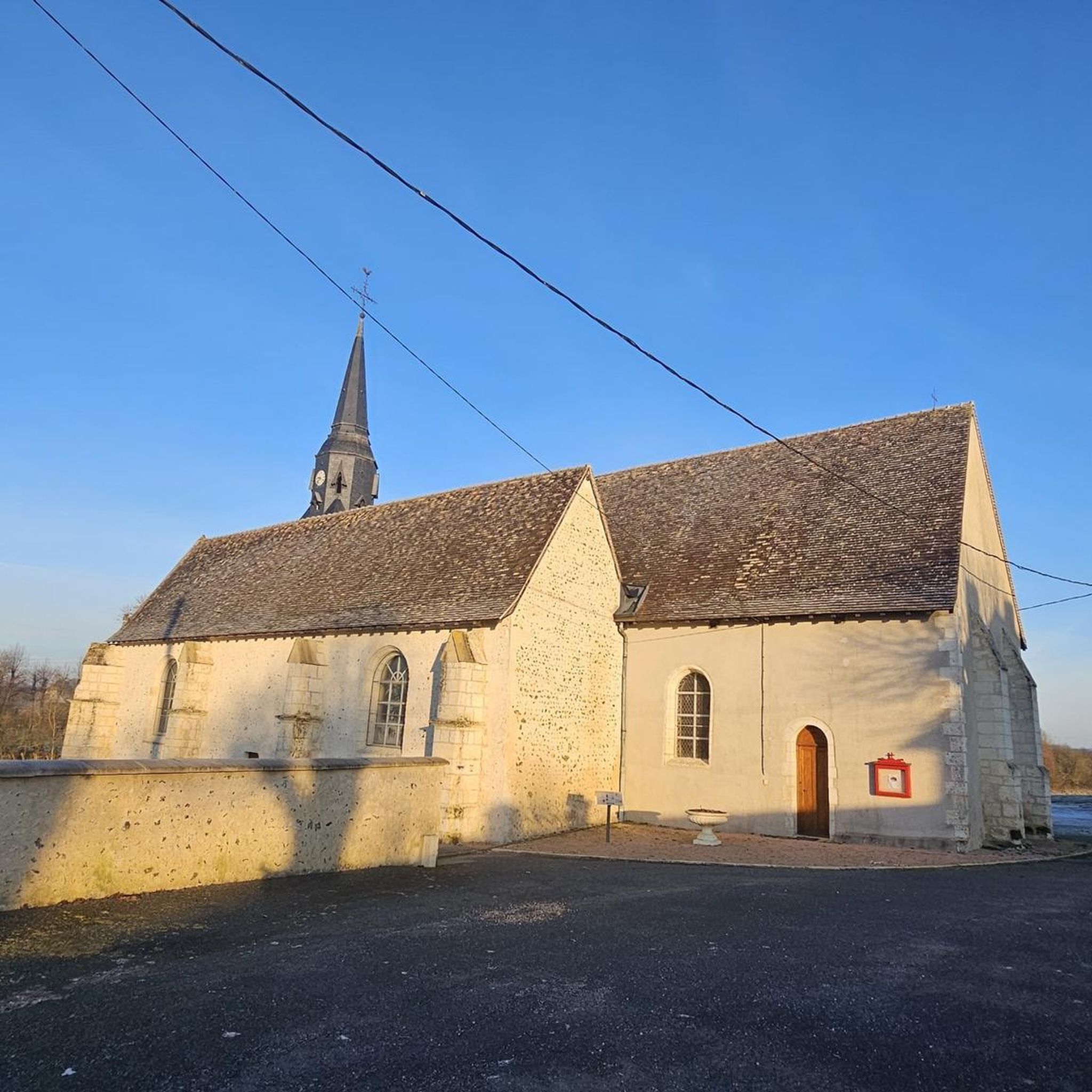
Placed under the patronage of Saint Hilaire, this parish was given by Gannelon de Montigny, lord of the place, to the abbey of Marmoutier around 1042. Its reconstruction probably dates from this period; it then became a priory. The church has a rectangular nave ending in a choir with a flat chevet. An examination of the masonry easily reveals two distinct periods of construction: the Romanesque period and the Renaissance. Built of flint rubble with rendering, the western part of the building appears to date from the 11th or 12th century. A limestone cornice supported by rather crude corbels underlines the base of the roof. To the south, two narrow Romanesque windows flared inwards light the nave. To the north, the bays were later reworked and enlarged. On this same side, a Romanesque doorway was walled up; It allowed the church to connect with a building whose traces of detachment remain. The bell tower was built to the north of the Romanesque nave, extending the western façade. The absence of a connection between the east and west walls of the bell tower and the north wall of the nave clearly indicates that it is an entirely later construction. However, its crowning is much later, as evidenced by its cornice, whose molding is in the classical style. Flanked by obliquely angled buttresses, it is covered with a saddleback roof. The eastern half of the church appears to be an extension built during the Renaissance period. Its ogee-shaped cornice and the decoration of the eastern gable, as well as the moldings of the buttress bands, attest to this dating. A vast rectangular choir then appears to have replaced a semicircular Romanesque apse; the eastern gable and the southern and northern façades were then pierced with networked bays. In the lower part of the north façade, projecting ashlars appear to have supported the roof of a lean-to building. To the south, a sacristy was built in the 19th century. Inside, the entire building is covered with a paneled vault with exposed tie beams and kingposts. The 18th-century high altar is surmounted by an Assumption of the Virgin inspired by Murillo's. For the restoration of the roofs and façades, the Sauvegarde de l'Art Français (French National Art Protection Agency) awarded a grant of €30,490 in 2001.
0
0
The Church of Saint Sauveur La Trinité, probably built in the 12th century, is notable for its Romanesque windows with columns and capitals. On its walls, alternating with the consecration crosses, one can admire a Stations of the Cross in blue enamel on earthenware. The choir is lit by five Romanesque windows decorated with stained glass depicting Our Lord and the four Evangelists.
0
0
The church dates from the 12th century and was remodeled in the 15th or 16th century, its buttresses and bell tower date from the 19th century. It houses a wrought iron communion table from the 18th century.
0
0
The Saint-Barthélémy church dates from the 12th century but was restored and enlarged in the 17th and then in the 19th century. The elegant bell tower, formed of a square tower, becomes octagonal at 20 m high. Small loophole-type windows light the belfry. It is topped by a dome, itself topped by a campanile and a lantern. It is considered a case study by schools of architecture. This church also contains several movable objects classified as Historic Monuments including Christ on the Cross, a polychrome wooden statue from the 17th century, two oils on canvas from the 17th century, a funerary plaque from 1674 by Michel de Verthamon, Knight of Malta, in stone and marble (epitaph in Latin and coat of arms) and a bronze bell, tuned in F, from 1580.
0
0
The church of Notre-Dame de l’Assomption stands on a hill, a little away from the village of Chauvigny from which it is separated by the cemetery. It is built on the site of a former priory dependent on the abbey of Marmoutier, founded between 1116 and 1136 by Barthélemy de Vendôme. In 1342, Marmoutier abandoned the priory to the bishop of Chartres while retaining the appointment to the parish. It is a large church, whose initial core, probably from the 12th century (?), was considerably enlarged in the 16th, then in the 19th century. Originally, it consisted of a single nave supported by buttresses, whose flat chevet was later pierced by a large window with a pointed arch axis. In the 16th century, a first aisle was added to the south, separated from the central nave by four semicircular arches resting on circular pillars. In the 17th century, the choir was shortened by the erection of the large altarpiece of the high altar which isolates the space of a sacristy. Finally, in 1860-1863, the church was again enlarged by the construction of a north aisle, identical to the one that existed to the south. The district architect Édouard Marganne, responsible for this enlargement, also designed a new western façade in order to harmonize the gable walls of the three naves. The church is distinguished by a large set of paneling covering the walls of the three sanctuaries. Seventy-seven sculpted panels from the 16th and 17th centuries are inserted there, representing biblical characters and scenes from the life of Christ. As indicated by an inscription in the south chapel, they were donated to the parish in 1938, after the destruction of the chapel of the Château de la Gaudinière, which stood in the Fréteval forest. They were apparently brought back from Menton in 1867 by the Duke of La Rochefoucauld to adorn his château, which was then under construction. The church also preserves a small stone group from the 16th century representing the education of the Virgin, a painted wooden Saint Gildéric from the 17th century, and a beautiful portrait of Mgr Fleuriau d’Armenonville, Bishop of Orléans, commemorating his solemn entry into the city of Orléans in 1707. To participate in the restoration of the church roof, the Sauvegarde de l’Art français granted a donation of €5,000 in 2011.
0
0
In 1133, Geoffroi, Viscount of Châteaudun, founded a priory dependent on the abbey of Tiron, in the diocese of Chartres, in this place. When he died, his wife, Helvise de Mondoubleau, built the church around 1140. The church is formed of a long nave ending in a semicircular apse. It has retained several narrow bays, with a semicircular arch, very flared towards the inside. In the 16th century, a chapel was added to the south of the church, a paneling with exposed tie beams above the nave and the choir, and a mass of carpentry to the west which supports the spire of the bell tower on pointed arches. The choir has a trefoiled piscina from the 14th century. In 1660, Jean Gry, a carpenter from Vendôme, executed the altarpiece and the following year, Pierre Janvier, a painter from Mondoubleau, painted the Resurrection which decorates it. The church houses two funerary slabs, one of a priest who died in 1658, the other of François Leboulx, Lord of Chauvellières, who died in 1691.
0
0
The Saint Hilaire church is a vast building from the end of the 11th or 12th century which originally consisted of only a nave with choir and semi-circular apse supported by slightly protruding buttresses made of grison, an extremely hard ferruginous agglomerate which does not allow any work. of sculpture. You can see the primitive work in the walls of the nave and the choir with its small windows and the exterior buttresses in gray. Its appearance was considerably modified during the Renaissance period, when a transept was added, then during a second campaign of transformations, the small side chapels of the choir covered with ribbed vaults with vines and tiers which would have had to be topped with a pavilion roof. The entire monument is covered with a paneled vault with visible beams and hallmarks; above the sanctuary the shingle decorated with arabesques and painted cherubs' heads bears the date 1561. In the 17th century, like many churches of the time, the glass roof at the bottom of the apse was closed to build an altarpiece then fashionable, as it is today with the woodwork that accompanies it. On the west side of the north transept, above the small shed, we can clearly see in the masonry a stone arch which is perhaps the beginning of the cloister mentioned in the archives. In addition to the charm of its Renaissance parts, this church is fortunate to have beautiful furniture from the 17th and 18th centuries which preserves the appearance it had under the Ancien Régime: a lectern dated 1754, modified in 1784 with a antiphonary and a Chartres gradual from 1784. It is in perfect condition, as the cantors must have used it before the revolution. Another valuable piece, the solid oak work bench, cleaned a few years ago of the paint with which it had been decorated, and which now serves as an altar to meet the new standards of the liturgy for the mass facing the faithful.
0
0
The 12th century church of Saint Jean-Baptiste de Courtalain, already repaired in 1592, was rebuilt in 1809, increased by an aisle in 1838, then by a remarkable porch bell tower topped with a twelve meter spire. height, thanks to the generosity of the Montmorency family, owner of the castle. It is to Guillaume Davaugour and Perette de Baïf, his wife, that we attribute the erection of the Courtalain chapel into a parish church; The church is located in the immediate perimeter of the castle. The entire building is partly covered with flat tiles for the roof of the nave, the bell tower, the staircase turret; the three cut sides of the apse and the lower north side are covered in natural slate. Inside the nave is a Mutin Cavaillé Coll organ dating from 1936. It contains several interesting paintings.
0
0
Frequently Asked Questions
How many road cycling routes are available around Chauvigny-Du-Perche?
There are over 35 road cycling routes around Chauvigny-Du-Perche, offering a diverse range of options for cyclists. These routes are highly rated by the komoot community, with an average score of 4.6 stars from over 20 reviews.
What kind of terrain can I expect on road cycling routes in this region?
The region offers a rich tapestry of landscapes. You'll encounter the distinctive "bocage" countryside with its hedged fields, lush green valleys, and meandering rivers. Routes also pass through ancient forests like Reno-Valdieu and Bellême, providing varied elevation changes from gentle paths to more significant climbs, often rewarding cyclists with panoramic views.
Are there routes suitable for different skill levels?
Yes, the routes around Chauvigny-Du-Perche cater to various skill levels. You'll find 11 easy routes perfect for a relaxed ride, 25 moderate routes offering a good challenge, and 1 difficult route for experienced cyclists seeking a more demanding adventure.
What historical landmarks or points of interest can I see while cycling?
Many routes offer glimpses of historical and cultural sites. For instance, the Saint-Marc Church – Saint Michael's Church loop from Romilly connects historical churches. You might also pass by the View of Montigny-le-Gannelon Castle or the La Gaudinière Castle (ruins). The region is also close to charming towns like Vendome and Chateaudun, known for their historical significance.
Are there any notable natural features or parks along the cycling routes?
Absolutely. The routes are situated close to the Perche Regional Natural Park, renowned for its rich biodiversity and ancient forests. You can cycle through areas with old oaks, beeches, and ash trees, and potentially spot wildlife like red squirrels and roe deer. The "bocage" countryside itself, with its hedged fields and verdant valleys, is a significant natural feature.
Are there any circular road cycling routes available?
Yes, many of the road cycling routes around Chauvigny-Du-Perche are designed as loops, allowing you to start and finish at the same point. Examples include the popular La Forêt de Fréteval, l'étang de Lubin — loop from Fontaine-Raoul and the Feudal Castle of Fréteval loop from La Chapelle-Vicomtesse.
What is the best time of year for road cycling in Chauvigny-Du-Perche?
The Centre-Loire Valley region generally offers pleasant cycling conditions from spring through early autumn. During these seasons, the weather is typically mild, and the landscapes are at their most vibrant, making it ideal for exploring the "bocage" countryside and forests.
Are there family-friendly road cycling options?
While specific routes are not explicitly designated as 'family-friendly' in the data, the presence of 11 easy routes suggests there are gentler paths suitable for families or those looking for a less strenuous ride. These routes often feature less elevation gain and can be a good starting point for family outings.
Where can I find parking for my car when starting a road cycling route?
Many routes around Chauvigny-Du-Perche start from villages or towns that typically offer public parking facilities. For example, routes like the La Forêt de Fréteval, l'étang de Lubin loop begin from Fontaine-Raoul, where you can usually find suitable parking.
What do other road cyclists enjoy most about cycling in Chauvigny-Du-Perche?
The area is highly rated by the komoot community, with an average score of 4.6 stars. Reviewers often praise the region's picturesque "bocage" countryside, the tranquility of the ancient forests, and the varied terrain that keeps rides interesting. The well-developed infrastructure for cycling is also frequently highlighted.
Are there options for food and drink along the routes?
While specific cafes or restaurants are not listed for each route, many routes pass through or near charming villages and towns in the Centre-Loire Valley. These locations often provide opportunities to stop for refreshments or a meal, especially in larger towns like Vendome or Nogent-le-Rotrou, which are accessible from the region.
Can I reach the starting points of routes using public transport with my bike?
Information on specific public transport options for bikes is not detailed. However, the region's proximity to larger towns like Vendome and Chateaudun, which have train stations, suggests that some public transport connections might be available. It is advisable to check local transport provider websites for their bike carriage policies.
Most popular attractions around Chauvigny-Du-Perche

Get inspired with the komoot mobile app


Explore more
Browse the best Road cycling routes in other regions.
