Attractions and Places To See around Landres-Et-Saint-Georges - Top 20
Best attractions and places to see around Landres-Et-Saint-Georges are found in this small commune in the Ardennes department of France. The area offers a rural setting and serves as a base for exploring historically significant and naturally beautiful sites. Visitors can discover a variety of landmarks, natural features, and cultural sites in the surrounding Grand-Est region. This location provides access to both historical depth and natural landscapes.
Best attractions and places to see around Landres-Et-Saint-Georges
- The most popular attractions is…
Last updated: July 15, 2026
Pershing Bridge of Dun-sur-Meuse
Highlight • Bridge
The upper town was largely destroyed during the First World War.
This bridge over the …
Translated by Google •
Tip by

Meuse-Argonne American Cemetery
Highlight • Other
Translated by Google •
Tip by

Sign up now to discover places like this
Get recommendations on the best single tracks, peaks, & plenty of other exciting outdoor places.
Sign up for free
Grandpré
Highlight • Other
Translated by Google •
Tip by
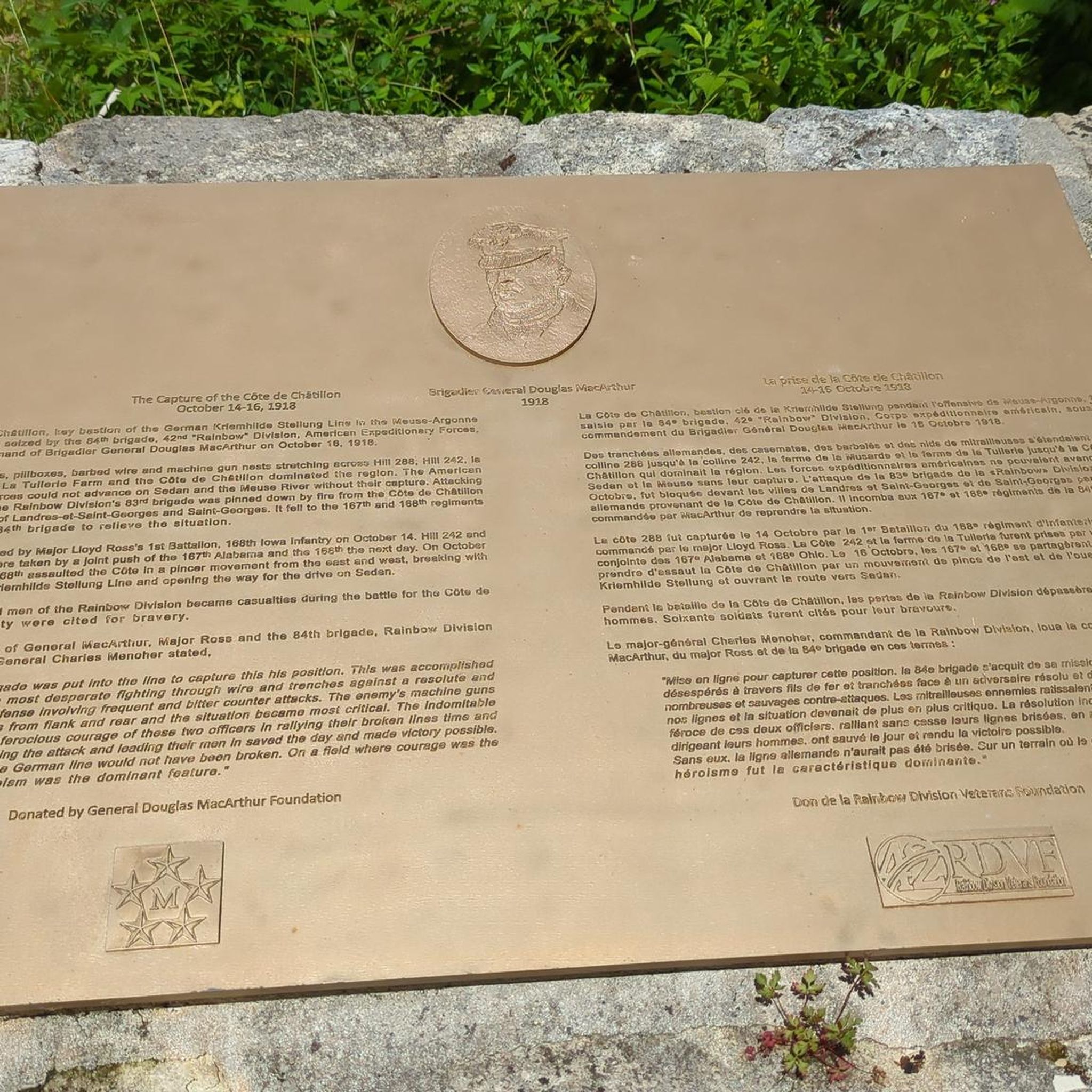
Sergeant York trail
Highlight • Other
Tip by

Château de Grandpré
Highlight • Castle
Translated by Google •
Tip by
Sign up for free to discover even more attractions around Landres-Et-Saint-Georges.
Sign up for free
Already have an account?
Start today with a free account
Your next adventure awaits.
Login or Signup
Popular around Landres-Et-Saint-Georges


Tips from the Community

Dun-sur-Meuse is a French commune in the Meuse department, in the Lorraine region. During the First World War, the upper city was largely destroyed. This bridge over the Meuse is one of the most beautiful monuments of this type in France. There are bronze balustrades on both sides of the bridge, with designs in the center and engraved plaques. It reminds French citizens and others, who will cross the bridge for years to come, of the passage of the Meuse. The crossing of the Meuse by the 5th Division was commanded by General John Pershing.
6
0
The American military cemetery in Romagne-sous-Montfaucon contains the graves of 14,246 soldiers who died during the First World War in northwest France. It is the largest American military cemetery in Europe. The cemetery site is located in the old front line of the Meuse-Argonne offensive that took place between September 26 and November 11, 1918. The plot of land was used as a cemetery on October 14, 1918 after it had been occupied by the American forces just before. 32nd Infantry Division. The site was given on permanent loan to the US by the French government. The 14,246 graves are spread over eight fields. There are lime trees surrounding the fields, the fields themselves are covered with grass. Each grave has its own stone. For Jewish graves, the top of the stone is shaped like a Star of David. The text on each stone states the soldier's name, rank, division, state and date of death. Of the 14,246 graves, 486 soldiers have not been identified. The stones of the unidentified soldiers bear the text: Here rests in honored glory an American soldier known but to god. On the south side of the cemetery is a memorial building, designed by the architectural firm York and Sawyer from New York. The center of the memorial gives access to a chapel containing the flags of the US and the other allied countries. The stained glass windows show the insignia of the various divisions that operated in the region. The two loggias outside the chapel display the names of 954 missing soldiers. The visitors building is located on the north side of the cemetery. There is a book here in which a visit can be registered. The entrance to the cemetery, both on the west and east sides, is 'guarded' by two white towers with the American eagle on top. There is a large pond in the middle of the site. The maintenance and management of the cemetery is the responsibility of the American Battle Monuments Commission.
5
0
The Castle of Grandpré is located in Grandpré, in the Ardennes, France. It was built by the Joyeuse, Counts of Grandpré, at the end of the 16th century and the beginning of the 17th century. For a long time, the place has been strategically located on the northern slope of the Aire valley, controlling one of the rare passages that cross the Argonne forest. This is the Grandpré passage.
7
0
Grandpré is a commune in the French department of Ardennes, in the Grand Est region. It has about 500 inhabitants and an area of 32.67 km². It is located on the River Aire and is part of the canton of Attigny. Grandpré has a rich history, dating back to the Middle Ages. It was an important city in Champagne, which became a county and later a duchy. It had a castle, an abbey and a fortified wall, testifying to its power and influence. One of the sights is the Église Saint-Médard, a Gothic church from the 13th century, decorated with stained glass windows and sculptures. Grandpré was also the scene of fierce fighting during the First World War. It was occupied by the Germans in 1914 and later liberated by the Americans in 1918. The village was largely destroyed by bombing and artillery. One of the monuments that commemorate this period is the Monument aux Morts, a memorial to the fallen soldiers, designed by the sculptor Paul Moreau-Vauthier. Grandpré is a quiet and charming place where you can enjoy nature and the rural atmosphere. You can walk, cycle, fish or taste the local gastronomy. One of the specialties is the boudin blanc, a white sausage made from pork, cream and spices.
5
0

Alvin Cullum York (December 13, 1887 – September 2, 1964), also known as Sergeant York, was one of the most decorated United States Army soldiers of World War I.[1] He received the Medal of Honor for leading an attack on a German machine gun nest, gathering 35 machine guns, killing at least 25[2] enemy soldiers and capturing 132 prisoners. York's Medal of Honor action occurred during the United States-led portion of the Meuse-Argonne Offensive in France, which was intended to breach the Hindenburg line and force the Germans to surrender. He earned decorations from several allied countries during WWI, including France, Italy and Montenegro.
0
0

Dun-sur-Meuse is a French commune located in the department of Meuse, in the Lorraine region. The upper town was largely destroyed during the First World War. This bridge over the Meuse is one of the most beautiful monuments of this type in France. There are bronze balustrades on both sides of the bridge, with designs in the center and inscribed plaques. It reminds French citizens and others, who will cross the bridge for years to come, of the passage of the Meuse. The crossing of the Meuse by the 5th Division was commanded by General John Pershing. It was one of the most brilliant military exploits of the American army on French territory.
2
0

The old castle of the place, unfortunately closed.
2
0
Frequently Asked Questions
What historical sites can I visit near Landres-Et-Saint-Georges?
The region around Landres-Et-Saint-Georges is rich in history, particularly related to World War I. You can visit the Meuse-Argonne American Cemetery, the largest American military cemetery in Europe, which commemorates soldiers who died during the Meuse-Argonne Offensive. Another significant site is the Pershing Bridge of Dun-sur-Meuse, which honors the crossing of the Meuse by the 5th Division during WWI. Additionally, the city of Verdun, about 35 km away, is a major historical site known for its pivotal role in World War I.
Are there any castles or medieval sites to explore in the area?
Yes, the region offers notable historical architecture. You can visit the Château de Grandpré, a castle built by the Joyeuse, Counts of Grandpré, between the late 16th and early 17th centuries. Further afield, in Sedan (approximately 39 km away), you'll find the largest medieval castle in Europe, the Château de Sedan, which is a significant historical and architectural landmark.
What natural features can I explore around Landres-Et-Saint-Georges?
While Landres-Et-Saint-Georges itself is a quiet rural commune, the wider region offers natural beauty. The Argonne Forest provides opportunities for experiencing nature and learning about the local ecosystem. The area is characterized by its rural charm, offering a peaceful setting for outdoor exploration.
Are there opportunities for cycling near Landres-Et-Saint-Georges?
Absolutely! The area around Landres-Et-Saint-Georges is great for cycling. You can find various routes for different types of bikes. For touring cyclists, there are routes like the 'Sedan Castle – Sedan loop from Bayonville'. Road cyclists can explore routes such as the 'Verdun Citadel – Verdun loop from Romagne-sous-Montfaucon'. For more details and specific routes, check out the Cycling around Landres-Et-Saint-Georges and Road Cycling Routes around Landres-Et-Saint-Georges guides.
Can I find mountain biking trails in the vicinity?
Yes, there are mountain biking trails available. Routes like the 'La Samaritaine loop from Bar-lès-Buzancy' and the 'Grandpré Church – Château de Grandpré loop from Chevières' offer options for MTB enthusiasts. You can find more information and specific routes in the MTB Trails around Landres-Et-Saint-Georges guide.
What kind of family-friendly attractions are available?
Many of the historical sites, such as the Pershing Bridge of Dun-sur-Meuse, can be interesting for families looking to learn about history. The rural setting and nearby forests also offer opportunities for family walks and enjoying nature. Exploring the larger medieval castle in Sedan could also be an engaging family outing.
What is the best time of year to visit Landres-Et-Saint-Georges for outdoor activities?
The Grand-Est region, including Landres-Et-Saint-Georges, is generally pleasant for outdoor activities from spring through early autumn (April to October). During these months, the weather is typically mild, making it ideal for cycling, walking, and exploring historical sites. Summer offers the warmest temperatures, while spring and autumn provide beautiful scenery with fewer crowds.
Where can I experience local culture, like markets?
To experience local life and culture, you can visit the markets in nearby towns. Stenay hosts a market on Fridays, Vouziers on Saturdays, Sainte-Menehould on Mondays, Verdun on Fridays, and Sedan on Wednesdays and Saturdays. These markets offer a glimpse into local produce and traditions.
What do komoot users enjoy most about the attractions around Landres-Et-Saint-Georges?
Komoot users appreciate the historical significance of the attractions, with sites like the Pershing Bridge of Dun-sur-Meuse being particularly popular for its commemorative value and unique bronze balustrades. The Meuse-Argonne American Cemetery is also highly regarded for its solemn atmosphere and historical importance. The overall appeal lies in the blend of historical depth and the tranquil, rural setting.
Are there any significant religious landmarks in the region?
Yes, the Basilica of Notre Dame de l'Épine, located in the village of L'Épine, is a significant religious and architectural site worth visiting in the wider region.
What is the <a href="https://www.komoot.com/highlight/4793248" target="_blank" rel="noopener">Sergeant York trail</a> and its historical context?
The Sergeant York trail is named after Alvin Cullum York, one of the most decorated United States Army soldiers of World War I. He received the Medal of Honor for his actions during the Meuse-Argonne Offensive, where he led an attack on a German machine gun nest. The trail commemorates his bravery and the significant events that took place in this area during the war.
What is the significance of Grandpré as a location?
Grandpré, a commune near Landres-Et-Saint-Georges, has a rich history dating back to the Middle Ages. It was an important city in Champagne, known for its castle and fortified wall. It was also a scene of fierce fighting during World War I, being largely destroyed and later liberated by American forces. Today, it's a quiet place where you can enjoy nature and its historical landmarks, such as the Grandpré village itself and the Château de Grandpré.
Most popular routes around Landres-Et-Saint-Georges

Get inspired with the komoot mobile app


Explore more
Still not found the Highlight you’re looking for? See guides of the top attractions in other regions:
