Attractions and Places To See around La Cornuaille - Top 6
Best attractions and places to see around La Cornuaille, a former commune in the Maine-et-Loire department, are primarily located within the wider Val d'Erdre-Auxence area. This region is characterized by its undulating landscape, including the Erdre River, and offers access to various historical and natural points of interest. Visitors can explore local sites and discover the rich heritage of the Anjou region.
Best attractions and places to see around La Cornuaille
- The most popular attraction is Bridge Over the Erdre…
Last updated: July 1, 2026
Bridge Over the Erdre in Candé
Highlight • Bridge
Translated by Google •
Tip by

Les Fours de La Veurière
Highlight • Historical Site
Translated by Google •
Tip by

Sign up now to discover places like this
Get recommendations on the best single tracks, peaks, & plenty of other exciting outdoor places.
Sign up for free
Villemoisan Commandery
Highlight • Religious Site
Translated by Google •
Tip by

Saint-Denis Church of Candé
Highlight • Religious Site
Its facade with two square bell towers evokes the great Gothic cathedrals, such as Notre-Dame de Paris.
Translated by Google •
Tip by

Dolmen du Champ-du-Ruisseau
Highlight • Other
fr.wikipedia.org/wiki/Dolmen_du_Champ-du-Ruisseau
Translated by Google •
Tip by

Sign up for free to discover even more attractions around La Cornuaille.
Sign up for free
Already have an account?
Start today with a free account
Your next adventure awaits.
Login or Signup
Tips from the Community

The Champ-du-Ruisseau dolmen, also known as the Pontpiau covered alley, was only discovered in 1949 by Dr. J.-B. Glotin. The site was reused during the Gallo-Roman period. The building was listed as a historic monument in 1961. https://fr.wikipedia.org/wiki/Dolmen_du_Champ-du-Ruisseau
1
0
Building and chapel built in the 12th century by the Knights Templar. This particularly well-preserved chapel is unique in Anjou. https://angerslumiere.blogspot.com/2016/08/la-commanderie-de-villemoisan.html
0
0

Car-free rolling path from Carquefou to Candé.
0
0

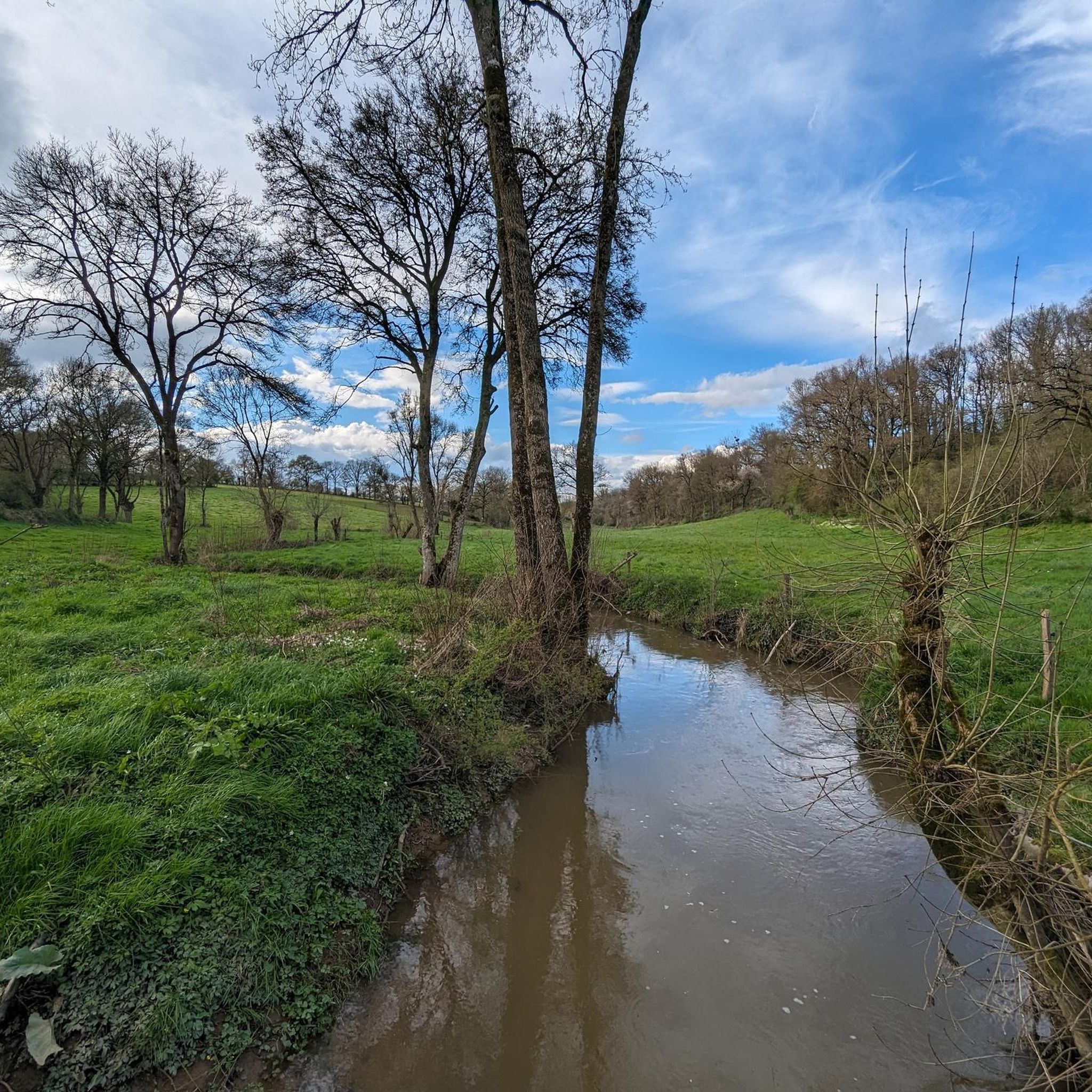
Entering Candé via the greenway, in a quiet & bucolic setting, is very pleasant. Passage over the Erdre, which at this point is still only a stream
0
0

Dating from the 19th century, the Veurière (or Saint-Anne) lime kilns are Angevin industrial buildings located in Angrie (Maine-et-Loire), about fifteen kilometers southwest of Segré. Angevin lime production developed in the 19th century and left its mark on the landscape of the department. In Angrie, a locality in Segréen, there were several industrial activities: marble quarries (La Verrière), slate quarries (La Boue, La Grée des Cerisiers), iron mine (La Roserie), antimony mine (Grand-Bois ), as well as lime kilns. A rural country, agricultural activity is very present, notably with cereal crops. A lime kiln is mentioned there at the end of the 18th century, and others in Dérouères and La Fresnaie at the beginning of the 19th century. Those of La Veurière, located between Angrie and Vern-d'Anjou, were built at the beginning of the 19th century, and mentioned in 1832 and 1857. They include three large units, with three ovens around fifteen meters high. Boilermaking activity was important before the First World War, of which there were around fifteen sites in the Angrie and Vern-d'Anjou sector. They ceased their activity in the middle of the 20th century. The Chaufournier site of La Veuvrière is a protected heritage site. The lime kilns and access ramp are listed as Historic Monuments by decree of March 25, 1980. This disused industrial establishment is the property of a private person. It is possible to visit the site, as well as the chapel and the Saint-Pierre ovens source: https://www.wiki-anjou.fr/index.php/Fours_%C3%A0_chaux_de_la_Veuri%C3%A8re
0
0

The Veurière lime kilns are a site of three large lime kilns which were built in the early 1800s and operated for around a hundred years. There you can discover the history and the lime production process, as well as admire the architecture and landscape of the site. You can book a guided tour or an educational tour by contacting the owners on 06 72 92 20 631. The site is open to groups by reservation all year round. The entry price is 5 euros per adult and free for children under 18 years old.
2
1

The Saint-Denis de Candé church strikes with its imposing side. Its facade with two square bell towers evokes the great Gothic cathedrals, such as Notre-Dame de Paris. The restoration of this church in an imposing way is part of the current of Catholic renewal of the 19th century, in the west of France. The replacement of the parish churches, often medieval, was then necessary, to respond to the strong demographic growth. It was also a way to affirm the Catholic nature of the region after the troubles of the Revolution.
0
0
With, among others, the Commandery of Angers, the House of the Temple of La Lande des Verchers/ Layon, the Commandery of Saulgé in Luigné, the House of the Temple of Saumur, the Commandery of Villemoisan is one of the Templar possessions of the 'Anjou. It had been a dependency of the Maison du Temple Saint-Laud in Angers since the 12th century. After the arrest of the Templars, accused of heresy by King Philippe le Bel, the Commandery was devolved by the Pope to the Order of the Hospital (which later became the Order of the Knights of Malta). It then took the name of the Béconnais Hospital. Source: https://angerslumiere.blogspot.com/2016/08/la-commanderie-de-villemoisan.html
0
0
Frequently Asked Questions
What are some unique historical sites to visit around La Cornuaille?
You can explore Les Fours de La Veurière, a site featuring three large lime kilns from the early 1800s, offering insight into local industrial history. Another significant historical site is the Villemoisan Commandery, a well-preserved 12th-century chapel built by the Knights Templar.
Are there any natural attractions or parks near La Cornuaille?
Yes, the area offers several natural spots. The Bridge Over the Erdre in Candé provides a pleasant passage over the Erdre River, part of a car-free greenway. You can also visit Parc de la Burelière, a 7-hectare wooded park within La Cornuaille, known for its walking paths and tree climbing activities. The Erdre River itself flows through the territory, and nearby ZNIEFF areas like Bois des Charmeraies and Étang de la Clemencière offer significant ecological interest.
What kind of outdoor activities can I do around La Cornuaille?
The region is great for various outdoor pursuits. You can find numerous routes for running, mountain biking, and cycling. For example, there are several running loops like the 'Parc Bellevue – Château de Villegontier loop from Candé' and mountain biking trails such as the 'Les Fours de La Veurière – Manoir de la Gâchetière loop from Angrie'. Cycling enthusiasts can enjoy routes like the 'Manoir de la Gâchetière – Les Fours de La Veurière loop from Candé'. For more details on routes, check the Running Trails around La Cornuaille, MTB Trails around La Cornuaille, and Cycling around La Cornuaille guides.
What do visitors particularly enjoy about the attractions near La Cornuaille?
Visitors appreciate the quiet and bucolic setting of the Bridge Over the Erdre in Candé, especially its car-free rolling path. The historical significance and architecture of sites like Les Fours de La Veurière and the well-preserved Villemoisan Commandery are also highly valued.
Are there any family-friendly attractions or activities in the area?
Yes, several attractions are suitable for families. The Bridge Over the Erdre in Candé offers a pleasant, car-free path for walks or bike rides. Les Fours de La Veurière is also categorized as family-friendly, where you can learn about lime production history. Additionally, Parc de la Burelière offers tree climbing, and nearby activities include husky dog sledding experiences and swimming at Piscine de Villemoisan.
Where can I find prehistoric sites in the area?
You can visit the Dolmen du Champ-du-Ruisseau, also known as the Pontpiau covered alley. This ancient megalithic structure was discovered in 1949 and is listed as a historic monument.
Are there any notable castles or châteaux within a reasonable distance of La Cornuaille?
Yes, the wider Maine-et-Loire department is rich in châteaux. Approximately 32 km away is the mighty Château d'Angers, home to the impressive Apocalypse Tapestry. Other notable castles include Château Plessis-Bourré (around 34 km away), known for its unique architectural styles, and Château de Brissac (about 40 km away), which is the tallest castle in France.
What are the best options for walking or cycling paths near La Cornuaille?
The Bridge Over the Erdre in Candé is part of a car-free greenway, offering a very pleasant and easy rolling path. Parc de la Burelière also features walking paths. For more extensive options, explore the various cycling and running routes available in the area, detailed in the Cycling around La Cornuaille and Running Trails around La Cornuaille guides.
Are there any religious buildings of historical interest in the vicinity?
Absolutely. The Villemoisan Commandery is a 12th-century chapel built by the Knights Templar, unique in Anjou and particularly well-preserved. Another significant site is the Saint-Denis Church of Candé, which stands out with its imposing facade and two square bell towers, reminiscent of great Gothic cathedrals.
What is the best time of year to visit La Cornuaille for outdoor activities?
The region is generally pleasant for outdoor activities from spring through autumn. Spring offers blooming landscapes, while summer allows for activities like swimming at Piscine de Villemoisan and enjoying the parks. Autumn provides beautiful foliage for walks and cycling. Winter walking routes are also available, but some activities might be weather-dependent.
Are there any markets or local shopping opportunities nearby?
While La Cornuaille itself is a former commune, nearby towns like Candé, Segré, and Angers host various markets throughout the week. These markets offer opportunities to experience local culture and find regional products.
Can I find information on guided tours for historical sites?
For Les Fours de La Veurière, you can book a guided tour or an educational tour by contacting the owners directly at 06 72 92 20 631. The site is open to groups by reservation all year round.
Most popular routes around La Cornuaille

Get inspired with the komoot mobile app


Explore more
Still not found the Highlight you’re looking for? See guides of the top attractions in other regions:
