The best cycling routes around Sapignies
4.3
(15)
277
riders
83
rides
Touring cycling around Sapignies benefits from its location within the Pas-de-Calais department, characterized by varied landscapes suitable for cycling. The area features extensive countryside with wide-open fields, gentle rolling hills, and rural roads. Cyclists can expect routes that traverse agricultural land and potentially connect to regional networks along canals and rivers. This diverse terrain offers a range of experiences for touring cyclists.
Best touring cycling routes around Sapignies
- The most popular touring cycling route is Miraumont – Avro Lancaster Mk…
Last updated: July 2, 2026
9
riders
32.5km
02:30
240m
240m
Moderate bike ride. Good fitness required. Mostly paved surfaces. Suitable for all skill levels.
5.0
(1)
8
riders
29.9km
02:14
150m
150m
Moderate bike ride. Good fitness required. Mostly paved surfaces. Suitable for all skill levels.

Sign up for free
9
riders
56.3km
04:13
480m
480m
Hard bike ride. Very good fitness required. Mostly paved surfaces. Suitable for all skill levels.
2
riders
22.0km
01:40
130m
140m
Easy bike ride. Great for any fitness level. Mostly paved surfaces. Suitable for all skill levels.
5.0
(1)
2
riders
24.3km
01:32
110m
110m
Easy bike ride. Great for any fitness level. Mostly paved surfaces. Suitable for all skill levels.
Get access to more routes and recommendations from other explorers.
Sign up for free
Already have an account?
Our route recommendations are based on thousands of hikes, rides, and runs completed by other people on komoot.
Start today with a free account
Your next adventure awaits.
Login or Signup




Tips from the Community

The Pipers Memorial in Longueval is a special tribute to all pipers who died during the First World War, regardless of their regiment or origin. It was unveiled on 20 July 2002 and stands in the village square, just off the Rue de Bazentin. The bronze statue, designed by Andy De Comyn, shows a piper in full uniform climbing out of a trench playing—a powerful symbol of courage and moral support for troops under fire. Plaques around the plinth list the regiments that lost pipers, and the memorial also remembers heroes such as Piper James Richardson VC, who led his battalion into the attack with his music and was later killed trying to retrieve his bagpipes. It is a rare monument that honours not only military valour but also cultural identity and tradition. A place where music and memory come together in stone and bronze.
8
0
Miraumont is a small village in the Somme department, in the Hauts-de-France region, which occupies a historically and geographically special place. It is situated in a narrow valley at the source of the Ancre River, a tributary of the Somme, and is surrounded by gently rolling hills that were once the scene of fierce fighting during the First World War. During the Battle of the Somme in 1916, Miraumont was close to the front line and was badly hit. Today it is a quiet rural commune of around 630 inhabitants, where the past is still palpable in the surroundings and in nearby military cemeteries. Its proximity to other historic sites such as Thiepval and Beaumont-Hamel makes it a worthwhile stop for those wishing to explore the region's wartime past.
7
0
On 11 April 1944, an Avro Lancaster Mk I, serial number LL836 BQ-E, crashed near Achiet-le-Petit, in the Bois de Logeast, during a mission by the RAF 550 Squadron. The aircraft had taken off from North Killingholme in England and was part of a bombing raid on the railway installations at Aulnoye-Aymeries, as part of the Allied Transportation Plan2. The Lancaster was intercepted and shot down at around 02:43 by a German night fighter, a Messerschmitt Bf 110, flown by Hauptmann Helmut Bergmann. The aircraft exploded in mid-air and came down in flames approximately 1.5 km north-northwest of Achiet-le-Petit3. All seven crew members were killed. Among them were five Britons and two Canadians, including: F/Lt Richard William Picton (pilot, age 24, DFC) F/O John Foster Potter (bomb aimer, age 23, RCAF) F/O John James Logan (navigator, age 26, DFC) Sgt William Essar (age 22, RCAF) Sgt Thomas Henry Guest (flight engineer) Sgt Kenneth Percy Charles Williams (radio operator, DFM) F/Lt William Hugh Waycott (air force, age 22, DFM)3 They are all buried in Achiet-le-Petit cemetery. The crash is a harrowing illustration of the risks faced by bombers during night operations over occupied Europe.
8
0
An interesting anecdote is that Achiet-le-Petit changed hands several times during the war. The village was occupied by British troops in March 1917, lost to the Germans in March 1918, and retaken by the British in September 1918. In 1924, 300 bodies that had been temporarily buried elsewhere were transferred to this cemetery.
6
0
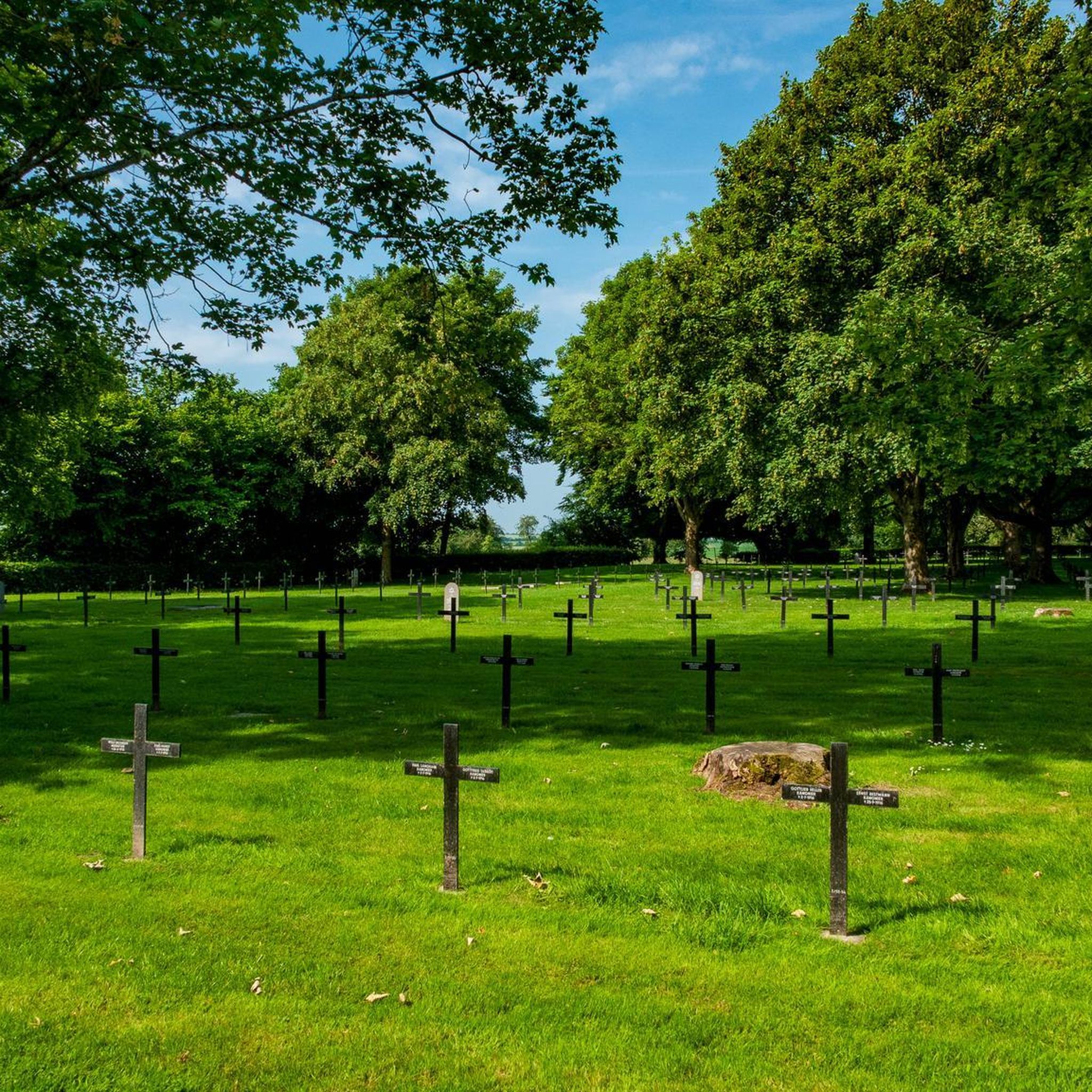
Cimetière militaire allemand d'Achiet-le-Petit is a World War I military cemetery located in Achiet-le-Petit, France. The cemetery contains the graves of 1,314 German soldiers. It was created in the autumn of 1914 to bury the bodies of German soldiers who had fallen during the fighting in the region.
6
0
French politician, MP and then resistance fighter, born on November 6, 1890 in Bapaume, he became mayor of the town in 1929. In 1934, he was elected general councilor of Pas-de-Calais. In 1936, he ran in the legislative elections and was elected in the second round. He was arrested in 1943 by the Nazis as he left the prefecture, and deported to the Gross-Rosen camp where he died on November 27, 1944. Since 1948, a monument showing him at the time of his arrest honors his memory. At the Town Hall there is an urn with soil from Gross-Rosen as well as a painting of him.
0
0

The 41st Division memorial sits in Flers in commemoration of their liberation of the village. This memorial, topped with a bronze battle dressed soldier, has been made particularly famous in its depiction as the photo on the cover of Rose Coombs' quintessential battlefield tour guide Before Endeavours Fade. The statue by Albert Toft is the same figure used at the Royal London Fusiliers Monument in London and Oldham war memorial
0
0
The Piper's Memorial pays tribute to the pipers who fell during the Great War, regardless of nationality or unit. Unveiled in 2002, this 3-meter-high statue depicts one of these musicians, straddling the parapet of his trench, playing his instrument to encourage the soldiers heading into the assault.
1
0
Frequently Asked Questions
How many touring cycling routes are available around Sapignies?
There are over 75 touring cycling routes available around Sapignies, offering a variety of experiences for different skill levels.
What is the typical terrain like for touring cycling in the Sapignies area?
The Sapignies area, situated within the Pas-de-Calais department, features extensive countryside with wide-open fields, gentle rolling hills, and rural roads. You can expect routes that traverse agricultural land and potentially connect to regional networks along canals and rivers, offering diverse terrain.
What are the difficulty levels of touring cycling routes near Sapignies?
The routes around Sapignies cater to various abilities. You'll find approximately 23 easy routes, 43 moderate routes, and 9 more challenging routes, ensuring options for beginners and experienced cyclists alike.
When is the best time of year to go touring cycling around Sapignies?
The Pas-de-Calais region generally offers pleasant cycling conditions from spring through autumn. During these seasons, the weather is typically mild, making it ideal for exploring the rural roads and countryside. Summer provides longer daylight hours, while spring and autumn offer cooler temperatures and beautiful landscapes.
Are there any historical landmarks or points of interest to see along the touring cycling routes?
Yes, the region is rich in history. Many routes pass by significant sites. For example, the Bapaume Town Hall – Pipers' Memorial Longueval loop from Bapaume leads through historical memorial sites. You can also find landmarks like the Bapaume Town Hall and the Monument to Abel Guidet, which are often incorporated into routes.
What kind of scenic views can I expect while cycling near Sapignies?
While cycling near Sapignies, you'll primarily enjoy scenic views of agricultural landscapes, open fields, and tranquil rural settings typical of the French countryside. The broader Pas-de-Calais department also offers diverse landscapes, including coastal paths and natural parks, which you might connect to on longer regional routes.
Are there circular touring cycling routes available around Sapignies?
Yes, many touring cycling routes in the area are designed as loops, allowing you to start and finish at the same point. An example is the Bike loop from Warlencourt-Eaucourt, which offers a convenient circular journey.
Is it possible to find parking for touring cyclists in the Sapignies area?
Given the rural nature of Sapignies and its surrounding communes, parking is generally available in village centers or near trailheads. It's advisable to check specific starting points for designated parking areas, especially for longer routes.
Are there family-friendly touring cycling routes near Sapignies?
Yes, with 23 easy routes available, there are plenty of options suitable for families. These routes typically feature gentler terrain and shorter distances, making them enjoyable for all ages. The rural roads and quiet paths provide a safe environment for family outings.
Are touring cycling routes around Sapignies suitable for cyclists with dogs?
Many rural cycling routes in the Pas-de-Calais region are suitable for cyclists with dogs, provided your dog is well-behaved and accustomed to cycling alongside you. Always ensure your dog is on a leash and be mindful of local regulations, especially when passing through agricultural areas or near livestock.
Are there places to stop for refreshments like cafes or pubs along the touring cycling routes?
While Sapignies itself is a small commune, many routes pass through or near other villages and towns in the Pas-de-Calais region. These larger settlements often have local cafes, bakeries, or small restaurants where you can stop for refreshments. It's a good idea to plan your route to include such stops.
How does touring cycling in Sapignies connect to the broader Pas-de-Calais region?
Sapignies is well-positioned to access the broader cycling networks of the Pas-de-Calais department. This region is known for its diverse landscapes, including sections of La Vélomaritime (EuroVelo 4) along the coast and routes through natural parks like the Regional Natural Park of the Caps et Marais d'Opale. You can find more information on the region's natural beauty at Hauts-de-France Tourism.
What do other touring cyclists say about their experience in Sapignies?
The touring cycling routes around Sapignies are highly rated by the komoot community, with an average score of 4.2 stars from 9 reviews. Cyclists often praise the quiet rural roads and the opportunity to explore the historical and agricultural landscapes of the region.
Most popular routes around Sapignies
Most popular attractions around Sapignies

Get inspired with the komoot mobile app


Explore more
Browse the best Cycling routes in other regions.
