The best road cycling routes around Saint-Avit
4.8
(7)
80
riders
46
rides
Road cycling around Saint-Avit, situated in the Dordogne region of France, features diverse landscapes suitable for various cycling preferences. The area is characterized by rolling hills and valleys, offering both ascents and descents, alongside routes that follow river valleys. Cyclists can navigate through forests and woodlands, as well as agricultural lands dotted with walnut groves and vineyards. This varied topography provides a range of road cycling experiences.
Best road cycling routes around Saint-Avit
- The most popular road cycling route is Châteaux and Seigneuries of Perche Loop, a 29.3 miles (47.1 km) trail that takes 2 hours 7 minutes to complete. This moderate route passes by historic châteaux, offering cultural interest alongside the ride.
- Another top favourite among local road cyclists is Château de Montmirail – Montmirail Castle loop from Le Plessis-Dorin, a moderate 29.6 miles (47.6 km) path. This route features varied terrain with ascents and descents, leading to a historic castle.
- Local road cyclists also love the Saint John the Baptist Church – Sainte-Suzanne stream loop from Saint-Avit, a 31.5 miles (50.7 km) trail leading through river valleys and past charming villages, often completed in about 2 hours 13 minutes.
- Road cycling around Saint-Avit is defined by rolling hills, river valleys, and agricultural lands. The network offers options for different ability levels, from routes with significant elevation gains to those with gentler gradients.
- The routes in Saint-Avit are highly rated by the komoot community with an average score of 4.75 stars from more than 3 reviews. More than 70 road cyclists have used komoot to explore Saint-Avit's varied terrain.
Last updated: July 16, 2026
2
riders
47.1km
02:08
390m
400m
This moderate 29.3-mile (47.1 km) road cycling loop from Saint-Agil explores the scenic Perche Natural Park, passing Château de Montmirail.
5.0
(1)
6
riders
47.6km
02:31
550m
550m
Moderate road ride. Good fitness required. Some segments of this route may be unpaved and difficult to ride.

Sign up for free
7
riders
82.3km
03:40
750m
750m
Moderate road ride. Good fitness required. Mostly well-paved surfaces and easy to ride.
4.5
(2)
6
riders
Moderate road ride. Good fitness required. Some segments of this route may be unpaved and difficult to ride.
3
riders
45.1km
02:01
330m
330m
Moderate road ride. Good fitness required. Mostly well-paved surfaces and easy to ride.
Get access to more routes and recommendations from other explorers.
Sign up for free
Already have an account?
Our route recommendations are based on thousands of hikes, rides, and runs completed by other people on komoot.
Start today with a free account
Your next adventure awaits.
Login or Signup



Tips from the Community


This church contains 14th century wall paintings. These paintings were discovered in 1895. They formerly occupied the entire width of the western wall of the nave. The central part was destroyed following the renovation of the door. The left side represented paradise. Of the bust of Christ, in a trilobed medallion, which occupied the center, there remains only a fragment of the cruciform halo. The rest of the composition is divided into rectangular compartments, each enclosing, in the surviving part, a figure of a crowned chosen one. On the right, hell is represented by a cauldron in which several characters are immersed, including a pope, a bishop, a monk, a king, a queen. Above, a woman with her legs apart. On the right, an enormous horned demon sticks out its tongue. On the left, another carries a basket filled with the damned and is about to plunge a woman into the cauldron. Construction periods: 14th century
0
0
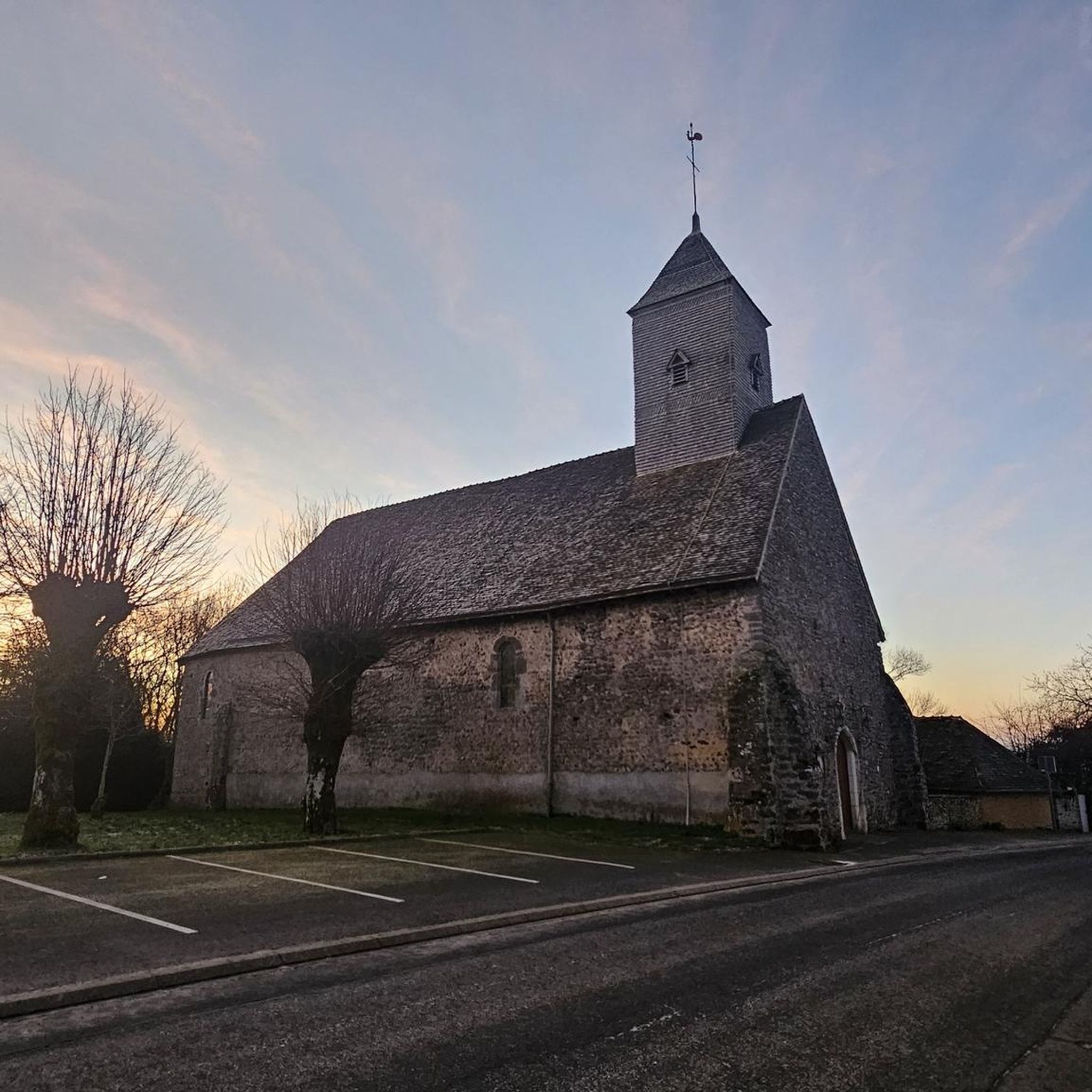
The church, which remained in the diocese of Chartres in the 18th century, belonged to the Abbey of Saint-Calais. Built in the 12th century, it consists of a single nave continued by a semicircular apse. The semicircular portal is surmounted by a consecration cross. Several pointed bays were pierced in the 15th century. In the 16th century, the church was enriched with paneling with exposed beams. In the sacristy behind the high altar, a beam sculpted with nails, crowns of thorns, fighters, monsters and coats of arms supports the altarpiece. It dates from the 16th century and most likely comes from a half-timbered house.
0
0
In the Middle Ages, Saint-Avit-au-Perche was a priory of the abbey of Saint-Calais, founded by Avit's companion. Today's church dates from the very beginning of the 12th century. It consists of a five-bay nave ending in a semicircular apse. It is covered with chestnut shingles. Several original windows remain; others have been reworked (including the first window, on the north side). This can be seen in the shape of the keystones. A walled-up side door to the south can be seen from the outside. It has an enormous mitre lintel. Inside, it has been transformed into a niche housing Our Lady of Lourdes. The apse is flanked by projecting buttresses. Those at the corners of the façade are from the 15th century. The western portal in a pointed arch is a 15th-century renovation that was completely redone at the end of the 20th century.
0
0
From its source to its confluence with the Ozanne, the Sainte-Suzanne covers 19.2 km and crosses 5 communes. From upstream to downstream: Authon-du-Perche; Beaumont-les-Autels; Coal pits; Les Altars-Villevillon; A glass.
0
0
Building built in the 15th century, ribbed vaulted, with straight apse; beginning of the 16th century, c. 1530, construction of the Sainte-Barbe chapel on the south side; Renaissance stained glass, not. Tree of Jesse (surviving fragments); 17th century altarpiece and high altar. History of protection: the classification order of April 25, 2003 replaces the classification order of February 11, 1911 and the registration orders on the supplementary inventory of historic monuments of January 20, 1926 and February 4, 2002.
0
0
the Saint-André church dates from the 11th century; it was a priory then dependent on the abbey of St.-Calais, but the current building was completely rebuilt around the walls and framework of the old building. The project was carried out in 1877. The construction of a transept, enlarged windows and a stone bell tower completely modified the old monument. The environment has also changed a lot. All traces of the old cemetery, transferred outside the village at the beginning of the 18th century, have disappeared. The furniture includes a stone baptistery, a statue of the Virgin and Child, a confessional and a Louis XV period bench. The beautiful wooden tabernacle decorated with a statue of Saint Lubin comes from the church which was located a few kilometers away, in Saint-Lubin-des-Cinq-Fonts, and of which only the choir, which has become a chapel, remains today. .
0
0
Saint John the Baptist is considered the pivotal figure of the Bible, between the Old and New Testaments: the last of the Prophets, he is the precursor of Christ, the messenger who announces Him... His mother - Elizabeth, is related to Mary and both women meet while they are both expecting their son. We can only refer to the Gospel of Luke (1, 39-45) which powerfully depicts this touching scene, and which the Church has celebrated every year since the 13th century under the name of Visitation (May 31). Jean, as an adult, will lead the harsh life of an ascetic in the desert. He preaches, teaches prayer and proposes a baptism of conversion, while announcing the coming of “one more powerful than he… who will no longer baptize only in water, but in the Holy Spirit…” He himself will baptize Jesus.
0
0
Frequently Asked Questions
How many road cycling routes are available around Saint-Avit?
There are over 50 road cycling routes around Saint-Avit, offering a diverse range of experiences. These include 21 easy routes and 30 moderate routes, catering to various skill levels.
What kind of terrain can I expect when road cycling in Saint-Avit?
The region around Saint-Avit features varied terrain, from rolling hills and valleys with both challenging ascents and enjoyable descents, to routes that follow tranquil river valleys. You'll also cycle through dense forests and picturesque agricultural lands dotted with walnut groves and vineyards, providing a scenic backdrop.
Are there road cycling routes suitable for beginners or families in Saint-Avit?
Yes, Saint-Avit offers routes suitable for beginners and families. The region has 21 easy road cycling routes, and the Dordogne Valley also features dedicated bicycle tracks, including a route from Cazoulès to Sarlat-la-Canéda, which is mostly flat and shaded, making it ideal for family outings.
What is the best time of year for road cycling in Saint-Avit?
The ideal conditions for road cycling in Saint-Avit are typically from April to October. During these months, the climate is most favorable, allowing for comfortable rides through the region's beautiful landscapes.
Are there any challenging road cycling routes for experienced cyclists?
Yes, for experienced cyclists seeking a challenge, the region offers routes with significant elevation gains. For example, the Stage 1 of the Véloscénie – Château de Montmirail loop from Arville is a moderate route spanning over 82 km with more than 750 meters of elevation gain, providing a substantial workout.
What historical sites or landmarks can I see along the road cycling routes?
Many routes pass by significant historical sites. For instance, the Châteaux and Seigneuries of Perche Loop takes you past historic châteaux. You can also explore attractions like Château de Montmirail, or various religious buildings such as Notre-Dame Church of Chapelle-Guillaume and Saint-André Church of Saintigny.
Are there any scenic loop routes around Saint-Avit?
Absolutely. Many of the road cycling routes around Saint-Avit are designed as scenic loops. A popular option is the Saint John the Baptist Church – Sainte-Suzanne stream loop from Saint-Avit, which guides you through river valleys and charming villages over 50 km.
What do other road cyclists enjoy most about cycling in Saint-Avit?
The road cycling routes in Saint-Avit are highly rated by the komoot community, with an average score of 4.75 stars. Cyclists often praise the varied terrain, which includes rolling hills, river valleys, and agricultural lands, as well as the cultural interest provided by passing historic sites and charming villages.
Are there options for longer distance road cycling routes?
Yes, for those looking for longer distances, routes like the Saint Hilaire Church – Saint Anne Church loop from Arville offer an extended ride of over 83 km, allowing for a full day of exploration on two wheels.
Can I find places to eat or drink along the road cycling routes?
The region is known for its charming villages and bastide towns, such as Domme and Monpazier, which are often integrated into cycling routes. These towns offer perfect spots for coffee breaks, meals, and experiencing local culture, ensuring you can refuel during your ride.
Is there public transport available for cyclists in the Saint-Avit area?
While specific public transport options for cyclists directly in Saint-Avit may be limited, the wider Dordogne region is well-regarded for cycling tourism. For detailed information on transport options that accommodate bicycles, it is advisable to check local transport services or consult the official Dordogne Valley tourism website: visit-dordogne-valley.co.uk.
Where can I find parking for road cycling routes in Saint-Avit?
Many routes start from or pass through villages and towns where public parking is generally available. It's recommended to check the starting points of specific routes on komoot for detailed parking information, as options can vary by location.
Most popular attractions around Saint-Avit

Get inspired with the komoot mobile app


Explore more
Browse the best Road cycling routes in other regions.
