Attractions and Places To See around Échavanne - Top 20
Best attractions and places to see around Échavanne include a mix of historical sites, religious architecture, and natural climbs. Located in the Haute-Saône department of France, Échavanne is a rural commune offering a natural setting for exploration. While small, the surrounding region provides diverse points of interest, from significant historical fortifications to challenging ascents. Visitors can discover the local heritage and natural beauty of the area.
Best attractions and places to see around Échavanne
- The most popular attractions is Ascent…
Last updated: May 9, 2026
The Lion of Belfort
Highlight • Other
Translated by Google •
Tip by

Citadel of Belfort
Highlight • Historical Site
Translated by Google •
Tip by
Sign up now to discover places like this
Get recommendations on the best single tracks, peaks, & plenty of other exciting outdoor places.
Sign up for free
Saint Christopher Cathedral
Highlight • Other
Translated by Google •
Tip by

Ascent to the Servance balloon from Plancher-Bas
Highlight (Segment) • Climb
Translated by Google •
Tip by

Notre-Dame-du-Haut Chapel
Highlight • Monument
The Notre-Dame-du-Haut chapel in Ronchamp is the icon of Christian sacred architecture that revolutionized church building in the 20th century.
The chapel is in a dominant …
Translated by Google •
Tip by

Sign up for free to discover even more attractions around Échavanne.
Sign up for free
Already have an account?
Start today with a free account
Your next adventure awaits.
Login or Signup


Tips from the Community

The Citadel of Belfort is a historically complex building, reflecting five centuries of fortifications. It was built after the conquest of the city in 1687, replacing a medieval castle that previously stood on this rocky outcrop.
5
0
The Lion is the symbol of the city of Belfort. All Belfort residents are proud of this pink sandstone colossus. The Citadel and the Lion of Belfort were voted the French people's favorite monument in 2020.
5
0

The lion is the largest stone statue in France. As a symbol and guardian of the city, it is also a visual landmark and even invites you to take a city safari. Info: https://www.belfort-tourisme.com/de/entdecken/die-highlights/der-loewe/
0
0

The Church of St. Christopher was designed by the engineer Philippe Mareschal and built from 1727 to replace the Saint-Denis Collegiate Church. It opened for worship in 1750. Its façade, in the classical style with superimposed Doric and Ionic colonnades, is decorated with a triangular pediment bearing the king's coat of arms and religious motifs. This ornamentation was partially altered after the siege of 1870-1871. The towers were built between 1784 and 1788 (north tower) and in 1845 (south tower). The large organ is the work of the postman J.-C. Valtrin and has been restored and modified several times, notably in 1971 by François and Joseph Calinet and Kurt Schwenkedel. It was declared a historic monument by decree of 28 January 1930, erected as a basilica in 1952, and became a cathedral in 1979 following the creation of the Diocese of Belfort-Montbéliard.
1
0

The name of Saint-CHRISTOPHE, to whom this cathedral (bishop's church) in Belfort is dedicated, means "Christ-bearer". According to the legend of the saint, he was a gigantic man and carried people across a river. One day a small child called to him and he carried it on his shoulders to the other bank. Amazingly, the child became heavier and he said he felt as if the weight of the whole world was on his shoulders. Then the child revealed himself to him as Jesus Christ, Savior and Redeemer of the world.
1
0

The Lion of Belfort is 11 meters high and 22 meters long and is the tallest stone monument in the country. It is best seen from the observation terrace, which is only open during the day. Admission costs €1 (as of 10/2024). The investment is worth it 👍.
0
0

Notre-Dame-du-Haut pilgrimage chapel, 1950 The Notre-Dame-du-Haut chapel in Ronchamp is the icon of Christian sacred architecture that revolutionized church building in the 20th century. The chapel is in a dominant position on a hill at the Burgundian Gate near Belfort. Apart from its rather bare summit, this hill is wooded, as are the neighboring hills. Le Corbusier took into account the trees, the views into the distance and the horizon line in his design. The basic features of the design for the chapel were created in just a few days: an asymmetrical building, curved walls, vaulted by a roof whose shape is reminiscent of the shell of a crab. The asymmetry broke with the traditional idea of a cruciform church floor plan. A unified church space was created, without a side or transept, which is nevertheless oriented towards the east.
9
0
In addition to the chapel, Le Corbusier built two smaller buildings, the guard's house and the pilgrim's house, which contains bedrooms and a kitchen. A step pyramid, also built from ruined stones and dedicated to the victims of the fighting in 1944, completes the architectural ensemble.
6
0
Frequently Asked Questions
What historical sites can I explore near Échavanne?
The region offers several significant historical sites. You can visit the Citadel of Belfort, an imposing fortress reflecting five centuries of fortifications with extensive views. Another notable site is Puits Sainte-Marie, a former coal mine shaft and historical monument, offering a glimpse into the area's industrial heritage.
Are there any notable religious buildings or architectural landmarks to see?
Yes, the area features impressive religious architecture. The Saint Christopher Cathedral in Belfort is a classic-style building constructed from Vosges sandstone, dominating the Place d'Armes. Additionally, the Notre-Dame-du-Haut Chapel, designed by Le Corbusier, is an iconic architectural masterpiece and a pilgrimage site.
What kind of natural climbs or challenging ascents are available?
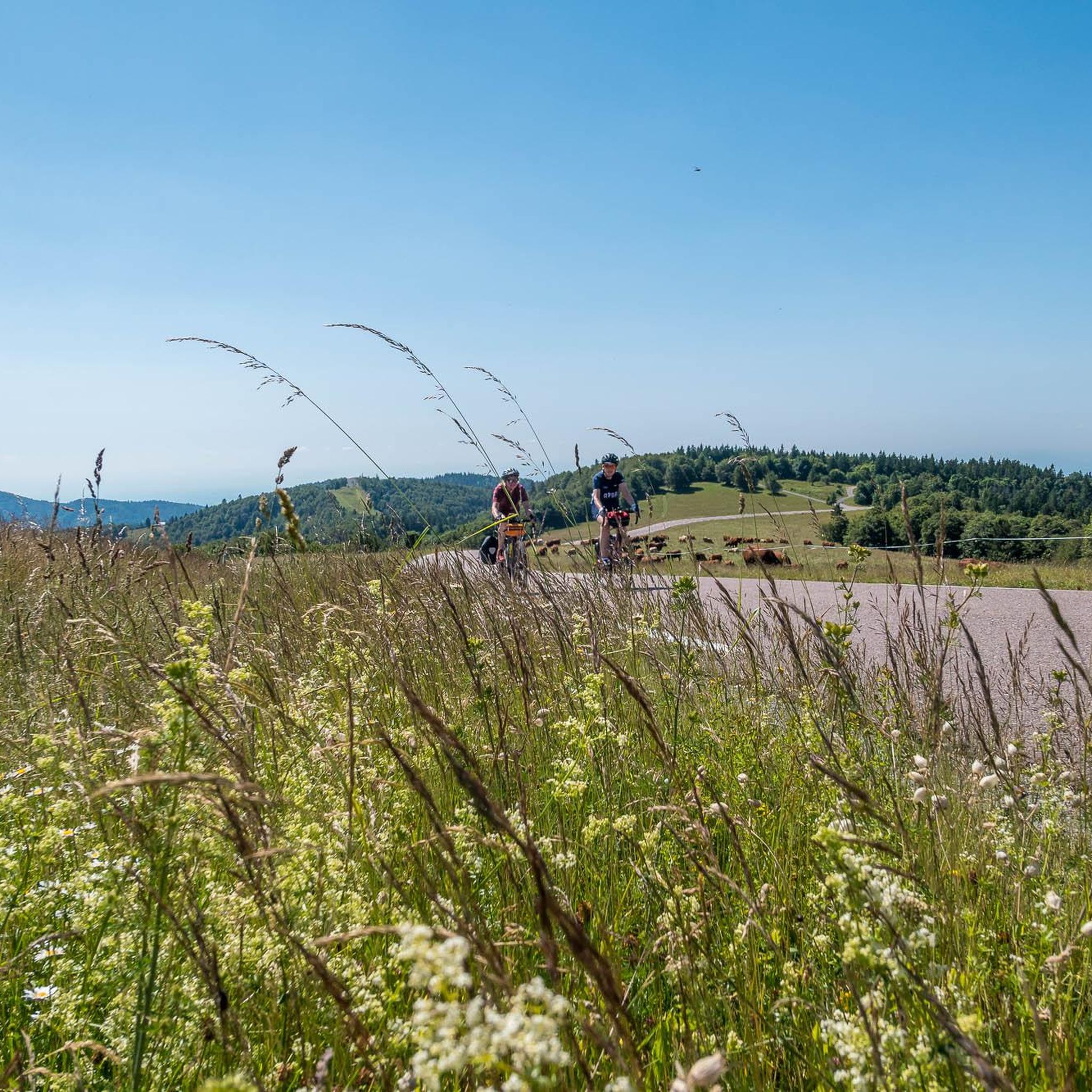
For those seeking a challenge, the Ascent to the Servance balloon from Plancher-Bas is a popular option. This 18-kilometer climb reaches an altitude of 1158 meters, featuring slopes of 5 to 12% through dense, shaded vegetation, offering pure nature and enjoyment.
What outdoor activities can I do near Échavanne?
The region around Échavanne is ideal for various outdoor activities. You can find numerous routes for hiking, gravel biking, and running. For detailed routes and guides, explore the options for hiking around Échavanne, gravel biking around Échavanne, and running trails around Échavanne.
Are there easy hiking trails suitable for families near Échavanne?
Yes, there are several easy hiking trails. The 'Bassin de Champagney' loop and the 'Port de Frahier loop from Échavanne' are both rated as easy and offer pleasant walks. You can find more details and other options in the hiking guide for Échavanne.
What is the best time to visit the Servance balloon for an ascent?
The Ascent to the Servance balloon from Plancher-Bas is best enjoyed during warmer months. In winter, access is not guaranteed as roads are often not cleared of snow and may be closed to traffic.
What do visitors enjoy most about the attractions around Échavanne?
Visitors appreciate the blend of historical depth, architectural beauty, and natural challenges. The Citadel of Belfort is loved for its imposing structure and great views, while the Servance balloon ascent is praised for its pure nature and peaceful, shaded route. The Notre-Dame-du-Haut Chapel is often highlighted for its unique architectural design and serene atmosphere.
Can I find viewpoints with scenic vistas in the Échavanne area?
Absolutely. The Citadel of Belfort offers extensive and impressive views of the city and its surrounding landscape from its elevated position.
Are there any family-friendly attractions or activities?
The Notre-Dame-du-Haut Chapel is listed as family-friendly, offering an interesting architectural experience. Additionally, the region's easy hiking trails, such as those around the Bassin de Champagney, can be suitable for families looking for outdoor activities.
What is the general character of Échavanne and its surroundings?
Échavanne itself is a small rural commune known for its natural setting and quiet charm. The broader Haute-Saône region, where Échavanne is located, offers a mix of natural beauty, historical sites, and opportunities for outdoor exploration, including proximity to areas like the Regional Natural Park of Ballons des Vosges.
Where can I find routes for gravel biking near Échavanne?
There are several gravel biking routes available, ranging in difficulty. You can explore options like the 'Malsaucy cycling link' or the 'Ballon d'Alsace loop'. For a comprehensive list of routes, refer to the gravel biking guide for Échavanne.
Are there running trails in the area?
Yes, the area provides various running trails. Options include loops around the Bassin de Champagney and the Port de Frahier. You can find detailed information and maps for these trails in the running trails guide for Échavanne.
Most popular routes around Échavanne

Get inspired with the komoot mobile app


Explore more
Still not found the Highlight you’re looking for? See guides of the top attractions in other regions:
