Attractions and Places To See around Lorignac - Top 19
Best attractions and places to see around Lorignac include a variety of historical sites, natural landscapes, and charming settlements. This tranquil rural village in Charente-Maritime serves as a base for exploring the surrounding area, which features vineyards and fields. Visitors can discover cultural offerings and natural attractions, making it suitable for those interested in history and outdoor activities.
Best attractions and places to see around Lorignac
- The most popular attractions is Mortagne-sur-Gironde Marina, an other man made facility with…
Last updated: June 23, 2026
Port Maubert
Highlight • Settlement
Tip by

Mortagne-sur-Gironde Marina
Highlight • Structure
Translated by Google •
Tip by

Sign up now to discover places like this
Get recommendations on the best single tracks, peaks, & plenty of other exciting outdoor places.
Sign up for free
A surprising church name
Highlight • Other
Translated by Google •
Tip by
Blue Ponds and Château de Beaulon
Highlight • Castle
Translated by Google •
Tip by
Saint-Pierre Church of Gémozac
Highlight • Religious Site
Translated by Google •
Tip by
Sign up for free to discover even more attractions around Lorignac.
Sign up for free
Already have an account?
Start today with a free account
Your next adventure awaits.
Login or Signup



Tips from the Community

Magnificent port
1
0

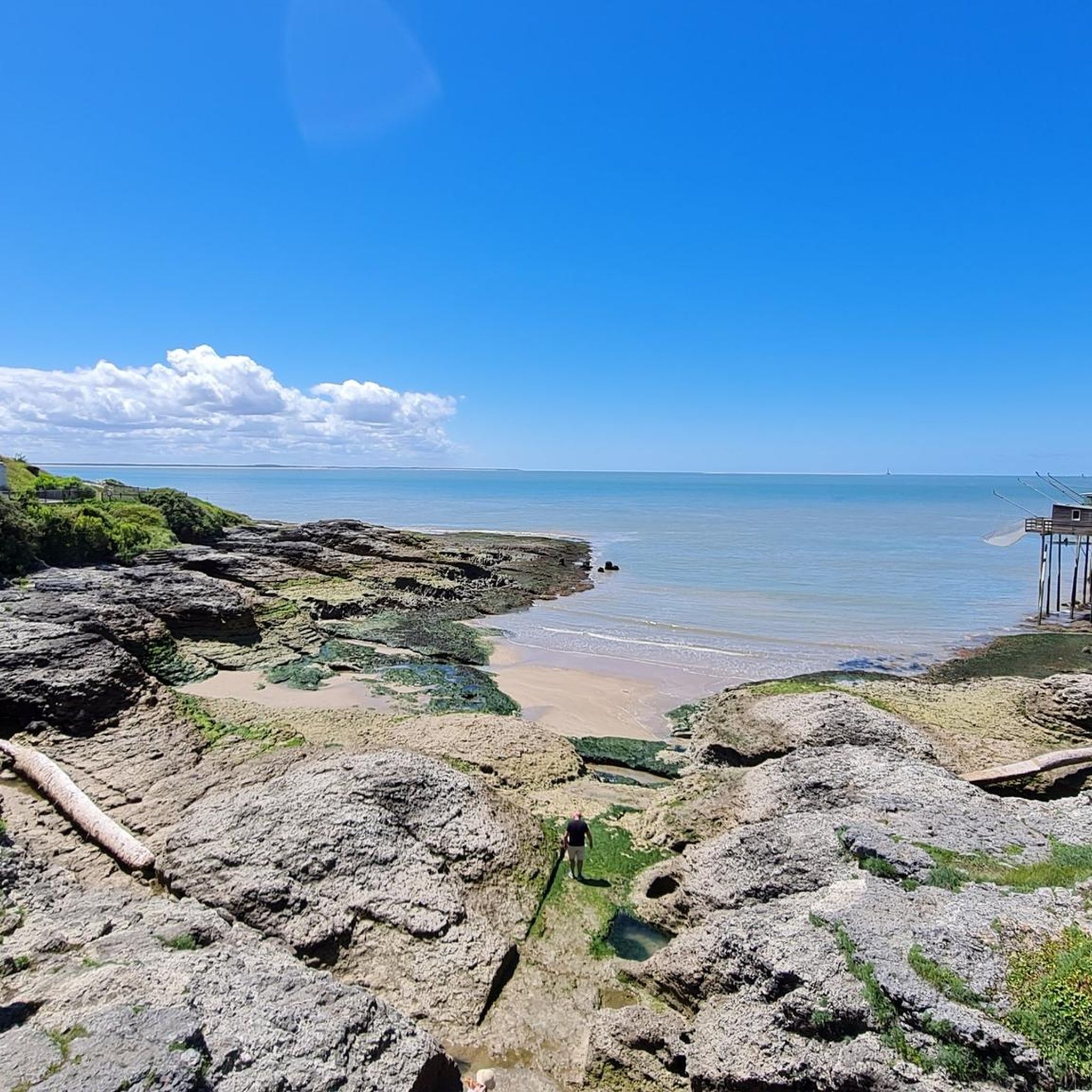
Cute little coastal village at the mouth of a small canal, with a recreational port and a few restaurants as well as picnic spots for a break.
0
0

nice little hike
1
0

Good selection of restaurants, however if like us you want to create your own lunch the supermarket is 10 minutes up hill on your bicycle.
0
0

Certain foundations of small elongated freestones bear witness to a building from the end of the 11th century or the beginning of the 12th century. The nave was taken over in the second half of the 12th century and reinforced by arcades. If the base of the bell tower is characteristic of Romanesque architecture, its upper part bears the mark of the first Gothic age. The octagonal stone spire crowns a bell chamber based on a similar plan, the sides featuring alternating single bays and twin bays. Finally, the north wall and the facade were redone in the 19th century, the first bay of the nave having been shortened in order to widen the road passing in front of the church41. Like the majority of churches in the region, the Saint-Pierre de Gémozac church is based on a plan in the shape of a Latin cross. It consists of a single nave with four bays covered with a pointed barrel vault, which was completely redone in the 16th century. Inside, arcades respond to the buttresses and serve to reinforce the structure of the building. As in some Romanesque churches in the region, the transepts are covered with cupolas. However, if the north brace has a dome on squinches, the south brace has the particularity of having a dome on pendentives. The two arms of the transept are extended by apsidioles: the oldest (12th century), that of the south transept, forms a vaulted hemicycle; the most recent is a rectangular chapel covered with ribbed vaults. A narrow arcade opens onto the first bay of the choir. This forms a set of two spans. The first is covered with quadripartite warheads, while the second is completed by liernes. The flat apse (13th century), pierced with a triplet, testifies to the Cistercian influence on the architecture of the time. The church of Saint-Pierre de Gémozac is part of the tourist inventory of the most beautiful churches of Saintonge and is often cited among the religious buildings worthy of a visit. In certain aspects, this church is indeed one of the beautiful Romanesque churches of the Saintonge type, among which are still the remarkable churches of Rétaud, Rioux or even Thaims, all located in its canton.
0
0
The Mortagne-sur-Gironde marina is located in the Charente-MaritimeAddress 9, place Parias 17120 Mortagne-sur-Gironde - GPS position-0.793356, 45.477200 - Landline: 05 46 90 63 15 - Mobile: 06 43 48 91 93 - VHF channel: 9 - Harbor master: Stéphane Donot The port of Mortagne-sur-Gironde has a capacity of 150 boats on pontoons but also a visitor area for stopovers with 20 places available. It is reserved for boats under 19 m. Attention, the maximum draft is 4 m. The depth of the outer harbor is 2.5 m (average tides) with dredged channel, of the basin 4 m on average, of the channel 3 m (average tides). The voltage and intensity of the electrical terminals are 220 V/16 A on the quay and 220 V/6 A on the pontoon. Water on the pontoon. Ice cream available at the Café de la Rive. The amenities include: 4 toilets and 2 showers, 2 sinks, 2 washing tubs, WIFI. Guarding ashore and afloat. A beaching area is available: 2 slipways (including 1 slipway), Slip, Shipyard.
1
0
The first mention of Port-Maubert appears in the 16th century. It is one of the ports with an intense wheat trade activity on the Gironde estuary. Trade is mainly with Bordeaux. The goods are loaded on barges which transported their cargoes according to the tides and the winds. In the middle of the 19th century, work changed the appearance of the port. At the same time, a landing stage was built to accommodate steamboat passengers. In the 1860s, the State ceded its land to build houses, warehouses for goods, a fairing slipway and establish a shipyard (the future "le Chérif" shipyard). At the entrance to the port, a steam flour mill processes and exports a large part of the cereal production of the Jonzac district. Port activity was at its peak: wines, wheat, potatoes, and other goods flowed in from all over Saintonge to be shipped to Bordeaux, Libourne, Pauillac. The fishing activity continues, the fishermen use boats equipped with nets the "filardières", some come out of the shipyard of Port Maubert, the "Chérif". Fishing has been mentioned in the estuary since the Middle Ages, a modest activity which grew with the modernization of the ports in the middle of the 19th century. The sturgeon, called here "Créac" or "Créa" is one of the fish caught for their flesh. According to tradition, a Russian princess would have come to St-Seurin-d'Uzet. She would then have undertaken to re-teach them how to prepare caviar and when she left, she would have forgotten her umbrella, now carefully kept in St-Seurin-d'Uzet. More specifically, the Prunier house, a great Parisian restaurateur, undertook in 1921 to organize the production of caviar in France and sent Alexandre Scott to St-Seurin-d'Uzet to teach the preparation of caviar to the fishermen of the region. From this activity by several production sites develop as in Port Maubert. The intensity of fishing, in addition to pollution and the modification of natural environments, leads to the scarcity of sturgeons. Its fishing declined in the 1960s and was finally banned in the 1980s, the sturgeon becoming a protected species. Since the 1990s, research has been carried out to reintroduce the original species of sturgeon, the sturio. At the same time, Baerii sturgeon farms are open along the estuary to provide caviar. In the 1980s, sturgeon fishing was banned and fishermen reoriented themselves towards pibales, hitherto practiced on foot or in skiffs with a landing net, and which now is done with boats equipped with "haveneaux": the "pibaliers", also used for shrimp fishing. Today the activity of Port Maubert is mainly linked to fishing and yachting, while a sailing school allows learning how to handle the Optimists on the hunting basin in complete safety. Local fishermen perpetuate the activity and offer the product of their work in the form of numerous recipes sold at the on-site shop.
0
1
"Agout" is an old Saintonge word meaning "sewer" which is here applied to the flow of water from the region to the marshes of the Gironde. The location of the church, on sloping ground on the edge of the road, may explain the addition of this word to its name, which gave St Georges d'Agout. 12th century church, enlarged in the 15th and 16th centuries. Dependent on the priory of St-Thomas-de-Conac in the 12th century, it retains a Romanesque structure and a western portal with arches and sculpted capitals. The right apse choir was covered with ribbed vaults in the 13th century. Existence of a solid square bell tower. New enlargement in the 19th century, with the construction of two chapels adjoining the collateral. Building built in the 12th century. At the end of the 15th-beginning of the 16th century, the western bays of the nave are doubled by a second vessel to the south, and a square bell tower is high. To face the Wars of Religion, an upper chamber was built; presence of an underground refuge. In the 19th century, the late collateral was divided by a longitudinal shear wall, and received a slight vault; the apse is pierced with a twin neo-Romanesque window. A sign at the entrance (and pictured in the must-see) explains the church's noteworthy features.
0
0
Frequently Asked Questions
What historical and cultural sites can I explore near Lorignac?
The area around Lorignac is rich in history. You can visit the Saint-Étienne Church, an originally Romanesque building with a fascinating past, or the unique St Georges d'Agout church, known for its surprising name and medieval architecture. Further afield, explore Talmont-sur-Gironde, one of France's 'Most Beautiful Villages' with its iconic Church Sainte-Radegonde, or the historic town of Pons, featuring a castle tower and the ancient pilgrims' hospital.
Are there any natural attractions or scenic spots to visit?
Yes, nature lovers will appreciate the Blue Ponds and Château de Beaulon, where you can wander through a 'remarkable garden' with thousands of trees and mysterious turquoise artesian springs. The nearby Forêt de la Lande, just 5 km from Lorignac, is a listed site of natural beauty, perfect for appreciating the local environment. You can also enjoy the scenic coastal village of Port Maubert, located at the mouth of a small canal.
What outdoor activities, like hiking or cycling, are available around Lorignac?
Lorignac's location amidst vineyards and fields makes it ideal for outdoor exploration. You can find numerous hiking trails through the countryside. For cycling enthusiasts, there are several routes, including the 'Gironde Estuary by Bike: Mortagne-sur-Gironde to Vitrezay' or the 'Port Maubert loop from Saint-Dizant-du-Gua'. Discover more options on the Cycling around Lorignac guide or the Road Cycling Routes around Lorignac guide.
Are there family-friendly attractions or activities near Lorignac?
Families have several options. The Mortagne-sur-Gironde Marina and Port Maubert offer pleasant settings for strolls and picnics. For a more active day, consider visiting Jonzac, home to Les Antilles de Jonzac, one of Europe's largest aquatic and recreational centers. The 'Le Chateau des Enigmes de Pons' also provides an engaging experience for children and adults alike.
What is there to do in the coastal town of Royan?
Royan, about a 40-minute drive from Lorignac, is a vibrant seaside resort. It's famous for its five main beaches, including Grande Conche, its distinctive 1950s modernist architecture, and its shell-shaped Central Market. Visitors can enjoy various water activities or simply relax by the sea.
Can I visit any vineyards or distilleries in the region?
Absolutely. Lorignac is nestled between vineyards, and the renowned town of Cognac is just an hour's drive away. In Cognac, you can tour famous distilleries such as Hennessy, Rémy Martin, or Martell to learn about and taste the region's namesake brandy. You can also explore the cobbled streets of the old town and the Château de Cognac.
What are some unique features or 'hidden gems' in the area?
Beyond the well-known spots, the area holds charming surprises. The 'Blue Ponds' at Château de Beaulon, with their mysterious turquoise color from microscopic algae, are a truly unique natural phenomenon. The historical significance of the ancient pilgrims' hospital in Pons also offers a glimpse into the region's past as a stop on French pilgrim routes.
What do visitors enjoy most about the attractions around Lorignac?
Visitors frequently praise the tranquil environment and the blend of historical sites with natural landscapes. The charm of coastal villages like Port Maubert, with its recreational port and picnic spots, and the amenities offered at the Mortagne-sur-Gironde Marina are highly appreciated. The community has shared 15 photos and given 54 upvotes, highlighting the beauty and appeal of these spots.
Are there running trails available near Lorignac?
Yes, if you enjoy running, there are several trails around Lorignac. You can find options like the 'Running loop from Lorignac' or 'Le Grand Bois du Pin loop from Bribaudon'. For more details and routes, check out the Running Trails around Lorignac guide.
What local gastronomy can I experience in Lorignac and its surroundings?
While in Lorignac, you can enjoy the peaceful environment and local gastronomy. The region is known for its Marennes-Oléron oysters, Charentes-Poitou butter, and Charentais melon. Many local restaurants, especially in coastal areas like Port Maubert or near the Mortagne-sur-Gironde Marina, offer these regional specialties.
What is the best time to visit Lorignac and its attractions?
Lorignac is an ideal destination for relaxing holidays and exploring the countryside. While specific seasonal activities vary, the region's vineyards and natural landscapes are generally best enjoyed during milder weather, typically from spring through early autumn, when outdoor activities are most pleasant.

Get inspired with the komoot mobile app


Explore more
Still not found the Highlight you’re looking for? See guides of the top attractions in other regions:
