The best cycling routes around Geay
4.5
(242)
1,509
riders
79
rides
Touring cycling around Geay offers routes through the Charente-Maritime department, characterized by its gently rolling terrain and proximity to the Charente River. The landscape primarily features agricultural fields, small villages, and occasional woodlands, providing a generally flat to undulating cycling experience. Elevation changes are typically gradual, making the area suitable for various cycling abilities.
Best touring cycling routes around Geay
- The most popular touring cycling route is Cathedral of Saintes – Crazannes Castle loop from Geay, a 51.1 miles…
Last updated: October 19, 2026
4.6
(32)
187
riders
53.6km
03:19
200m
200m
Moderate bike ride. Good fitness required. Mostly paved surfaces.
4.3
(22)
145
riders
80.4km
04:56
370m
370m
Hard bike ride. Good fitness required. You may need to push your bike for some segments of this route.

4.1
(16)
147
riders
103km
06:36
460m
460m
Hard bike ride. Very good fitness required. Mostly paved surfaces.
4.6
(7)
20
riders
22.6km
01:30
80m
80m
Easy bike ride. Mostly paved surfaces.
5.0
(1)
32
riders
37.7km
02:58
270m
270m
Moderate bike ride. Good fitness required. Mostly paved surfaces.
Get access to more routes and recommendations from other explorers.
Already have an account?
Our route recommendations are based on thousands of hikes, rides, and runs completed by other people on komoot.
Start today with a free account
Your next adventure awaits.




Tips from the Community

🏛️ Construction: 18-19 AD The arch was built around 18-19 AD, during the reign of Emperor Tiberius. It stood at the entrance to the Roman bridge crossing the Charente, at the outlet of the Via Agrippa, which connected Lyon to Saintes. It is therefore not truly a "triumphal arch": it was both a road monument and a monumental gate marking the entrance to Mediolanum Santonum, the capital of Roman Aquitaine. 👤 Who had it built? The arch was financed by Caius Julius Rufus, a Romanized notable from Saintonge. He dedicated it to Tiberius as well as his nephew Germanicus. The inscriptions engraved on the entablature still allow us today to know the figures to whom it was dedicated. The name "Arch of Germanicus" therefore comes from this dedication, and not from the fact that Germanicus personally had the arch built or crossed it. 🏗️ A rather exceptional monument The arch has two bays, likely allowing for the differentiation of traffic flows. It measures approximately 15 m high by 16 m wide. Its Corinthian and composite capitals bear witness to particularly meticulous Roman architecture. It constituted a true demonstration of the power and Romanization of Saintes. ⚠️ The moment the arch almost disappeared This is probably the most interesting episode in its history. For centuries, the arch was always located at the level of the Roman bridge and then the medieval bridge, on the right bank of the Charente. In the 19th century, the old bridge had become dilapidated. When it was decided to demolish it, around 1843, the arch was also threatened with destruction. It was then that Prosper Mérimée, Inspector General of Historical Monuments, intervened. He advocated for its preservation and arranged for its dismantling, relocation, and reassembly on the new bank. Another figure is also associated with this preservation: Victor Hugo, who stayed in Saintes in September 1843 and intervened in favor of the monument's conservation with Mérimée. 📍 Why is the arch no longer exactly in its ancient location? The arch we see today, on Place Bassompierre, is therefore no longer in its original location. It was moved a few dozen meters during the transformation of the quays and the disappearance of the old bridge. It was dismantled stone by stone and then reassembled in order to preserve it. It is now located in the immediate vicinity of the ancient Roman bridge crossing. 🏛️ Protection The Arch of Germanicus was finally classified as a historical monument in July 1905. An interesting detail The Crazannes quarries, located near Saintes, supplied a limestone widely used in the region's ancient constructions. Crazannes stone was notably used for monuments such as the Arch of Germanicus. In summary: 18-19 → construction of the arch at the entrance to the Roman bridge ↓ Antiquity → Middle Ages → the arch remains associated with the crossing of the Charente ↓ 1843 → demolition of the old bridge and threat to the arch ↓ 1843-1844 → Mérimée's intervention and relocation of the arch ↓ 1905 → classified as a Historical Monument
0
0

The Capuchin Castle in Tonnay-Charente, built on a former convent founded in the 17th century by the Rochechouart-Mortemart family, served as a convent, a temporary town hall during the Revolution, and was then sold as national property. It has had several lives, including as property of the Red Cross, and today houses a medical-professional institute. Its current architecture dates from the late 19th century, with a rectangular plan flanked by towers, and it is only visible from the outside.
2
0

Beautiful, almost flat route among marsh birds.
0
0

It is an absolutely beautiful village.
0
0

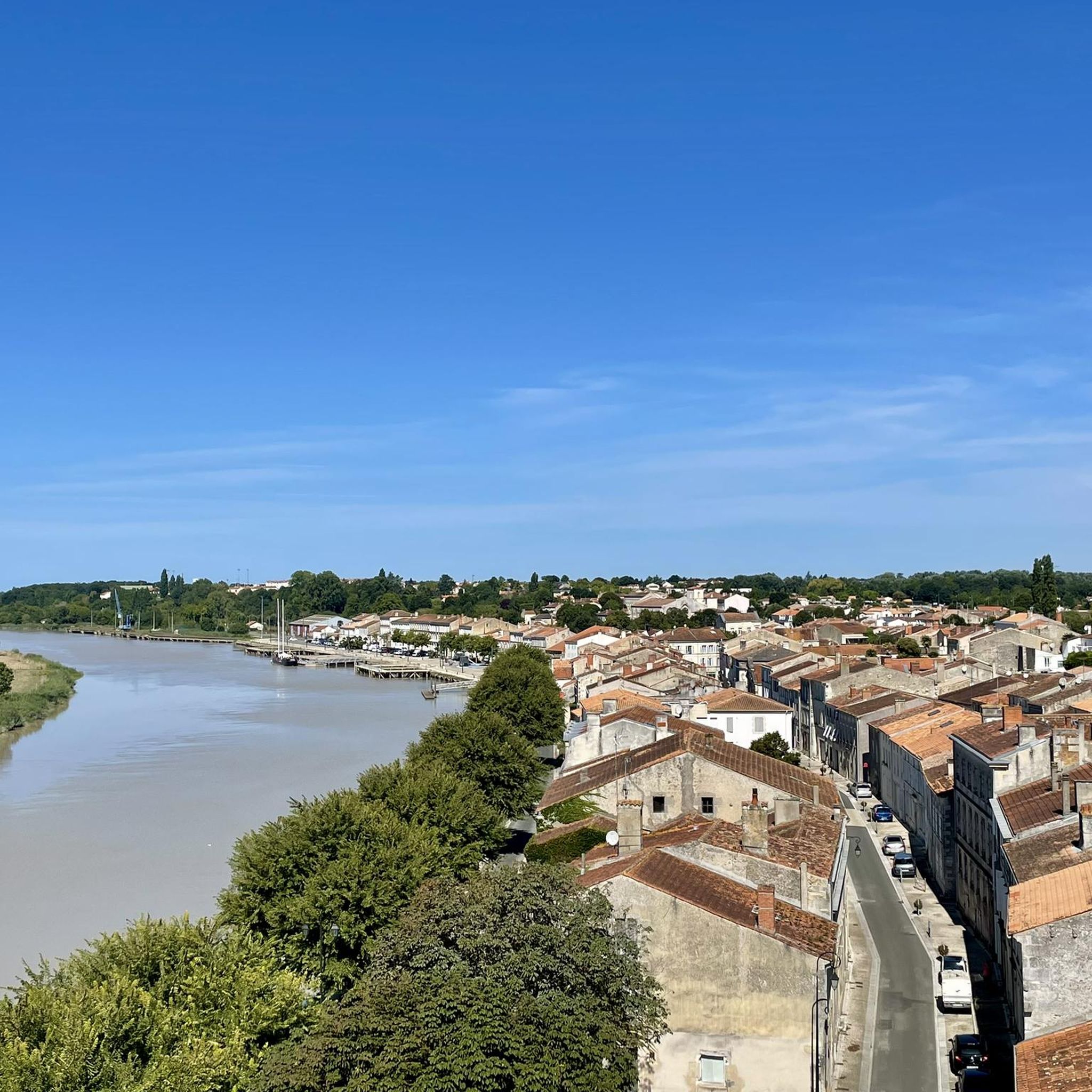
Tonnay-Charente marina and view of the suspension bridge (One of the oldest suspension bridges in Europe - 1842)
0
0
Mobile bridge at the Rochefort marina
0
0

It is another of the engineering jewels of the area.
0
0

Small town with a special charm along the Charente.
0
0
Frequently Asked Questions
How many touring cycling routes are available around Geay?
There are over 80 touring cycling routes in the Geay area, catering to various skill levels. This includes 41 easy routes, 27 moderate routes, and 13 more challenging options.
Are there any easy touring cycling routes suitable for beginners or families?
Yes, Geay offers many easy routes perfect for beginners or family outings. One popular option is the La P'tite Table de Bel Ébat loop from Bords, which is 20.1 miles (32.4 km) long with minimal elevation gain, offering a relaxed ride through the countryside.
What are some longer touring cycling routes for experienced cyclists?
For those seeking a longer challenge, the Cathedral of Saintes – Crazannes Castle loop from Geay is a demanding 51.1 miles (82.2 km) route. It connects historical sites and rural paths, typically taking over 5 hours to complete.
Are there any circular touring cycling routes in the Geay region?
Many routes around Geay are designed as loops, allowing you to start and finish in the same location. Examples include the Raoul bitaud – Saint-Vivien Church in Geay loop from Bords, a moderate 19.5 miles (31.5 km) path, and the Crazannes Castle – Crazannes Sculptures loop from Crazannes, which is 17.2 miles (27.7 km).
What kind of scenery can I expect on touring cycling routes around Geay?
The routes around Geay primarily feature the gently rolling terrain of the Charente-Maritime department. You'll cycle through agricultural fields, charming small villages, and occasional woodlands, often with views of the Charente River. The landscape is generally flat to undulating, offering a pleasant and varied experience.
What historical sites or attractions can I visit along the touring cycling routes?
Several routes pass by significant historical and cultural landmarks. You can explore Crazannes Castle, the Sainte-Madeleine Church of Crazannes, or the Saint-Savinien Church and Statues of the Apostles. The Crazannes Castle – Saint-Vivien Church in Geay loop from Geay is a good option for combining cycling with sightseeing.
What do other touring cyclists say about the routes in Geay?
The touring cycling routes in Geay are highly regarded by the komoot community, holding an average rating of 4.5 stars from over 160 reviews. Cyclists often praise the well-maintained paths, the peaceful rural scenery, and the opportunity to discover historic villages.
Is Geay a good destination for touring cycling with children?
Yes, the generally flat to undulating terrain and numerous easy routes make Geay suitable for cycling with children. Many paths are quiet and pass through small villages, offering a safe and enjoyable experience for families. Look for routes marked as 'easy' for the most family-friendly options.
What is the best time of year for touring cycling in Geay?
The spring and autumn months typically offer the most pleasant conditions for touring cycling in Geay, with mild temperatures and less rainfall. Summer can also be enjoyable, though it can get warm, so starting early in the day is advisable. Winter cycling is possible, but be prepared for cooler, potentially wetter weather.
Are there options for parking near the touring cycling routes in Geay?
Parking is generally available in the villages and towns that serve as starting points for many routes, such as Geay, Bords, or Crazannes. Specific parking information can often be found on individual route pages or local tourism websites.
Can I find bike-friendly cafes or places to eat along the routes?
Yes, as you cycle through the small villages and towns in the Geay area, you'll often find local cafes, bakeries, and restaurants where you can stop for refreshments or a meal. These establishments are typically welcoming to cyclists.
Most popular attractions around Geay

Get inspired with the komoot mobile app


Explore more
Browse the best Cycling routes in other regions.
