The best road cycling routes around La Tremblade
4.2
(142)
4,098
riders
39
rides
Road cycling routes around La Tremblade traverse a diverse landscape in the Charente-Maritime department of southwestern France. The region is characterized by extensive pine and oak forests, such as the Forêt de la Coubre, and the unique marshlands and oyster farming ports of the Seudre estuary. Cyclists will find a network of mostly paved paths, including sections of the Vélodyssée, offering varied terrain from flat coastal stretches to routes with gentle rolling hills. The highest point on local routes is…
Last updated: July 19, 2026
3.7
(7)
116
riders
Moderate road ride. Good fitness required. Mostly well-paved surfaces and easy to ride.
4.0
(1)
31
riders
Moderate road ride. Good fitness required. Mostly well-paved surfaces and easy to ride.

Sign up for free
5.0
(1)
19
riders
18.0km
00:41
30m
30m
Easy road ride. Great for any fitness level. Mostly well-paved surfaces and easy to ride.
18
riders
Moderate road ride. Great for any fitness level. Some segments of this route may be unpaved and difficult to ride.
9
riders
Moderate road ride. Great for any fitness level. Some segments of this route may be unpaved and difficult to ride.
Get access to more routes and recommendations from other explorers.
Sign up for free
Already have an account?
Our route recommendations are based on thousands of hikes, rides, and runs completed by other people on komoot.
Start today with a free account
Your next adventure awaits.
Login or Signup
Other adventures around La Tremblade

Tips from the Community

Built from 1955 and consecrated in 1958, the Notre-Dame de Royan church symbolizes the city standing tall and proud again. The reinforced concrete monument thus fits into the general trend of renewal in sacred art after the sad events the world experienced in the 1940s. It is considered today as a feat and a masterpiece of modern architecture. "Upon entering this concrete cathedral, be silent. Here, everything is momentum, rigor, roughness, austere beauty. The twilight sings the elusive, the divine, variable and constant like the sea." ANDRÉ MALRAUX Minister of Cultural Affairs (1958-1969)
1
0

Here you'll find a romantic little lighthouse, and behind it lies a garden with a bench overlooking the sea, a lovely place to stop for a break. Afterwards, you can continue along the cliff to the right until you reach Euro Velo 1 again.
0
0

Perfect beachside bike trail along the boulevard, with several rest stops with seating and beach acces.
0
0

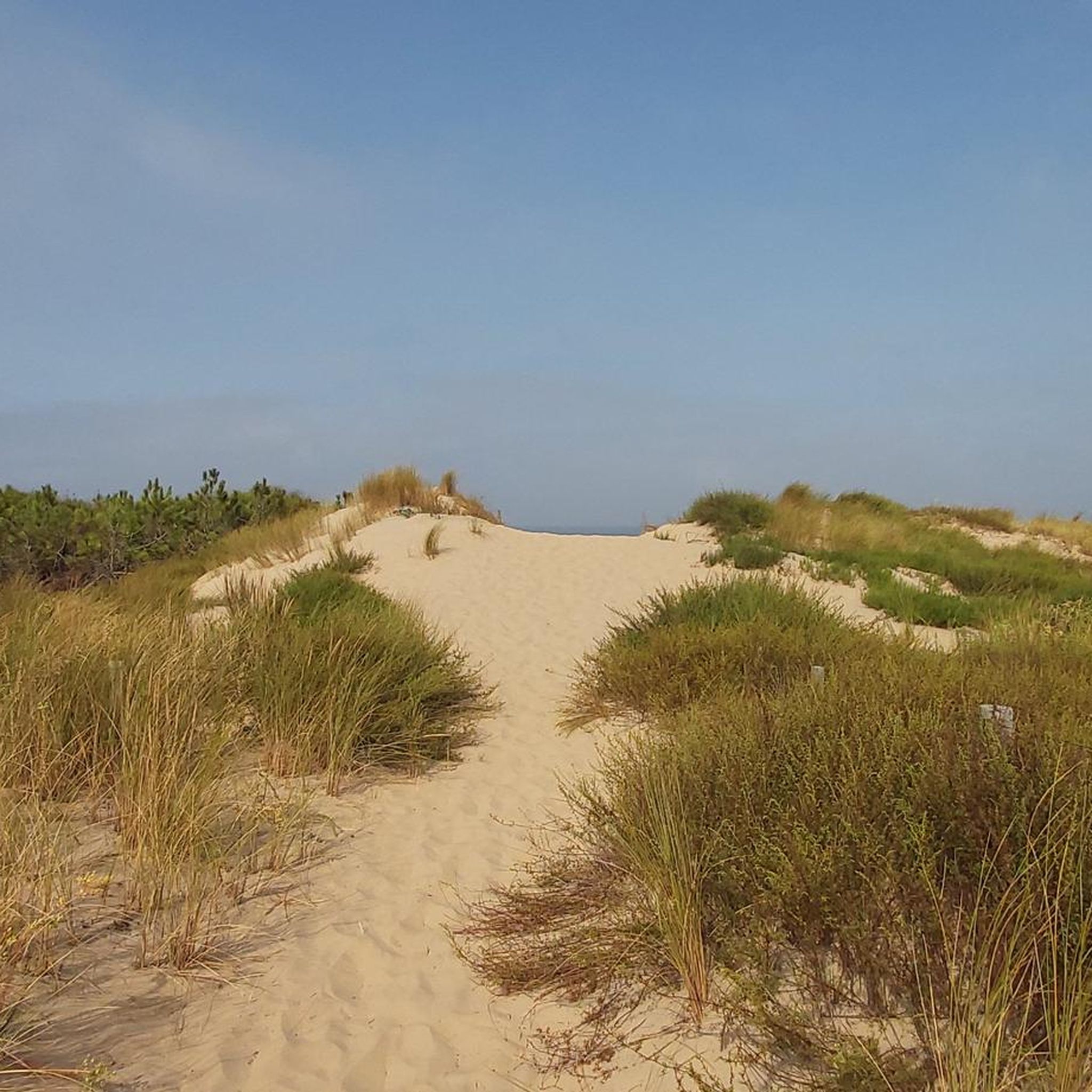
At the exit of the Coubre national forest, the landscape opens onto the dunes, and you can see the lighthouse. The Coubre lighthouse watches over maritime traffic in the Gironde estuary.
0
0

Chaillevette, from the Saintongeais "Chaille" which means "pebble" is a small town in Charente Maritime with 1620 inhabitants, on the Arvert Peninsula. Nestled on the left bank of the Seudre, in a setting of salt marshes, punctuated by "claires" where oysters are refined. The refinement gives them this blue-green color and this typical iodized flavor. Oyster farming by oyster farmers is an essential resource for maintaining two pretty ports: The port of Chatressac, (which almost entered history in the 17th century, having been considered for a time to accommodate the Grand arsenal maritime du Ponant wanted by Louis XIV, which was finally built further north and gave birth to the city of Rochefort), and the port of Chaillevettte. Typical with their oyster huts in various and shimmering colors, bordering the channel and welcoming barges, these two ports have managed to preserve their picturesque character. However, you can enjoy local products in the "tasting huts" and especially the oysters that make our town famous as the "cradle of the oyster". Each of these ports is animated each year by the July 14 festival in Chatressac and the August 15 festival in Chaillevette. In the Chaillevetonne countryside, the cultivation of cereals such as wheat or corn finds its place, without forgetting the vines, which will be used to produce, among other things, the Charente country wine, pineau and cognac.
0
0

On the beach of Royan (20,000 inhabitants). This is where the boat that takes you across the Gironde docks/departs.
0
0
The Terre-Nègre lighthouse is a landmark forming a cylindrical tower a little over 26 meters high. Located on the tip of Terre-Nègre, in the commune of Saint-Palais-sur-Mer, in Charente-Maritime, it is intended to mark the southern pass of the Gironde estuary and to signal the presence of a dangerous sandbank, the "Anglais bar". This building forms a tower-column 3.16 meters in diameter and 26.60 meters high. A spiral staircase with a central core of 143 steps leads to a summit platform equipped with a directional light. The tower is painted in two different colors to make it more visible: the upper part is red, the lower part is white. The base of the lighthouse is hidden by a building that once served as the keeper's accommodation. The installation of a beacon at this location was considered as early as 1763. De Kearney took over the beaconing plan four years later. Construction work on the tower began in 1770 and was completed in 1773, probably under the supervision of the Bordeaux engineer Claude Tardy. In 1807, the tower was raised. However, this work was considered insufficient by some of the estuary's navigators. In 1834, sailors from the nearby port of Royan sent a request to the Ministry of the Navy to study the possibility of equipping the tower with a light. However, this request was postponed the following year due to lack of sufficient funds. A new request from sailors prompted the lighthouse commission to experiment with a first light in 1836. Finally, on October 15, 1838, a fixed white 4th order light was permanently installed. The latter was replaced in 1856 by a fixed white light of the 4th order of a small dioptric model with a reinforced sector of the 5th order catoptric. It was equipped with new lights in 1899 and 1904. In 1939, it was electrified. During the German occupation, the lighthouse served as an observatory for the soldiers of the Wehrmacht. Damaged during the fighting of 1945 (presence of breaches at the top of the tower), it was restored in the immediate post-war period. In March 1947, the lighthouse was operational again. A light with 3 occultations — changing every 12 seconds — was installed. Its colors are white, red and green. Its current range is 18 miles. Listed as a Historic Monument since 2011, the lighthouse is not open to visitors. However, it can be admired from the outside and a pretty passage provides direct access to the coastal path.
0
0

Along the Oysterfields, This is France at its best (when the sun shines!)
0
0
Frequently Asked Questions
How many road cycling routes are available in La Tremblade?
There are over 35 road cycling routes around La Tremblade, offering a diverse range of experiences. These include 8 easy routes, 24 moderate routes, and 3 more challenging options, catering to various skill levels.
What natural features can I expect to see along the road cycling routes in La Tremblade?
Road cycling routes in La Tremblade often traverse the extensive Forêt de la Coubre, featuring maritime pines and holm oaks. You'll also encounter the unique marshlands and oyster farming ports of the Seudre estuary, as well as scenic stretches of the 'Côte Sauvage' with its sandy beaches and dunes.
Are there any notable landmarks or attractions accessible by road bike?
Yes, several landmarks are easily accessible. The iconic Phare de la Coubre is a prominent feature on many routes, offering panoramic views. You can also cycle past the picturesque oyster ports, such as La Grève, and explore historical sites like the German Bunkers of La Grande Côte.
What is the best time of year for road cycling in La Tremblade?
The region is enjoyable for road cycling for much of the year. Spring and autumn offer pleasant temperatures and less crowded routes. In spring, the Forêt de la Coubre is particularly fragrant with broom and gorse. Summer is also popular, though routes can be busier, especially near coastal areas.
Are there road cycling routes suitable for beginners in La Tremblade?
Absolutely. La Tremblade offers 8 easy road cycling routes, many of which are mostly paved and flat, making them ideal for beginners or those seeking a relaxed ride. Sections of the Vélodyssée through the Forêt de la Coubre are particularly accessible.
Can I find challenging road cycling routes in La Tremblade?
While the region is generally known for its accessible terrain, there are 3 routes classified as difficult for those seeking more of a challenge. These routes may feature longer distances and more significant elevation gains, such as the Mornac-sur-Seudre – Notre-Dame Church, Royan loop which includes over 370 meters of elevation.
Are there circular road cycling routes in La Tremblade?
Yes, many of the road cycling routes in La Tremblade are designed as loops, allowing you to start and finish at the same point. Examples include the Coubre Lighthouse – Coastal cycle path loop and the Seudre Bridge – Mornac-sur-Seudre loop.
Where can I experience the unique oyster farming culture while cycling?
You can explore the oyster farming culture along 'Les Chemins de la Seudre', an itinerary that winds through marshes and oyster ports along the Seudre estuary. The picturesque port of La Grève, with its colorful oyster huts, is a charming stop to witness traditional oyster farming and sample fresh Marennes-Oléron oysters.
Are there family-friendly road cycling options in La Tremblade?
Yes, the region is well-suited for family cycling. Many routes, especially those through the Forêt de la Coubre and sections of the Vélodyssée, are mostly paved and safe, offering a pleasant experience for all ages. Bike rental services are also readily available.
Where can I park my car when starting a road cycling route in La Tremblade?
Parking is generally available in La Tremblade and at popular starting points for routes, such as near the Phare de la Coubre or in Ronce-les-Bains. Look for designated parking areas near trailheads or town centers.
Are there places to stop for refreshments along the road cycling routes?
Yes, you'll find cafes, restaurants, and accommodation in towns and villages along the routes, such as La Tremblade, Ronce-les-Bains, and Mornac-sur-Seudre. The oyster ports also offer opportunities to enjoy local seafood and refreshments.
What do other road cyclists enjoy most about the routes in La Tremblade?
The road cycling routes in La Tremblade are highly rated by the komoot community, with an average score of 4.3 stars from over 50 reviews. Reviewers often praise the diverse landscapes, from dense pine forests to coastal paths and the unique Seudre estuary, as well as the well-maintained cycling infrastructure.
Does La Tremblade offer access to long-distance cycling routes like the Vélodyssée?
Yes, La Tremblade is a key point on the Vélodyssée, a major long-distance cycling route that is part of EuroVelo 1. A significant 20 km stretch of the Vélodyssée traverses the Forêt de la Coubre, providing a mostly paved and safe cycling experience through the forest.
Most popular routes around La Tremblade
Most popular attractions around La Tremblade

Get inspired with the komoot mobile app


Explore more
Browse the best Road cycling routes in other regions.
