The best walks and hikes around Royan
4.7
(111)
1,901
hikers
58
hikes
Hiking around Royan offers diverse landscapes, from the Atlantic coastline with its limestone cliffs and coves to expansive forests and tranquil estuaries. The region is characterized by varied terrain, including sandy beaches, pine woodlands, and marshlands influenced by the Gironde and Seudre estuaries. This mix provides a range of environments for outdoor activities, with numerous marked footpaths available.
Best hiking trails around Royan
- The most popular hiking route is Royan to Saint-Palais-sur-Mer Customs Trail, a 7.1 miles (11.5 km)…
Last updated: July 7, 2026
4.7
(18)
239
hikers
11.5km
02:58
70m
70m
Moderate hike. Good fitness required. Easily-accessible paths. Suitable for all skill levels.
5.0
(1)
53
hikers
8.05km
02:05
40m
40m
Moderate hike. Good fitness required. Easily-accessible paths. Suitable for all skill levels.

Sign up for free
3.8
(5)
26
hikers
4.58km
01:12
40m
40m
Easy hike. Great for any fitness level. Easily-accessible paths. Suitable for all skill levels.
5.0
(4)
79
hikers
6.63km
01:44
50m
50m
Easy hike. Great for any fitness level. Easily-accessible paths. Suitable for all skill levels.
75
hikers
Easy hike. Great for any fitness level. Easily-accessible paths. Suitable for all skill levels.
Get access to more routes and recommendations from other explorers.
Sign up for free
Already have an account?
Our route recommendations are based on thousands of hikes, rides, and runs completed by other people on komoot.
Start today with a free account
Your next adventure awaits.
Login or Signup
Popular around Royan



Tips from the Community

Built from 1955 and consecrated in 1958, the Notre-Dame de Royan church symbolizes the city standing tall and proud again. The reinforced concrete monument thus fits into the general trend of renewal in sacred art after the sad events the world experienced in the 1940s. It is considered today as a feat and a masterpiece of modern architecture. "Upon entering this concrete cathedral, be silent. Here, everything is momentum, rigor, roughness, austere beauty. The twilight sings the elusive, the divine, variable and constant like the sea." ANDRÉ MALRAUX Minister of Cultural Affairs (1958-1969)
1
0

The Riveau de Vallières (or Riveau de Boube) is a small stream that: • marks the border between Royan and Saint-Georges-de-Didonne, • serves as a natural outlet for the waters of the Boube and Belmont marshes, • flows into the Grande Conche beach after a section has been channeled. Today, some sections of the stream are buried or channeled due to urbanization.
0
0
The Jardin du Parc and Riveau de Vallières is located in the Parc district of Royan (Charente-Maritime), bordering Saint-Georges-de-Didonne. It is both a small urban park and a natural area crossed by a stream called the Rive au. Origin and History Originally, this area was occupied by a large dune system behind the Grande Conche beach. From the 18th century onwards, these dunes were planted with vegetation and landscaped to stabilize the coastline and create a promenade. In 1886, a true leisure park was inaugurated: it included a restaurant, a pastry shop, a bandstand, games, and an open-air theater. At that time, a tramway connected the center of Royan to the park for visitors and vacationers. The Park Today The public garden includes: - a children's playground, a mini-golf course, - a Basque pelota court, - walking paths in a wooded area. The site is also designated a biodiversity refuge by the League for the Protection of Birds (nesting boxes, ecological management of the areas). Originally, this area was occupied by a large dune system behind the Grande Conche beach. From the 18th century onwards, these dunes were planted with vegetation and landscaped to stabilize the coastline and create a walking area. In 1886, a true leisure park was inaugurated: it included a restaurant, a pastry shop, a bandstand, games, and an open-air theater. At that time, a tramway connected the center of Royan to the park for visitors and vacationers.
0
0
📍 Origins and Beginnings The tradition of games and entertainment in Pontaillac dates back to the late 19th century, with gambling clubs such as the Kursaal (around 1880) and the Otrada (1892). These establishments preceded the current casino and catered to a seaside and aristocratic clientele; they combined games, cafes, and entertainment on the beach. In 1902, La Restauration was built in Pontaillac, on the site of various games and entertainment venues. It served as a cafe-restaurant but also attracted gambling enthusiasts, such as horse racing. 🎲 Construction of the Sporting/Casino (1930s) In the 1930s, La Restauration was replaced by a new building called the Sporting, designed by the architect Auguste Bluysen, a specialist in modern casinos of the time. Built of concrete on stilts directly on Pontaillac beach, the building features a rationalist and Art Deco architecture typical of the interwar period, sometimes surprising with its style reminiscent of the 1950s. 🪖 World War II During World War II, the Sporting remained open, primarily serving German soldiers. During the massive bombings of 1945, which destroyed much of Royan, the Pontaillac casino was one of the few to survive, as it was virtually untouched by the raids. 🎭 Post-War and Golden Age After the war, the casino became a central hub of Royan's social life. It reopened in 1948, and the 1950s and 60s constituted a cultural golden age, with a rich program of shows, concerts, dances, and galas. Under the leadership of its "musician-director" Roger Genty, major French and international stars performed on its stage: Josephine Baker, Jacques Brel, Sacha Distel, Georges Brassens, Fernand Raynaud, Henri Salvador, and others. 🎰 Contemporary Era In 1986, the casino was acquired by the Lucien Barrière group, which expanded its operations by modernizing the gaming areas, adding slot machines, a bar, restaurants, and other services, while maintaining its role as a year-round entertainment hub. Today, the Casino Barrière in Royan-Pontaillac is the only casino still operating in the Royan area, bearing witness to more than a century of seaside history, gaming, and entertainment.
0
0
📍 Location Dr. Guillon's bathtubs are located along the Boulevard de la Côte d’Argent / Corniche de Pontaillac (between Royan and Vaux-sur-Mer), carved into the rocks of the Pontaillac cove facing the sea. They are still visible today, especially at low tide. 👨⚕️ Origin and Historical Context 📜 Dr. Frédéric-Auguste Guillon Frédéric-Auguste Guillon (1808-1890) was a physician, former naval surgeon, then a local councilor and practicing doctor in Royan. He contributed to the development of seawater therapy and thalassotherapy (treatments using seawater) on the Atlantic coast in the 19th century, a time when sea bathing was prescribed for health reasons. 🏖️ Construction of the "Bathtubs" In 1872, Dr. Guillon had a series of pools and bathtubs carved directly into the rocks of Bec des Brandes in Pontaillac. These pools were filled with seawater heated by the sun between tides. The aim was to offer natural therapeutic baths, particularly for treating scrofula, a chronic lymphatic and skin condition common at the time. 🛁 Description of the Facilities The facilities included: A large natural pool carved into the rock, Two large pools, Three individual bathtubs carved into the cliff face, which were filled with seawater at each tide. These structures provided access to seawater baths without having to directly face the currents or the depths of the ocean – a hygienic and medical approach ahead of its time. 🩺 Therapeutic Purpose At the time: Sea bathing was considered beneficial to health, improving circulation, treating chronic infections, and promoting overall well-being. Dr. Guillon's baths constituted an early form of thalassotherapy, combining the effects of seawater, sea air, and sunlight. 🌊 Heritage and Current Visibility Although the facilities are no longer used as treatment centers, the baths remain visible today on the rocks of Pontaillac, particularly at low tide. A tourist information panel installed by the city of Royan explains their origin and historical significance.
0
0
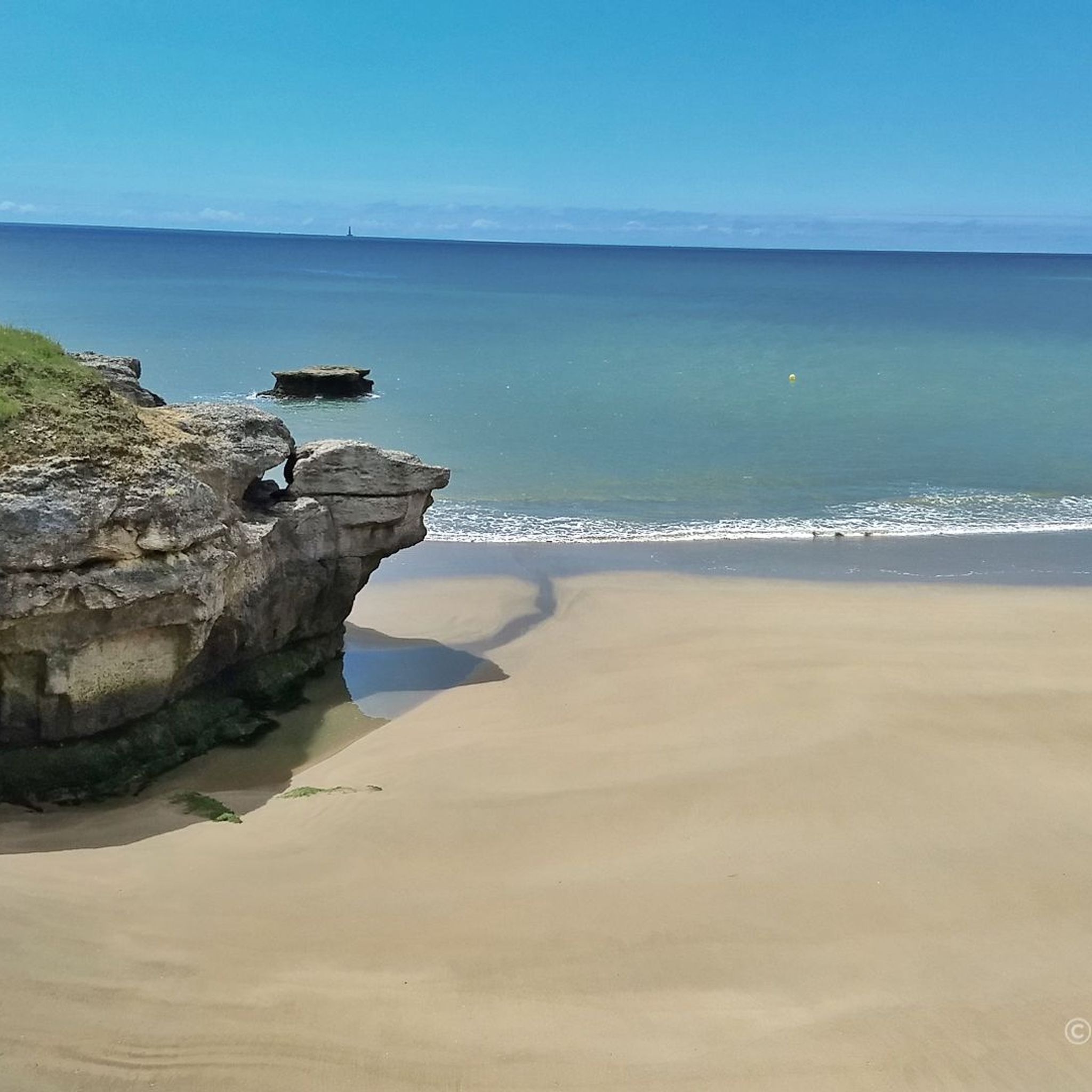
📍 Introducing the Gilet Cove The Gilet Cove is a small, natural beach on the oceanfront, located on Boulevard de la Conche de Gilet / Boulevard de la Falaise, in the town of Vaux-sur-Mer, just before Royan. 🌿 It's a sheltered, rocky cove, appreciated for its tranquility and more intimate setting compared to the larger urban beaches nearby. 🏖️ At high tide, the sea can completely cover this small beach, making the space very limited; at low tide, you can enjoy a patch of sand and rocks for relaxing or swimming. 🧭 Features & Tips 📍 Type of place: small, unsupervised beach, nestled among the rocks with sand and cliffs. 🏖️ Tides: access is best at low tide — at high tide the beach can disappear underwater. 🐶 Animals: prohibited from April 1st to September 30th (subject to municipal regulations). 👣 Access: via stairs from the boulevard above, surrounded by villas with sea views. 🚫 Lifeguard services: no lifeguard station or marked services. 📍 Location La Conche de Gilet is often considered the last small beach in Vaux-sur-Mer before reaching Royan/Pontaillac when following the coastline from Saint-Palais-sur-Mer.
0
0
🏖️ General Overview Chay Beach is a family-friendly, fine sandy beach located in Royan (Charente-Maritime), on the Côte d’Argent promenade between Pigeonnier Beach and Pointe du Chay. It stretches for approximately 200 meters and boasts a pleasant natural setting, with a cove bordered by rocks typical of the Charente coastline. 🏝️ Features • 🌊 Beach type: fine sand, sheltered cove. • 🏄♂️ Atmosphere: relatively calm and family-friendly, ideal for children and vacationers seeking relaxation away from the large urban beaches. • 🐾 Pets: prohibited from April 1st to September 30th. • 🫧 Water quality: excellent (Blue Flag label awarded for 2025). 🧭 Lifeguard and Safety • Swimming is supervised during the season (June to early September), with areas marked by red and yellow flags. • The area is classified as a Category 3 "Supervised Beach" and lifeguards are present during the indicated hours. 🪑 Amenities On-site, you can find: • 🏖️ Sun loungers, parasols, and mattresses for rent. • 🚿 Foot rinse and public restrooms. • 📶 Wi-Fi access, first aid station, and an area accessible to people with reduced mobility (assistance may be required depending on the slope). • 🍴 Beachfront restaurant ("Le Chay" bar-restaurant with sea views). 🚶♂️ Atmosphere and Activities • 🎈 Ideal for families and leisurely strolls. • 🌞 People come here for swimming, playing on the sand, flying kites, or simply relaxing by the ocean. • 🅿️ Parking is available nearby, and the beach is easily accessible on foot or by bike from Royan town center in just a few minutes. 🧭 Practical Tips • 📆 Best time to visit: summer for supervised swimming and full services, but also during the off-season for a more peaceful atmosphere. • ☀️ Arriving early in the morning makes parking easier during peak season. • 🐶 Dogs are not allowed during the summer season; check the signs on site during the off-season.
0
0
The Church of Our Lady of the Assumption is located in the Parc district, a neighborhood that had been developing well before the war. In response to the wishes of the residents of the Parc residential neighborhood, which had been developing along the Grande Conche River, the Church of Our Lady of the Park was built in the 1950s by architects Jean Bauhain, René Baraton, and Marc Hébrard. Largely inspired by the principles of modern architecture, particularly the buildings of Brazilian architect Oscar Niemeyer (Saint Francis of Assisi in Belo Horizonte), the building nevertheless remains traditional in its exterior appearance (harmonic façade), its interior space (a single nave punctuated by six parabolic arches without supporting posts, side chapels), and its decoration (use of stained glass and earthenware tiles). The materials used reflect this blend of tradition and modernity, combining concrete, which was used to create the parabolic arches, and cut stone, which was used for the building's base and the construction of the bell tower. The building's simple plan corresponds to the original program, and the opening created in the choir to increase summer capacity is an ingenious solution to meet the needs of this type of building located in a seaside town. The decoration is elaborate and utilizes various materials, such as stained glass and Gien earthenware in the exterior tympanum. The exterior wall cladding itself features an interesting texture, adorned with sinuous, wave-like lines that create subtle lighting effects. To realize the decorative program, the architects enlisted the help of numerous artists close to Maurice Denis's school of sacred art: the painters Maurice Rocher and André Trébuchet, as well as the master glassmaker Jean Barillet. Of particular note: the remarkable façade, which features an imposing ceramic decoration depicting the Virgin in Majesty, and the modern stained-glass windows designed by the expressionist painter Maurice Rocher. This building is all the more interesting because it is a concrete embodiment of the project the architects had envisioned for the Notre-Dame de Royan church and thus echoes this flagship monument of Royan's construction, making its protection and conservation judicious. It is the second church of the Reconstruction of Royan. The Eglise du Parc is certainly less impressive than the Notre-Dame Church in the center of Royan, a true symbol of the city's modernist reconstruction, but it does not leave one indifferent.
0
0
Frequently Asked Questions
What types of landscapes can I expect to see while hiking around Royan?
Royan offers a rich variety of landscapes for hikers. You'll find stunning coastal scenery with Atlantic Ocean views, limestone cliffs, and tranquil coves, particularly along paths like the one from Vaux-sur-Mer to Saint-Palais. Inland, the expansive La Coubre forest provides trails through pines and holm oaks. The region is also shaped by the Gironde and Seudre estuaries, featuring unique marshes and oyster-farming ports, as well as bucolic countryside and vineyards.
Are there any easy hiking trails suitable for families or beginners in Royan?
Yes, Royan has many easy trails. Out of over 50 routes, more than 35 are rated as easy. A great option for a relaxed walk is the Chay Beach – Fort du Chay loop from Royan, which is about 7.9 km long and takes around 2 hours. The region's diverse terrain ensures there are gentle paths suitable for all ages and fitness levels.
Can I find circular hiking routes in the Royan area?
Absolutely. Many of the trails around Royan are designed as circular routes, allowing you to start and end at the same point. For example, the Port of Royan – Chay Beach loop from Royan is a moderate 8.8 km circular hike. These loops are convenient for exploring different parts of the region without needing to retrace your steps.
What are some notable viewpoints or attractions along the hiking trails in Royan?
Hiking in Royan offers numerous scenic viewpoints and attractions. Coastal paths provide breathtaking views of the Atlantic Ocean and the Cordouan lighthouse in the distance. Trails around the Gironde and Seudre estuaries offer panoramas over oyster beds and the waterways. You can also explore natural highlights like Suzac Forest, the unique Grottes de Matata, or relax at Conche de Gilet, a sheltered rocky beach.
Are there any dog-friendly hiking options around Royan?
Many trails in Royan are suitable for dogs, especially those through the extensive forests like La Coubre or along less crowded coastal sections. It's always recommended to keep your dog on a leash, especially in nature reserves or areas with wildlife, and to check local signage for any specific restrictions, particularly on beaches during peak season.
What is the best time of year to go hiking in Royan?
Royan's pleasant climate makes it suitable for hiking throughout much of the year. Spring and autumn offer mild temperatures and beautiful scenery, with fewer crowds. Summer is ideal for combining hikes with beach activities, though trails can be busier. Even winter offers opportunities for peaceful walks, especially in the forests, thanks to the relatively temperate coastal weather.
How many hiking trails are available in the Royan region?
There are over 50 hiking routes available around Royan, catering to various skill levels. This includes a significant number of easy trails, as well as moderate and a few more challenging options, ensuring there's something for every hiker to explore.
What do other hikers say about the trails in Royan?
The hiking trails in Royan are highly regarded by the komoot community, with an average rating of 4.8 stars from over 100 reviews. Hikers frequently praise the diverse landscapes, from the stunning coastal views to the peaceful forest paths, and the well-maintained network of trails that make exploring the region a pleasure.
Are there any longer or more challenging hikes for experienced hikers?
While most trails are easy to moderate, Royan does offer options for more experienced hikers looking for longer distances. The region is the starting point for a 40 km section of the long-distance GR®4 trail, which follows the Customs Trail along the coast and delves into the national forest of La Coubre, providing a more extensive and challenging experience.
Can I access hiking trails in Royan using public transport?
Yes, some hiking trails in Royan are accessible via public transport, especially those starting within or close to the main towns and villages. For trails further afield, you might need to combine public transport with a short walk or consider local taxi services. It's advisable to check local bus routes and schedules in advance to plan your access to specific trailheads.
Are there any trails that go through the famous La Coubre forest?
Yes, the expansive La Coubre forest, covering 8,000 hectares, is a major hiking destination in the Royan region. Numerous trails, such as the Gardour, Reeds, Brandes, and Shark trails, wind through its pine and holm oak woodlands, offering a chance to immerse yourself in nature and observe local flora and fauna.
Most popular attractions around Royan

Get inspired with the komoot mobile app


Explore more
Browse the best Hikes in other regions.
