Attractions and Places To See around Barret - Top 16
Attractions and places to see around Barret include a variety of historical sites and natural features. This region offers 16 notable spots for exploration, ranging from ancient religious buildings to scenic viewpoints. The landscape is characterized by rolling fields and historical monuments, providing diverse points of interest. Visitors can discover significant cultural heritage alongside opportunities for outdoor appreciation.
Best attractions and places to see around Barret
- The most popular attractions is Rest area with view and picture board, a…
Last updated: May 11, 2026
Saint-Pierre Church of Bonneuil
Highlight • Religious Site
Translated by Google •
Tip by

Rest area with view and picture board
Highlight • Rest Area
Translated by Google •
Tip by

Sign up now to discover places like this
Get recommendations on the best single tracks, peaks, & plenty of other exciting outdoor places.
Sign up for free
Notre-Dame Church in Sainte-Radegonde
Highlight • Other
Translated by Google •
Tip by

Dolmen of Saint-Fort
Highlight • Historical Site
Translated by Google •
Tip by

Saint-Bonnet Church of Saint-Bonnet
Highlight • Religious Site
Translated by Google •
Tip by
Sign up for free to discover even more attractions around Barret.
Sign up for free
Already have an account?
Start today with a free account
Your next adventure awaits.
Login or Signup
Tips from the Community

The hunebed stands on a ledge halfway up the hill. The tumulus which covered it has disappeared. This dolmen is of an imposing and unusual height in the region. The deck table rests alone on three perfectly square pillars 2.20 m high. Several orthostats show traces of wear or write-off attempts by stonemasons [ 2 ] . All orthostats are of shell limestone [ 3 ] . The table, in sandstone , measures 5.40 meters long and 4.40 meters wide for a maximum thickness of 0.90 m, it weighs about 40 tons. The room opens to the southeast, the presumed entrance corridor that originally existed has completely disappeared [ 2 ] . The plan of the burial chamber seems to have been dictated by the shape of the deck table, making it a totally atypical dolmen [ 4 ] . The dolmen has been emptied a long time ago as it has been listed as such since 1826
2
0

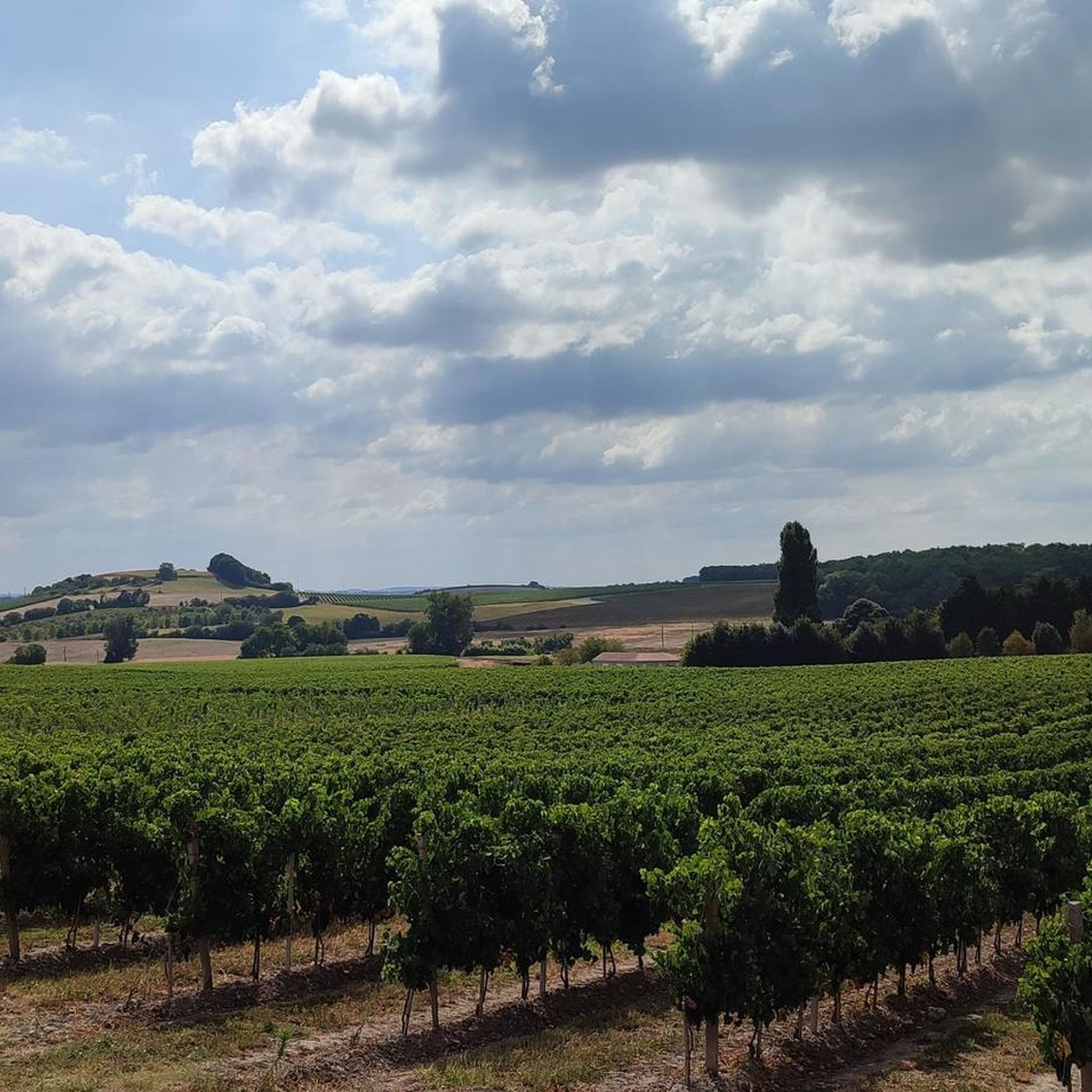
A nice place to take a break. There is a picnic bench and an orientation table. There are lovely views over the surrounding fields.
1
0

This dolmen has an unusual and imposing height of more than 2m high. The crowning table at the top would weigh 40 tons.
3
1

By “Radegondian place of worship”, we mean any place where Ste Radegonde is or was the object of a characterized cult – this place was only part of a sanctuary dedicated to another saint. In such a case, the presence of the one who is venerated there is materialized by an altar, a reliquary, a statue, a stained glass window, etc. Radegonde was a princess whose family was massacred by Clotaire 1st, son of Clovis who took her prisoner before forcibly marrying her, who against her will became queen of the Franks. As soon as she could, she hastened to flee her husband and enter the convent, thus renouncing her royal status. In Poitiers, she founded a monastery which took the name of Holy Cross when she received from the Byzantine emperor a relic of the True Cross. . She retained great authority until her death in 587 in the region, many churches of which are dedicated to her. Thanks to the cartulary of the abbey of Saint-Etienne, we know that the church already existed in the second half of the 11th century, because, between 1099 and 1107, the bishop of Saintes, Ramnulfe, made a donation to the abbey of Bathes in the church of Sainte-Radegonde following the abandonment by the secular lords of their rights over this church. In 1128, the new bishop of Saintes, Guillaume, came to confirm to the abbot Aimar the endowment of this church to the abbey. The Ste Radegonde church of Romanesque origin has been extensively altered over the centuries. This building probably dates from the 11th century. The engaged columns of the north wall are Romanesque while those of the south wall are distinctly Gothic and date from the 13th century. The Romanesque plan, a single nave extended by a flat chevet, was completed by a Gothic chapel to the south. It was above all the 19th century that left its mark on the monument: during these restoration projects, the neo-Romanesque and neo-Gothic styles born from the rediscovery of the Middle Ages were essential. This is the case for the Church of Ste Radegonde: in 1895, an imposing bell tower-porch replaced a simple pediment, bell tower-wall, where two bells were superimposed (it recalls the porch bell towers of neo-medieval churches St Martial and St Ausone d'Angoulême, built by Paul Abadie fils); another achievement of the 19th century, the Ste Radegonde stained glass window, whose workmanship is inspired by that of the stained glass windows of the Middle Ages (decorative borders, representations of the character under an architectural canopy, bright colors) hence its classification "Radegondian place of worship"
0
0

Periods of construction: 11th century, 12th century
0
0
The church depended on the priory of Barbezieux. The plan of the building is in the shape of a cross, with a flat apse. The nave includes two first bays from the 15th century, deviated on the axis of the rest of the building, with ribbed vaults and girders. A narrower bay is covered with ribbed vaults resting on Romanesque columns. The current transept and choir are covered with ribbed vaults resting on 13th century small columns with foliated capitals. The choir vault bears the date of 1682. The portal of the western facade dates from the 15th century and has pinnacles, prismatic moldings and kale. Square bell tower with twin trefoil windows.
1
0

I love this church because it exudes calm. She dominates the primary school with her handful of students. Something sweet, simple comes out of this church. She's not the prettiest, it's true, but nestled in the heart of the village of Bonneuil, she reminds us how much we have to take care of our villages so that schools remain open and children continue to learn and learn. play under the gaze of these ancient churches.
0
0
Frequently Asked Questions
What historical sites can I explore around Barret?
The Barret area is rich in history. A prominent site is the Dolmen of Saint-Fort, an ancient megalithic structure notable for its unusual height and massive crowning table. You can also visit several historic churches, which often have origins dating back centuries.
Are there any notable religious buildings to visit in the Barret area?
Yes, the region features several significant religious buildings. The Saint-Bonnet Church of Saint-Bonnet is a cross-shaped building with a 15th-century portal and a square bell tower. Another is the Saint-Pierre Church of Bonneuil, which offers a serene atmosphere. Additionally, the Notre-Dame Church in Sainte-Radegonde, with its Romanesque origins and 19th-century alterations, is also worth seeing.
Where can I find scenic viewpoints around Barret?
For panoramic views of the surrounding landscape, visit the Rest area with view and picture board. It provides a pleasant spot to take a break, with a picnic bench and an orientation table offering lovely vistas over the fields.
What do visitors enjoy most about the attractions in Barret?
Visitors particularly appreciate the historical depth and the peaceful atmosphere of the sites. For instance, the Saint-Pierre Church of Bonneuil is noted for its calm, simple charm. The Dolmen of Saint-Fort impresses with its imposing size and ancient mystery.
Are there family-friendly attractions around Barret?
Yes, the Dolmen of Saint-Fort is considered a family-friendly historical site. Its impressive size and ancient history can be an engaging experience for all ages.
What outdoor activities can I do near Barret?
The Barret area offers various outdoor activities. You can find numerous routes for mountain biking, road cycling, and running. For mountain biking, explore trails like the 'Château de Montchaude loop from Guimps'. Road cyclists can enjoy routes such as the 'Montchaude Church – Château de Montchaude loop from Barbezieux-Saint-Hilaire'. Runners have options like the 'Saint-Médard Church loop from Barbezieux-Saint-Hilaire'. You can find more details on these activities in the dedicated guides for MTB Trails around Barret, Road Cycling Routes around Barret, and Running Trails around Barret.
Are there mountain biking trails near Barret?
Yes, there are several mountain biking trails available. Popular options include the 'Château de Montchaude loop from Guimps' (36.6 km, moderate) and the 'La voie verte – Magnificent passage through nature loop from Barbezieux-Saint-Hilaire' (34.8 km, easy). For more routes, check the MTB Trails around Barret guide.
Can I find road cycling routes in the Barret region?
Absolutely. Road cyclists can enjoy routes such as the 'Montchaude Church – Château de Montchaude loop from Barbezieux-Saint-Hilaire' (61.1 km, moderate) or the 'Château de Barbezieux loop from Barret' (48.8 km, moderate). Discover more options in the Road Cycling Routes around Barret guide.
Are there running trails available near Barret attractions?
Yes, you can find running trails in the vicinity. Examples include the 'Saint-Médard Church loop from Barbezieux-Saint-Hilaire' (9.9 km, moderate) and the 'Château de Barbezieux loop from Barbezieux-Saint-Hilaire' (10.3 km, moderate). For a comprehensive list, refer to the Running Trails around Barret guide.
How long should I plan for visiting the attractions around Barret?
The time needed varies by attraction. For sites like the Dolmen of Saint-Fort or the various churches, you might spend 30 minutes to an hour at each. If you plan to combine several historical sites with a scenic viewpoint or an outdoor activity, a half-day to a full day would allow for a more relaxed exploration.
What kind of natural features can I see in the Barret area?
While the region is primarily known for its historical and religious sites, you can appreciate the natural landscape from places like the Rest area with view and picture board, which offers views over rolling fields. The setting of the Dolmen of Saint-Fort, situated on a ledge, also provides a connection to the natural environment.
Are there any hidden gems or less-known spots worth visiting near Barret?
Beyond the main highlights, exploring the smaller villages around Barret often reveals charming, less-frequented churches like the Saint-Pierre Church of Bonneuil, which offers a quiet and authentic experience away from larger crowds. These local spots provide a deeper sense of the region's heritage.

Get inspired with the komoot mobile app


Explore more
Still not found the Highlight you’re looking for? See guides of the top attractions in other regions:
