Attractions and Places To See around La Planche - Top 20
Best attractions and places to see around La Planche, a rural commune in the Loire-Atlantique department of western France, offers a tranquil setting approximately 25 km south of Nantes. The area is characterized by its rural landscape and proximity to various cultural sites and natural features. Visitors can explore a mix of historical landmarks, unique viewpoints, and recreational areas. The region provides opportunities to discover local heritage and enjoy outdoor activities.
Best attractions and places to see around La Planche
…Last updated: July 6, 2026
Picture frame by Emmanuel Ritz
Highlight • Viewpoint
Translated by Google •
Tip by

Reuzard mill and footbridge
Highlight • Viewpoint
Translated by Google •
Tip by

Sign up now to discover places like this
Get recommendations on the best single tracks, peaks, & plenty of other exciting outdoor places.
Sign up for free
The Old Bridge of Rocheservière
Highlight • Bridge
Translated by Google •
Tip by

Montaigu Castle
Highlight • Viewpoint
Translated by Google •
Tip by
Pont Caffino Leisure Centre
Highlight • Other
Translated by Google •
Tip by
Sign up for free to discover even more attractions around La Planche.
Sign up for free
Already have an account?
Start today with a free account
Your next adventure awaits.
Login or Signup



Tips from the Community

. Originally, there was an ovoid-shaped enclosure flanked by about ten towers and a gatehouse, located to the northeast. The fortified town was located to the north of the fortress and extended a little to the east. A dry moat separated the fortified town from the fortress. A barbican protected the gatehouse. A Romanesque keep of the Niort type, with its courtyard and small enclosure, was located in the castle courtyard, roughly in the middle in the north-south direction and located to the west. The fortified city extended from the rue de Gaulle, a gate was located at the level of the Carré de l'Europe (the porte de Nantes), then the ramparts continued along the rue de la Place du Champ de Foire, then went back down the Esplanade des Olivettes, where a gate was located towards the roundabout of the rue des Jardins (porte de Tiffauges) then the ramparts ran along the Asson to go up the rue du Pont Jarlet and around the barbican not far from the Presbytery The dry moats surrounding the city were 16 meters deep in the 15th century, today they are flowered and are the subject of different colored squares decorating this part of the ramparts.
0
0
In the 9th century, a castrum, a wooden castle built on a mound of earth, was built to counter the Viking raids that had previously sacked the city of Durivum (Saint-Georges-de-Montaigu). For strategic reasons, this fortress was built on a rocky spur at the junction between the Maine and Asson rivers. Maurice I of Montaigu, the first known lord, witnessed the consecration of the church of Saint-Nicolas de la Chaize-le-Vicomte in 1099. His successor until 1174 was Brient I of Commequiers, married to his daughter, Agathe de Montaigu. Later, his grandchildren, Brient II, Maurice II "the Younger," and Marguerite, succeeded him. It was perhaps this Brient II who had the Romanesque keep built in 1218, a large square tower with flat corner towers. He also removed the wooden palisade, replacing it with a wide moat extending to the Saint-Georges Gate. The Montagues (also known as Belleville by marriage around 1180) pledged allegiance to the Plantagenets, Henry II, Richard the Lionheart, and John Lackland. Margaret of Belleville-Montaigu, daughter of Brient de Montaigu and Agnes de Belleville, granddaughter of Maurice I de Montaigu, sister of Maurice II de Belleville-Montaigu, married Hugh of Thouars in 1203. In 1227, the couple submitted to Philip Augustus through the ceremony of homage. Hugh of Thouars died in 1229, and Margaret remarried in 1235 to the Duke of Brittany, Mauclerc, whose real name was Pierre de Dreux. Marguerite de Montaigu died in 1241, childless. The lordship of Montaigu fell to her nephew, Maurice III de Belleville-Montaigu (d. c. 1297; son of Maurice II). He became lord of Montaigu upon the death of Mauclerc in 1250[2], and his son Maurice IV (d. c. 1292) ensured the succession through his children Jeanne (d. 1284 Geoffroy II David de La Flocellière) and Maurice V de Belleville-Montaigu (he married 1° Sibylle, daughter of Geoffroy VI de Châteaubriant, then 2° Isabelle/Létice de Parthenay, daughter of Guillaume V Larchevêque de Parthenay). Jeanne de Belleville (c. 1300-c. 1359), daughter of Maurice V of Montaigu and Létice of Parthenay, married Olivier IV of Clisson for the second time in 1328. Olivier IV was executed by beheading after being suspected of "felony" against the English, during the Hundred Years' War. Jeanne became a privateer with her children Olivier V and Jeanne de Clisson, in revenge, and was banished from the kingdom of France. While she attacked French ships, the fortress of Montaigu was held by the English, according to the Treaty of Brétigny-Calais, a garrison of which engaged in pillaging the surrounding area. Jeanne lost her ship and withdrew with her children to England. Olivier V, having grown up, rallied to the king of France, recovered his property in 1362 and fought the English with Bertrand du Guesclin. In 1373, Olivier and Bertrand succeeded in driving the English out of Montaigu, and Olivier ceded the lordship to his sister Jeanne, who had married an English captain, Jean Harpedenne. The latter sided with the King of France in 1373 and became Jean de Belleville. His grandson, Jean III, married Charles VII's half-sister, Marguerite de Valois, in 1433. Louis I de Belleville succeeded Jean III. King Louis XI advised him to fortify the town between 1464 and 1468 to protect it from the Bretons.
0
0

An absolutely beautiful site, but difficult to access by bike. You can cross, but the footbridge is too narrow (for my bike anyway) and you have to push the bike vertically. Obviously impossible with panniers.
1
0

In the past, the Maine was crossed using beams fixed to the rock. The 17th century Reuzard mill with its metal footbridge attests to the intense milling activity that reigned on the river at the time. The current footbridge, which dates from 1911, was renovated in 1977 and allows hikers to access from one bank to the other.
1
0

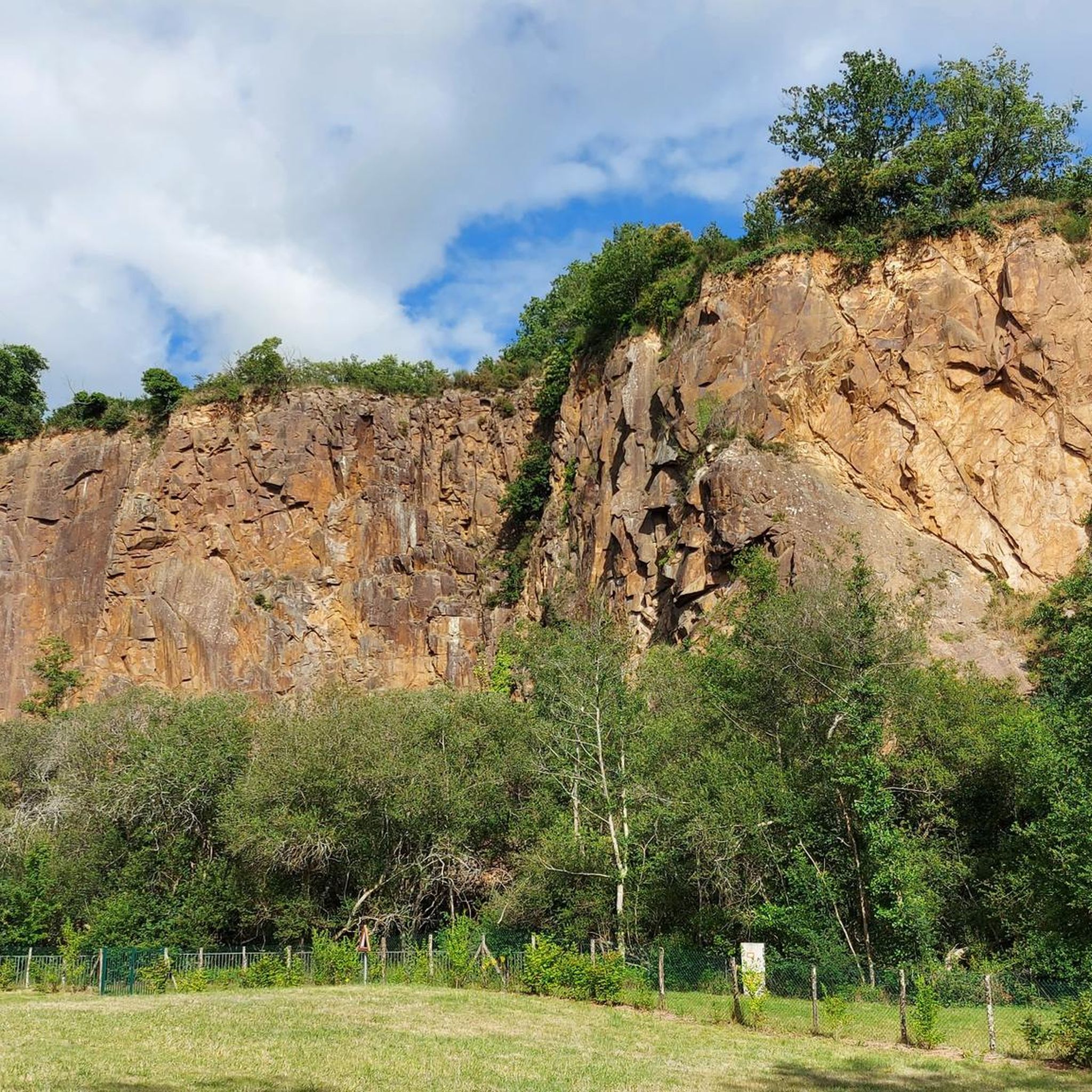
A viewpoint as astonishing as it is impressive stands out from the cliff 30 meters above the Pont Caffino leisure center. Put your feet on the ground to discover the magnificent panorama of the vineyards and the Maine valley.
1
0

After admiring the multicultural site of Pont Caffino, go back to the village of Château-Thébaud to contemplate the aerial view of this site from the magnificent belvedere
1
0

Nice bridge, kayak base underneath.
0
0

The view is worth it, you still need to have a little leg to get there
0
0
Frequently Asked Questions
What historical sites can I explore near La Planche?
The region around La Planche is rich in history. You can visit The Old Bridge of Rocheservière, a beautifully renovated bridge with Roman and Gothic arches, notable for its role in the Vendée insurrection. Another significant site is Montaigu Castle, a fortified spur from the 9th century that played a strategic role against Viking invasions and later conflicts. Further afield, you can explore Clisson Castle or the impressive Château des Ducs de Bretagne in Nantes.
Are there any unique viewpoints or natural features to discover?
Yes, for breathtaking views, head to the Picture frame by Emmanuel Ritz. This belvedere extends over the void, offering an exceptional panorama of the Pont Caffino valley. Another scenic spot is the Reuzard mill and footbridge, which provides beautiful views of the Maine river and its surroundings, though it can be challenging to access by bike.
What kind of outdoor activities are available near La Planche?
The area offers a variety of outdoor activities. The Pont Caffino Leisure Centre is a fantastic spot for climbing, tree climbing, zip lines, and various water sports like canoeing and kayaking. You can also find numerous hiking, cycling, and gravel biking routes. For hiking, explore options like the 'Moulin des Épinettes – Reuzard mill and footbridge loop' or the 'Viewing Gate – Picture frame by Emmanuel Ritz loop'. For more details on routes, visit the Hiking around La Planche guide.
Are there family-friendly attractions in the La Planche area?
Absolutely! The Pont Caffino Leisure Centre is ideal for families, offering activities like tree climbing, zip lines, and a children's play area. Both The Old Bridge of Rocheservière and Montaigu Castle are also marked as family-friendly historical sites. A short drive to Nantes will bring you to Les Machines de l'île, a highly-rated, family-friendly attraction known for its extraordinary mechanical creatures.
What cultural experiences can I find in and around La Planche?
In La Planche itself, you can visit the Musée de la chanson française, dedicated to preserving the legacy of French song artists. The commune also hosts a memorial for the 1973 Nantes Mid-Air Collision. For a unique entertainment experience, consider 'Le Sanatorium Hermann', an escape game with actors located in nearby Montbert. Nantes, a short distance away, offers major cultural landmarks like the Château des Ducs de Bretagne and the architecturally significant Passage Pommeraye.
What do visitors enjoy most about the attractions near La Planche?
Visitors particularly appreciate the unique experiences offered, such as the exhilarating panorama from the Picture frame by Emmanuel Ritz. The historical significance and recent renovation of The Old Bridge of Rocheservière are also highly valued. Many enjoy the diverse activities available at the Pont Caffino Leisure Centre, from climbing to water sports, set within a beautiful natural landscape.
Are there opportunities for cycling or gravel biking near La Planche?
Yes, the rural landscape around La Planche is well-suited for cycling and gravel biking. There are numerous routes available, such as the 'Saint-Colomban Wooden Bridge – Chemin de Notre-Dame loop' for touring bicycles or the 'Montaigu Castle – The Rousselin mill loop' for gravel biking. You can find detailed routes and guides for these activities by visiting the Cycling around La Planche and Gravel biking around La Planche pages.
Where can I find green spaces or parks for relaxation?
While La Planche itself is rural, providing a tranquil setting, nearby Nantes features a well-regarded Botanical Garden, offering a green oasis. Another option is Park Rochettes in Montaigu-Vendee. For a more immersive natural experience, Camping du Lac de la Chausselière, about 25 minutes away, provides access to a lake and outdoor activities in a rejuvenating setting.
What is the best way to experience the Pont Caffino valley?
The Pont Caffino valley, often described as resembling a small canyon, is best experienced through its various activities. You can engage in climbing, tree climbing, zip lines, or water sports at the Pont Caffino Leisure Centre. Additionally, hiking trails in the area offer stunning views, including the impressive belvedere of the Picture frame by Emmanuel Ritz, which provides a unique perspective over the valley.
Can I find easy walking routes suitable for beginners near La Planche?
Yes, there are routes suitable for various fitness levels. For an easier walk, consider the 'Lake of the Valleys loop from Vieillevigne', which is approximately 4.7 km long and rated as easy. Many of the paths around the rural areas offer gentle terrain for leisurely strolls. Check the Hiking around La Planche guide for more options and difficulty ratings.
What is the significance of the Montaigu Castle?
Montaigu Castle is a historically significant site, with its rocky spur fortified as early as the 9th century to defend against Viking invasions. Later, in the 15th century, it protected the medieval town from the Bretons. The remains visible today, including ramparts and a Romanesque keep, offer a glimpse into its past importance. It was also involved in the Hundred Years' War and the Vendée insurrection.
Most popular routes around La Planche
Most popular attractions around La Planche

Get inspired with the komoot mobile app


Explore more
Still not found the Highlight you’re looking for? See guides of the top attractions in other regions:
