Attractions and Places To See around Saint-Étienne-De-Tulmont - Top 10
Best attractions and places to see around Saint-Étienne-De-Tulmont include its rural landscape and historical roots. This commune is situated in the alluvial plain bordering the Aveyron river, characterized by several small streams. While Saint-Étienne-De-Tulmont offers a quiet, rural experience, it provides convenient access to the historical and cultural sites of nearby Montauban and Nègrepelisse. The region is also popular for outdoor activities such as hiking and cycling.
Best attractions and places to see around Saint-Étienne-De-Tulmont
- The most popular attractions is…
Last updated: May 17, 2026
Montauban
Highlight • Settlement
Translated by Google •
Tip by

The Four Hundred Cannon Shots of Montauban
Highlight • Historical Site
Translated by Google •
Tip by

Sign up now to discover places like this
Get recommendations on the best single tracks, peaks, & plenty of other exciting outdoor places.
Sign up for free
Old Bridge
Highlight • Other
Translated by Google •
Tip by

Saint-Pierre Church of Nègrepelisse
Highlight • Religious Site
Translated by Google •
Tip by

Place Nationale
Highlight • Other
Translated by Google •
Tip by

Sign up for free to discover even more attractions around Saint-Étienne-De-Tulmont.
Sign up for free
Already have an account?
Start today with a free account
Your next adventure awaits.
Login or Signup


Tips from the Community


At the beginning of the 17th century, after the assassination of Henri IV (1610), the France of Louis XIII launched an attack on the republic of parpaillots. The Edict of Nantes (1598) allowed them to obtain a certain number of freedoms such as the practice of religion but also political advantages: places of security, assemblies, deputies representing the Protestant party at court. Supported by his mother Marie de Medici, the young Louis XIII did not intend to maintain this situation which defied the royal authority which, for its part, could only be Catholic. Tensions between the two religious communities were now such that the royal army mobilized to face Huguenot resistance. Protestant strongholds which deny the religion of the King of France are systematically besieged. Refractory to this authority, Montauban must therefore suffer the wrath of the canons of the Catholic King. At that time, Montauban was a place of safety like La Rochelle. The Quercy stronghold was then called Little French Geneva. Entirely Huguenot, its population of approximately 15,000 inhabitants includes 10,000 Calvinists. The management of the city is in the hands of consuls (elected by 25 inhabitants representing all the city's corporations) who enjoy great autonomy. Since 1600, there has been a college and an academy there which recruit students from all the provinces of the kingdom and abroad. It is for all these reasons that Montauban-la-Protestante gives the image of a true Huguenot republic where Catholics no longer have the right to live. Louis XIII, after subduing Agen, decided on August 10, 1621 to put an end to the Montalbanese revolt. On August 17, the king moved to the castle of Montbeton and began the siege. The latter only stopped four months later with the victory of the Montalbanais. Effective resistance to modify It is a fact that the Montalbanais were able to resist thanks to a small number of men against the plethoric royal army. It is also true that the city's first Consul, Jacques Dupuy (1591-1621) had taken care to prepare the city for the siege by building up large reserves of food. Throughout the siege, the Montalbanais did not suffer from hunger at any time. The royal army suffered dramatic losses. Louis XIII would have called on an Aragonese Discalced Carmelite, a very well-known alchemist. He would have meditated for a long time before giving the following recommendation to the King: “we must scare the inhabitants of the city. A great fear that will make them surrender.” The cannonade was mentioned by Marshal de Bassompierre in his Memoirs where he wrote that the king, incited by the Discalced Carmelite to bombard the city with 400 cannon shots, “sent for me on Sunday September 20 to fire the 400 cannon fire; as I did.” There were more than 650 shots that day, according to another witness... The expression "400 shots" recalls the violence of the cannonades, but these 400 shots could not be fired at the same time as legend has it. In total, there have been nearly 16,000 shots in two and a half months. In vain… Let us add for the sake of understanding, that until then the cannonades were mainly aimed at the ramparts to create breaches... The Carmelite's idea was to fire 400 shots into the city, to frighten the population, which was actually without effect. Decimated by purple fever, a serious epidemic which caused bright red spots on the body, Louis XIII's army capitulated at the beginning of November and the king lifted the siege.
1
0

This charming town takes its name from the lumberjacks who made charcoal and sold it to the locals. Their fur coats were blackened with dust. With 1,000 years of history, this pretty fortified town is worth a visit, especially for its castle. It has all the necessary shops, and the town's campsite is "Accueil Vélo" (Bicycle Welcome) and offers charging points for those with electric bikes.
1
0

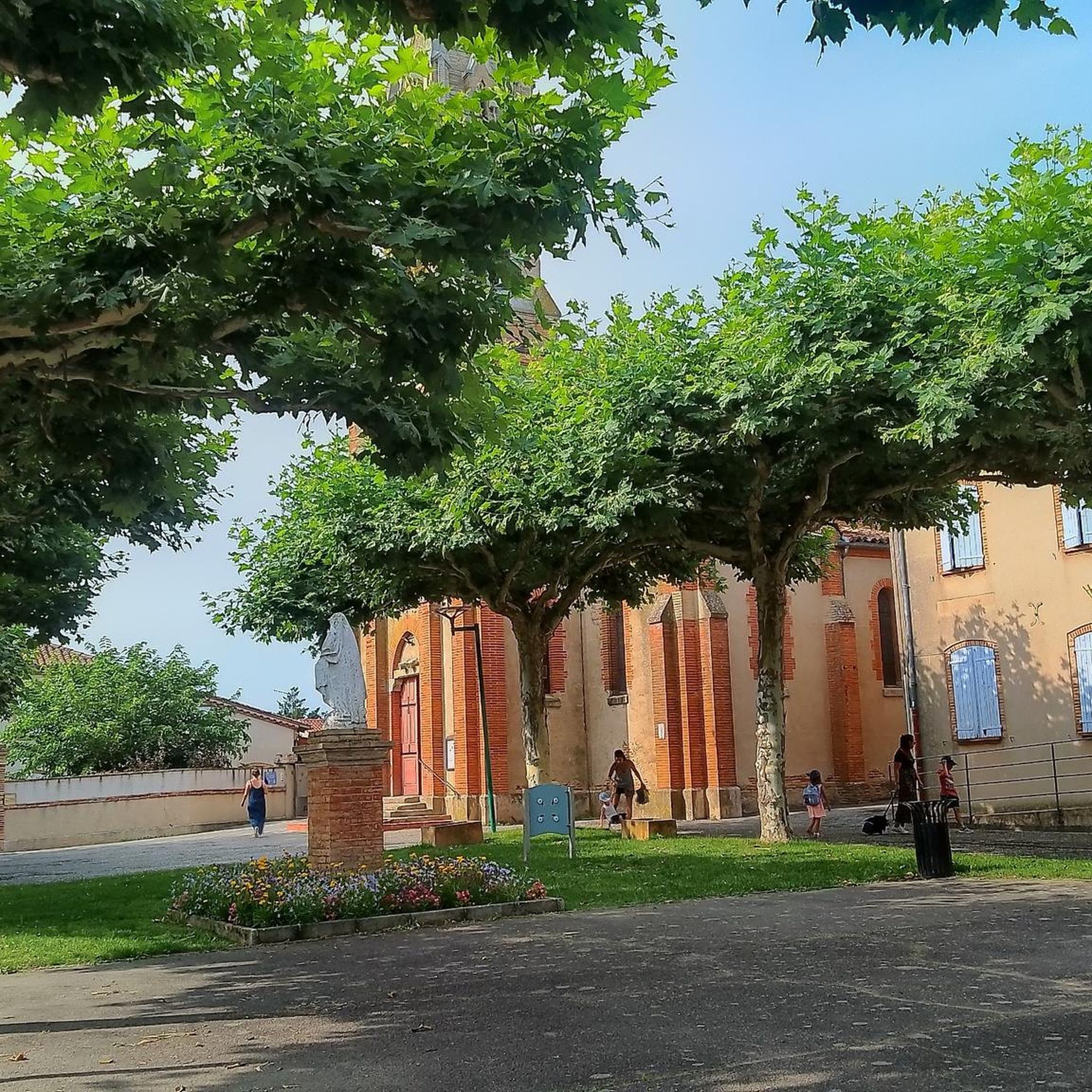
Church of Negrepelisse with special tower
0
0

The bridge was protected as a historic monument in 1911. In 2005, after the declassification of the former N11, the bridge became the property of the Communauté d'agglomération du Grand Montauban. The restoration of the bridge started in 2020.
1
0
The bridge has 14 arches, of which 7 arches span the 205 meter wide riverbed itself. The heavy bridge pillars are reinforced at the bottom and have an opening at the top to better withstand the pressure of the water.
1
0
The Pont Vieux (French for 'old bridge') is a 14th-century bridge over the Tarn in the center of the French city of Montauban (Tarn-et-Garonne).
1
0
Frequently Asked Questions
What historical sites can I explore near Saint-Étienne-de-Tulmont?
The region offers a rich historical experience, primarily centered around nearby Montauban and Nègrepelisse. In Montauban, you can visit Montauban itself, known for its distinctive orange brick architecture, the 14th-century Old Bridge, and the historic Place Nationale. Nègrepelisse, a charming fortified town, is home to the significant Saint-Pierre Church of Nègrepelisse.
What is the historical significance of Saint-Étienne-de-Tulmont itself?
Saint-Étienne-de-Tulmont has a history dating back to the 13th century, originating from the 'Forêt de Tulmont'. Its local heritage is symbolized by its coat of arms, depicting Saint Stephen. While a smaller community, the commune also features a notable former train station (L'ancienne gare) as a point of interest.
What natural features characterize the landscape around Saint-Étienne-de-Tulmont?
The commune is situated in the alluvial plain bordering the Aveyron river. The area is characterized by several small streams, including the Brive, l'Angle, and la Tauge, contributing to its rural and picturesque landscape. Historically, the region was known as the 'Forest of Tulmont'.
What outdoor activities are popular near Saint-Étienne-de-Tulmont?
The region around Saint-Étienne-de-Tulmont is popular for various outdoor activities. You can find numerous routes for hiking, cycling, and mountain biking. For detailed routes, explore the Cycling around Saint-Étienne-De-Tulmont, MTB Trails around Saint-Étienne-De-Tulmont, and Running Trails around Saint-Étienne-De-Tulmont guides.
Are there specific hiking trails I can explore near Saint-Étienne-de-Tulmont?
Yes, the area offers various hiking opportunities. While specific named trails within Saint-Étienne-de-Tulmont itself are not detailed, you can find numerous routes for exploring the surrounding landscapes. Check the Running Trails around Saint-Étienne-De-Tulmont guide for routes that are also suitable for walking.
Can I go cycling around Saint-Étienne-de-Tulmont?
Absolutely! The region is well-suited for cycling, with routes for both road and mountain biking. You can find a variety of tours, such as the 'Lake Tordre loop from Saint-Étienne-de-Tulmont' for mountain biking or the 'Moulin de Bellerive – Château de Bioule loop from Saint-Étienne-de-Tulmont' for touring. Discover more options in the Cycling around Saint-Étienne-De-Tulmont and MTB Trails around Saint-Étienne-De-Tulmont guides.
Are there family-friendly attractions in the region?
Yes, the nearby city of Montauban offers family-friendly options, such as the Musée des Jouets (Toy Museum), a 700 m² museum popular with both children and adults. Additionally, the numerous easy outdoor routes for cycling and walking provide opportunities for families to enjoy nature together.
When is the best time to visit Saint-Étienne-de-Tulmont for outdoor activities?
The Occitanie region generally enjoys pleasant weather for outdoor activities for much of the year. Spring and autumn offer mild temperatures ideal for hiking and cycling. Summer can be warm, perfect for enjoying the natural features and nearby river areas, while winter activities are less prominent but still allow for exploring the rural landscape.
What do visitors particularly enjoy about the attractions near Saint-Étienne-de-Tulmont?
Visitors appreciate the blend of quiet rural charm in Saint-Étienne-de-Tulmont with convenient access to the richer historical and cultural sites of its surroundings. Montauban's distinctive orange brick architecture, the beauty of Place Nationale, and the historical significance of Nègrepelisse are frequently highlighted. The komoot community has shared 37 photos and given 73 upvotes to the attractions in the area, indicating a positive visitor experience.
Is there a local point of contact for visitors in Saint-Étienne-de-Tulmont?
Yes, the Centre Accueil et Tourisme des Vallées et Terrasses de L'Aveyron serves as a local point of contact for visitors within Saint-Étienne-de-Tulmont, providing information and assistance for exploring the area.
What is Montauban known for?
Montauban, a short drive from Saint-Étienne-de-Tulmont, is designated a 'Grand Site d'Occitanie' and a 'City of Art and History'. It is famous for its distinctive orange brick architecture, the historic Pont Vieux spanning the Tarn River, and the beautiful Place Nationale. The city also hosts the Musée Ingres Bourdelle and the Musée des Jouets.
Are there any notable religious buildings in the area?
Yes, the Saint-Pierre Church of Nègrepelisse is a significant religious site located in the charming fortified town of Nègrepelisse, which has a thousand-year history.
Most popular routes around Saint-Étienne-De-Tulmont

Get inspired with the komoot mobile app


Explore more
Still not found the Highlight you’re looking for? See guides of the top attractions in other regions:
