The 20 Most Amazing Peaks around La Roca Del Vallès
Best mountain peaks around La Roca Del Vallès are characterized by unique rock formations and elevated hiking opportunities within natural parks. The region offers a blend of natural landscapes and historical sites. Visitors can explore areas like the Bosque Mágico of Òrrius, known for its sculpted rocks, and significant megalithic monuments such as Roca d'en Toni. These locations provide diverse experiences for those seeking to explore the natural and cultural heritage of the area.
Best mountain peaks around La Roca…
Last updated: July 12, 2026
Corredor Sanctuary
Highlight • Religious Site
Translated by Google •
Tip by

La Torrassa del Moro
Highlight • Monument
Open on Saturdays, Sundays and public holidays …
Translated by Google •
Tip by

Sign up now to discover places like this
Get recommendations on the best single tracks, peaks, & plenty of other exciting outdoor places.
Sign up for free
Montalt
Highlight • Summit
Montalt is a mountain that belongs to the Catalan coastal range, within the Corredor mountain range and the …
Translated by Google •
Tip by

Creu de Montcabrer Summit
Highlight • Summit
Sea and Cabrils.
Translated by Google •
Tip by

Fire lookout tower on Turó d'en Galceran
Highlight • Viewpoint
Translated by Google •
Tip by

Sign up for free to discover even more peaks around La Roca Del Vallès.
Sign up for free
Already have an account?
Start today with a free account
Your next adventure awaits.
Login or Signup

Tips from the Community

En Salvi Arenes i en Bosch, pagesos i propietaris dels boscos del Corredor, van promoure al 1523 la construcció d’una petita capella, dedicada a la Mare de Déu dels Socors, tot interpretant uns suggeridors senyals celestials. Se’n feu càrrec l’ermità Bernat Penitència. Al 1583, el frare Lleonard Claus va construir l’actual temple, d’estil gòtic tardà. S’hi celebren tres aplecs a l’any: dilluns de Pasqua (general), sant Marc (gent de Dosrius) i primer de maig (vot de poble de Canyamars). Font: XPN
0
0

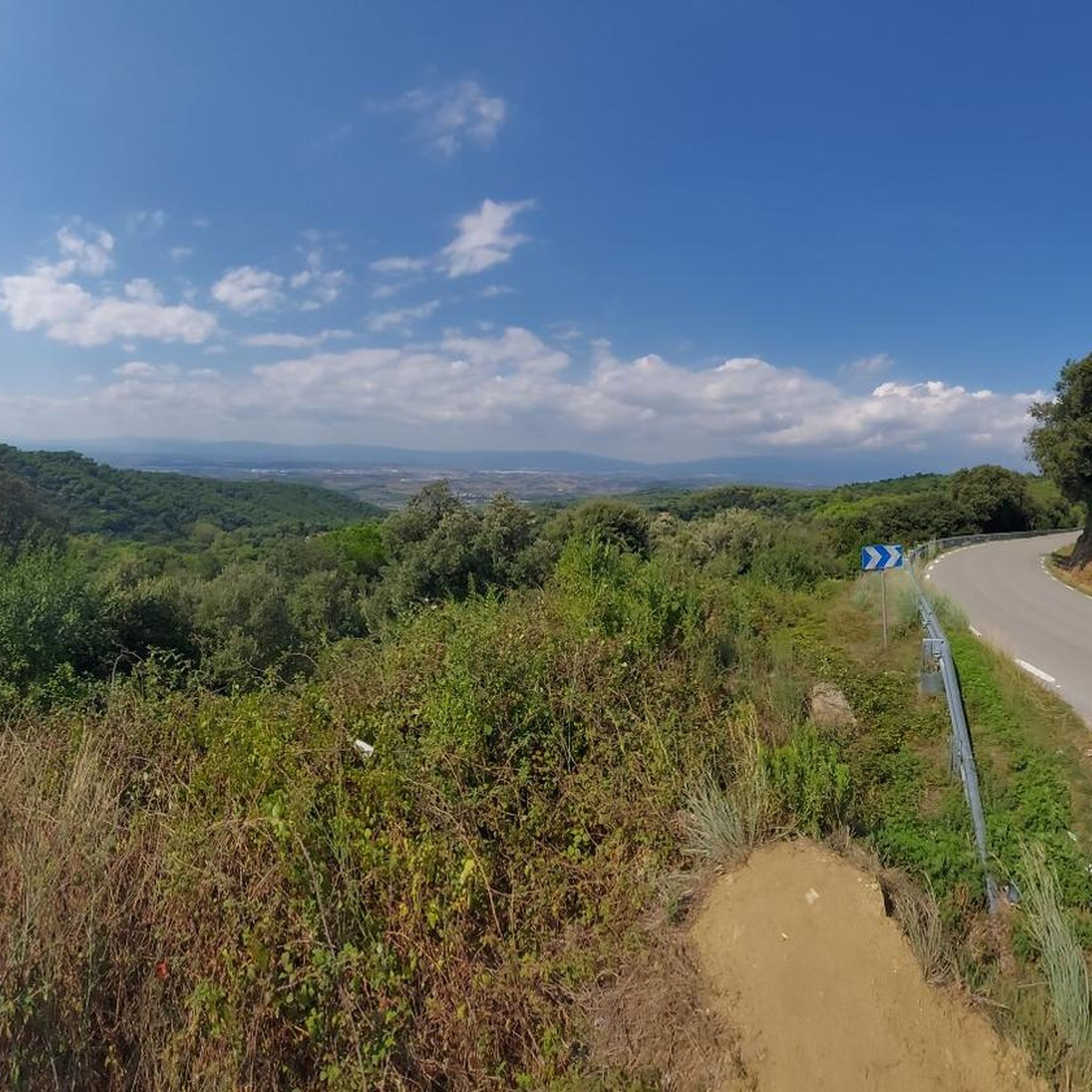
The Creu de Montcabrer crowns one of the most emblematic points of the Serralada Litoral. The current cross, placed in 1982 and blessed in 1983, is the last in a long tradition dating back to 1565. Over the centuries, it has been replaced several times due to lightning, vandalism, and even bullet impacts during the Civil War. In addition to its unique history, this place is wonderful for the spectacular views it offers: from Montseny to Barcelona, passing through the Castell de Burriac and reaching Blanes on clear days. It's ideal for stopping, breathing, and contemplating the landscape. 🚴 WARNING: Do not attempt to ride down the path that leads to the caves located just below the cross. It is not suitable for cycling and can be dangerous. It is recommended to return along the same path you came in.
3
0

Fire watchtower on the summit. You can't climb the tower - but the view from up here is still magnificent.
3
0

La Creu de Montcabrer (311 meters) is a viewpoint with spectacular views of the sea and mountains. The iron cross that presides over it has a long history of legends related to the towns of Cabrera de Sea and Cabrils.
1
0
From the same hill and in a southerly direction (toward the sea) descends a rocky ridge. There are three caves where various archaeological remains have been found. Looking out to sea from the cross, on the left side and near the summit, there is the Cova dels Tres Cercles. On the right side and at mid-height, the Cau de les Formigues. In the center and at the bottom of the ridge, the Cave of the Good Women. Access to all of them is not easy, as you need to have a minimum of climbing skills and also wear suitable walking shoes.
3
0
Popular belief gives Montcabrer a range of peculiar characteristics such as, for example, that the rocks are magnetized or that smoke has been seen coming out of the stones because there is a volcano below. A legend says that, on an ugly winter day, a goatherd from the Pyrenees who lived in Cabrils died there. The goatherd was well known and loved for his ability to cure illnesses using mountain herbs, and this is where the name Montcabrer comes from.
3
0
On the small esplanade at the top there is a cross: the Santa Creu de Cabrils. The existence of a cross is already recorded in 1565 in a property document that mentions it as a threshold. Later on, we again find information about a cross that was planted in June 1707, in a solemn procession, to appease the rains that were damaging the crops. It was made of teak wood and was 20 spans. Inside was a glass tube with the vicar general's license and some fragments of the relics of the Holy Martyrs of Vilassar de Dalt. In July 1726, during an afternoon summer storm, a bolt of lightning tore it to pieces and scattered the bones of the saints.
4
0
The Sanctuary has its origins in the 16th century and is in the late Gothic style. Since 1984 it has been run by the Auladell Perarnau family. Our location, very close to the top of the Corredor mountain range, allows us to enjoy an excellent landscape.
6
0
Frequently Asked Questions
What are some unique natural and historical sites to explore near La Roca Del Vallès?
Near La Roca Del Vallès, you can discover a blend of natural wonders and historical sites. The Bosque Mágico (Magic Forest) of Òrrius offers an enchanting experience with its mysteriously sculpted rocks resembling figures like an 'Indian' or an 'elephant'. For history enthusiasts, Roca d'en Toni (Dolmen de Can Boquet) is a significant Neolithic dolmen, providing insight into prehistoric communities. Additionally, the Corredor Sanctuary combines a religious building with a summit experience, and La Torrassa del Moro is a historical Roman-origin watchtower.
Which mountain peaks offer historical insights around La Roca Del Vallès?
Several elevated sites near La Roca Del Vallès are rich in history. The Roca d'en Toni (Dolmen de Can Boquet) is a prominent Neolithic dolmen, a collective burial chamber dating back to 2200-1800 BC. You can also visit La Torrassa del Moro, a cylindrical tower of Roman origin later used as a medieval watchtower. The Corredor Sanctuary, a late Gothic style religious building from the 16th century, is another significant historical point located near a summit.
Are there family-friendly hiking options among the peaks near La Roca Del Vallès?
Yes, the Bosque Mágico (Magic Forest) of Òrrius is particularly suitable for families. Its low-difficulty trails lead through a landscape of unique rock formations that spark imagination, making it feel like a fairy tale adventure for all ages. Many of the trails in the Parc de la Serralada Litoral, which encompasses some of these sites, also offer easy to moderate options.
Where can I find unique rock formations or natural sculptures near La Roca Del Vallès?
The Bosque Mágico (Magic Forest) of Òrrius is the primary place to find unique rock formations and natural sculptures. Located within the Ca l'Argent forest, it features rocks naturally sculpted into figures such as an 'Indian,' a 'Moai,' and an 'elephant.' The mysterious origin of these carvings adds to the allure of the forest.
What kind of views can I expect from the elevated points in the La Roca Del Vallès area?
From various elevated points, you can enjoy impressive panoramic views. For instance, the Fire lookout tower on Turó d'en Galceran offers stunning vistas of the surrounding regions. From Montalt, you can get magnificent views of the entire Maresme coast, stretching from Arenys de Mar to the Llobregat estuary, and Montseny to the north. The Creu de Montcabrer Summit also provides spectacular views of both the sea and mountains.
Can I find a recognized summit for experienced hikers near La Roca Del Vallès?
Yes, Montalt is a recognized summit that is part of the F.E.E.C.'s list of 100 peaks. While the peak itself is surrounded by forest, the ascent from Coll de la Ferradura involves a narrow path with a very steep slope, offering a more challenging experience for those seeking it. The summit houses a geodesic vertex and a mailbox.
Are there places to eat or find facilities near the mountain peaks?
Yes, some locations offer facilities. The Corredor Sanctuary has a restaurant with a grill and typical Catalan food, open on weekends and holidays, with options for indoor dining or a terrace. It also provides free parking and sanitary facilities. La Torrassa del Moro also offers bar service, sandwiches, and barbecue on Saturdays, Sundays, and public holidays.
What outdoor activities can I do near these mountain peaks?
The area around La Roca Del Vallès is excellent for various outdoor activities. You can find numerous hiking trails, such as the 'Prehistoric route through the Parco de la Serralada Litoral' or the 'Òrrius and Céllecs Prehistoric Trail'. For running enthusiasts, there are routes like the 'Dolmen de Céllecs – Pedra Foradada (Natural Arch) loop from la Roca del Vallès'. Cycling is also popular, with options like the 'Sant Salvador Church – Plaça de Sant Joan loop from Cardedeu'. You can explore more options in the Hiking around La Roca Del Vallès, Running Trails around La Roca Del Vallès, and Cycling around La Roca Del Vallès guides.
Are there specific hiking trails that focus on prehistoric sites?
Yes, the region offers dedicated prehistoric routes. The 'Prehistoric route through the Parco de la Serralada Litoral' and the 'Prehistoric route II: Dolmen of Can Planes and hermitage of Sant Bartomeu — circular from La Roca del Vellès' are excellent choices. These trails allow you to explore ancient sites like the Roca d'en Toni (Dolmen de Can Boquet) and other megalithic monuments, blending natural beauty with archaeological interest. You can find more details in the Hiking around La Roca Del Vallès guide.
What is the best time to visit the mountain peaks and natural areas near La Roca Del Vallès?
The region generally offers pleasant conditions for outdoor activities for much of the year. Spring and autumn are often ideal, with milder temperatures and lush landscapes. Summer can be warm, so early morning or late afternoon visits are recommended. Winter offers cooler, crisp air, though some higher or more exposed areas might require appropriate gear. The tranquil atmosphere of places like the Bosque Mágico can be enjoyed in most seasons.
Are there any trails suitable for beginners or easy walks?
Absolutely. The Bosque Mágico (Magic Forest) of Òrrius features low-difficulty trails perfect for easy walks and families. Additionally, the 'Iberian settlement and Cèllecs viewpoint — circular via the Ermita Sant Bartomeu de Cabanyes' and 'Canal del Mogent and Castillo de la Roca del Vallés via the Dolmen de Can Planes — circular from La Roca del Vellès' are listed as easy hiking routes in the Hiking around La Roca Del Vallès guide.
What do visitors enjoy most about the elevated areas around La Roca Del Vallès?
Visitors particularly appreciate the unique blend of nature, history, and tranquility. The mysterious rock formations of the Bosque Mágico captivate imaginations, while the ancient history of sites like Roca d'en Toni (Dolmen de Can Boquet) offers a journey back in time. The stunning views from various viewpoints, like Montalt and Turó d'en Galceran, are also highly praised. The opportunity to combine hiking with cultural exploration in a peaceful natural setting is a major draw.
Most popular routes around La Roca Del Vallès
Most popular attractions around La Roca Del Vallès

Get inspired with the komoot mobile app


Explore more
See even more amazing summits around La Roca Del Vallès with these guides:
