The best walks and hikes around Greaghnafine
4.0
(3)
53
hikers
1
hike
Hiking around Greaghnafine offers access to varied landscapes, including mountain trails and woodland paths. The region is characterized by the prominent Cuilcagh Mountain, known for its unique geological features and elevated terrain. Lower elevations feature established trails through forested areas, providing diverse hiking experiences.
Best hiking trails around Greaghnafine
- The most popular hiking route is Cuilcagh Mountain from Caran Road, a 8.1 miles (13.1 km) moderate trail that takes 3 hours 53 minutes to complete. This route ascends a…
Last updated: November 24, 2026
4.0
(3)
34
hikers
8.68km
02:22
130m
130m
13.1km
03:53
350m
350m
Moderate hike. Good fitness required. Easily walkable paths.

10
hikers
4.98km
01:18
30m
30m
Easy hike. Easily walkable paths.
3
hikers
3.69km
00:58
30m
30m
Easy hike. Easily walkable paths.
Our route recommendations are based on thousands of hikes, rides, and runs completed by other people on komoot.
Start today with a free account
Your next adventure awaits.
Popular around Greaghnafine

Tips from the Community

Great walk, very touristy but it's worth the detour! Be careful of the crowds (on weekends and in summer I dare not imagine!). However, BE CAREFUL, the summit is not accessible, you have to pass the protective barriers which allow the wild nature to be preserved from our steps and from this crowd of people. If we, the Komoot community, start to do this all the tourists will allow themselves and the landscape will never be so beautiful again! (Ps: no need to climb to the top to already see enough in the eyes!)
1
0

Cuilcagh Mountain sits right on the border between Ireland and Northern Ireland. From the top, you can enjoy magnificent views across the rolling hills of Ireland in all directions.
2
0
Beautiful thatched summer house situated in the Pleasure Gardens of Florence Court House.
1
0
Florence Court House is a magnificent 18th-century country estate situated in the foothills of Cuilcagh Mountain. The house is amongst a medley of lush green parkland and thick woodland with sights of the wonderful Benaughlin Mountain in the distance. The house is now owned by the National Trust and is open to explore daily. For more information regarding opening times and ticket prices visit https://www.nationaltrust.org.uk/visit/northern-ireland/florence-court
2
0
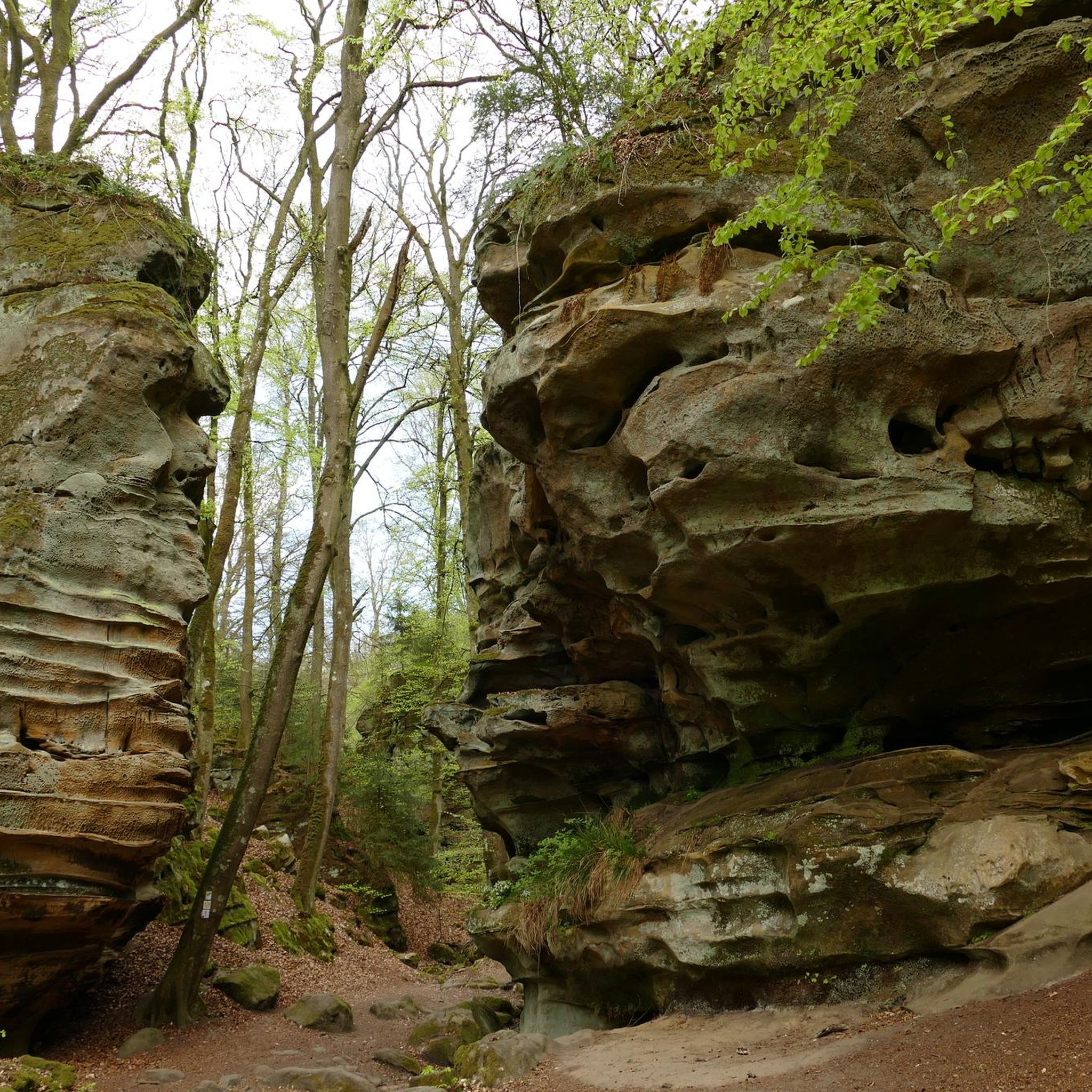
This is a fantastic viewpoint offering extensive vistas across endless forests, bogland, and the highs and lows of the valley. The views extends over Cuilcagh Mountain and toward Benaughlin and Upper Lough Erne.
2
0

Florence Court is a Georgian mansion nestled in the foothills of Cuilcagh Mountain and surrounded by picturesque countryside. The first house was built by John Cole in the early 18th century and named after his wife. The family lived in the house for over 250 years. The estate is now managed by the National Trust with over 10 miles of hiking and cycling trails. There is a also a water-powered sawmill and blacksmith's forge to gain an understanding of the areas industrial heritage. There is an Irish yew tree in the grounds, known as Florence Court Yew. This specimen is thought to be the ancestor of all Irish Yews worldwide as they have to be propagated from a cutting otherwise they revert to common yews. Due to their compactness and attractive columnar shape they are common in churchyards throughout the world.
1
0

Nestled in the foothills of Cuilcagh Mountain, Florence Court is a wonderful Georgian mansion surrounded by picturesque countryside. The first house was built by John Cole at the beginning of the 18th century and named after his wife, Florence. The Cole family lived in the house for over 250 years. Today, the estate is managed by the National Trust. There are over 10 miles (16 km) of hiking and bike trails to explore the grounds. You can visit a water-powered sawmill and blacksmith's forge that reveal the area's industrial heritage. There's also a beautiful Irish yew tree, Florence Court Yew, which is one of two original Irish Yew discovered in 1767. There is a small entrance fee to the gardens and forest.
2
1

The name Cuilcagh comes from the Irish Cuilceach, which has been translated as "chalky". However, the mountain is mainly sandstone and shale, covered with bog and heather. The cliff-edged summit surface of the mountain is formed from the hard-wearing Lackagh Sandstone which itself overlies the Briscloonagh Sandstone. "It is possible that the name refers to the limestone rock on the lower northern flanks, namely the Glencar and Dartry Limestone formations.[6] Here a number of streams disappear below ground at swallow holes named Cats Hole, Pollawaddy, Pollasumera and Polliniska, all forming part of the Marble Arch cave system. If so, the name would mean 'calcareous' rather than 'chalky'".[7] It has also been called Slieve Cuilcagh in English,[8] 'Slieve' being an anglicisation of Sliabh ("mountain"). In the 1609 Plantation of Ulster, Cuilcagh formed part of lands which were granted to John Sandford of Castle Doe by letters patent dated 7 July 1613 (Pat. 11 James I – LXXI – 38, Quilkagh).[9][10] It was later sold by Sandford to his wife's uncle Toby Caulfeild, 1st Baron Caulfeild, Master of the Ordnance and Caulfield had the sale confirmed by letters patent of 12 July 1620 (Pat. 19 James I. XI. 45, Quilkagh). (https://en.wikipedia.org/wiki/Cuilcagh)
4
0
Frequently Asked Questions
How many hiking trails are available around Greaghnafine?
There are 4 distinct hiking routes documented around Greaghnafine, offering a mix of easy and moderate options. These include trails through woodlands and mountain ascents.
What types of landscapes can I expect to see while hiking in Greaghnafine?
Hiking around Greaghnafine features varied landscapes, from the elevated terrain and unique geological features of Cuilcagh Mountain to established woodland paths and parkland trails, particularly around Florence Court.
Are there any easy hiking trails suitable for beginners or a relaxed walk?
Yes, for an easier experience, consider the Florence Court – Florence Court loop from Drumlaghy, which is 5.0 km (3.1 miles) long and takes about 1 hour 18 minutes. Another easy option is the Florence Court loop from Drumlaghy, at 3.7 km (2.3 miles).
What are some notable points of interest or attractions near the hiking routes?
Hikers can explore several interesting spots. The historic Florence Court estate offers beautiful grounds. You might also encounter Ballyconnel Lock 2, or enjoy views from the Thatched Summer House in Florence Court Pleasure Gardens. For those seeking a summit, Slieve Rushen is also nearby.
Are there any circular hiking routes in the Greaghnafine area?
Yes, there are circular options. The Florence Court – Florence Court loop from Drumlaghy is a 5.0 km (3.1 miles) loop, and the Florence Court loop from Drumlaghy is a shorter 3.7 km (2.3 miles) circular trail.
What is the most challenging hike available in Greaghnafine?
The most challenging hike listed is the Cuilcagh Mountain from Caran Road. This moderate 13.1 km (8.1 miles) route involves a significant ascent of 353 meters (1,158 feet) and typically takes around 3 hours 53 minutes to complete.
What do other hikers say about the trails in Greaghnafine?
The trails in Greaghnafine are highly regarded by the komoot community, with an average rating of 4.5 stars from 2 reviews. Hikers appreciate the varied terrain, from mountain ascents to tranquil woodland paths.
Is there a trail that offers expansive views?
Yes, the Cuilcagh Mountain from Caran Road route ascends a prominent mountain, providing expansive views of the surrounding landscape from its higher elevations.
Are there any trails that go through estate grounds or managed woodlands?
Absolutely. The Florence Court Red Trail, a moderate 8.7 km (5.4 miles) path, specifically winds through established woodlands and the historic Florence Court estate grounds.
What is the longest hiking route available in the area?
The longest hiking route is Cuilcagh Mountain from Caran Road, covering 13.1 km (8.1 miles).
What is the shortest hiking route in Greaghnafine?
The shortest hiking route is the Florence Court loop from Drumlaghy, which is 3.7 km (2.3 miles) long.
Most popular routes around Greaghnafine
Most popular attractions around Greaghnafine

Get inspired with the komoot mobile app


Explore more
Browse the best Hikes in other regions.
