Top 10 Castles around Schwelm
Best castles around Schwelm are found in North Rhine-Westphalia, Germany, a region known for its historical significance and varied landscapes. The town itself features notable historical structures, with additional significant ruins located in its surrounding area. This area offers a blend of cultural heritage and natural scenery, providing opportunities to explore historical sites. The presence of both well-preserved castles and ruins contributes to the region's historical character.
Best castles around Schwelm
- The most popular castles is Ruins of Volmarstein Castle…
Last updated: October 4, 2026
Ruins of Volmarstein Castle
Highlight • Castle
Translated by Google •
Tip by

Haus Martfeld
Highlight • Castle
Translated by Google •
Tip by

Sign up now to discover places like this
Get recommendations on the best single tracks, peaks, & plenty of other exciting outdoor places.
Half-timbered houses in Volmarstein
Highlight • Historical Site
You can still feel the old charm today!
Translated by Google •
Tip by

Haus Waldstein
Highlight • Historical Site
Translated by Google •
Tip by

Volmarstein War Memorials
Highlight • Monument
Translated by Google •
Tip by

Sign up for free to discover even more castles around Schwelm.
Already have an account?
Start today with a free account
Your next adventure awaits.


Tips from the Community

Today it's part of a retirement home. But it's still beautiful to look at.
1
0

"Volmarstein was mentioned in the Werden monastery records as early as 1047. The name of the place has developed over the centuries; it refers to the height on the Volme. The place was granted civil rights in 1342 and had had a court of justice under the Counts of Mark since the 15th century. The village of Volmarstein and the castle were destroyed by a large fire in 1754. Only rubble remained of the castle. The residents used the stones from the castle to rebuild their houses. On January 19, 1939, Grundschöttel was incorporated. With the municipal regional reform, the Ennepe-Ruhr district was reorganized on January 1, 1970. The municipality of Volmarstein, located south of the Ruhr, became part of the town of Wetter. Esborn and Wengern, which had belonged to the Volmarstein administrative district, were also incorporated. In 1997, the municipality celebrated its 950th anniversary." https://www.stadtmarketing-wetter.de/die-stadt/volmarstein/#:~:text=Der%20Name%20des%20Ortes%20hat,und%20die%20Burg%201754%20zerst%C3%B6rt.
1
0
"On the way up to the Volmarstein castle ruins there are two war memorials (names based on the text on the memorial plaques): + Memorial to the dead of the wars of 1866 and 1870/71 + Memorial to the victims of 1939 to 1945 + Inscription on the front of the base: Volmarstein's brave sons died far from home. Free on the mountains, gratitude, love and loyalty live. + Inscription on the back of the base: In memory of the dead of the wars of 1866 and 1870/71 The memorial with base and sculpture is located below the Volmarstein castle ruins The First World War took place largely outside of Germany. And yet it left deep traces: in families who suffered from the loss of loved ones, in city dwellers who had less and less to eat, in women who suddenly had to do work that had previously been the preserve of their men. It is now just over 100 years since the jubilation about the mobilization began. And only a little later the lamentation over the millions of victims began. Herdecke was able to draw a proud balance sheet for the first Christmas of the war: the community provided 460 soldiers, including 80 volunteers. 17 brave warriors were awarded the EK2. But heavy sacrifices had also been made: 23 brave men had remained in front of the enemy and 53 warriors were reported as wounded. The fallen from Herdecke died in Verdun, on the Somme or in the Argonne Forest, at sea or in the vastness of the East. In October 1928 the memorial was erected on Goethestrasse. And there is also a memorial for the dead of the First World War in Ende and in Wengern and Volmarstein. Name follows name, showing how death has repeatedly gripped individual families: Paul Kötter, 25.5.15, Beau-Puits; August Kötter, June 9, 2017, Field Hospital 407 West; Ewald Kötter, April 5, 2018, Malpart. The new dimension of the war quickly becomes apparent when visiting local memorial sites: There are just a handful of entries that record the dead of the war from the years 1870/71. A single plaque is rarely enough for the fallen of the First World War. In the Second World War, on the other hand, the number of victims will hardly be countable..." https://www.kdwupper.de/denkmale_volmarstein.html
0
0


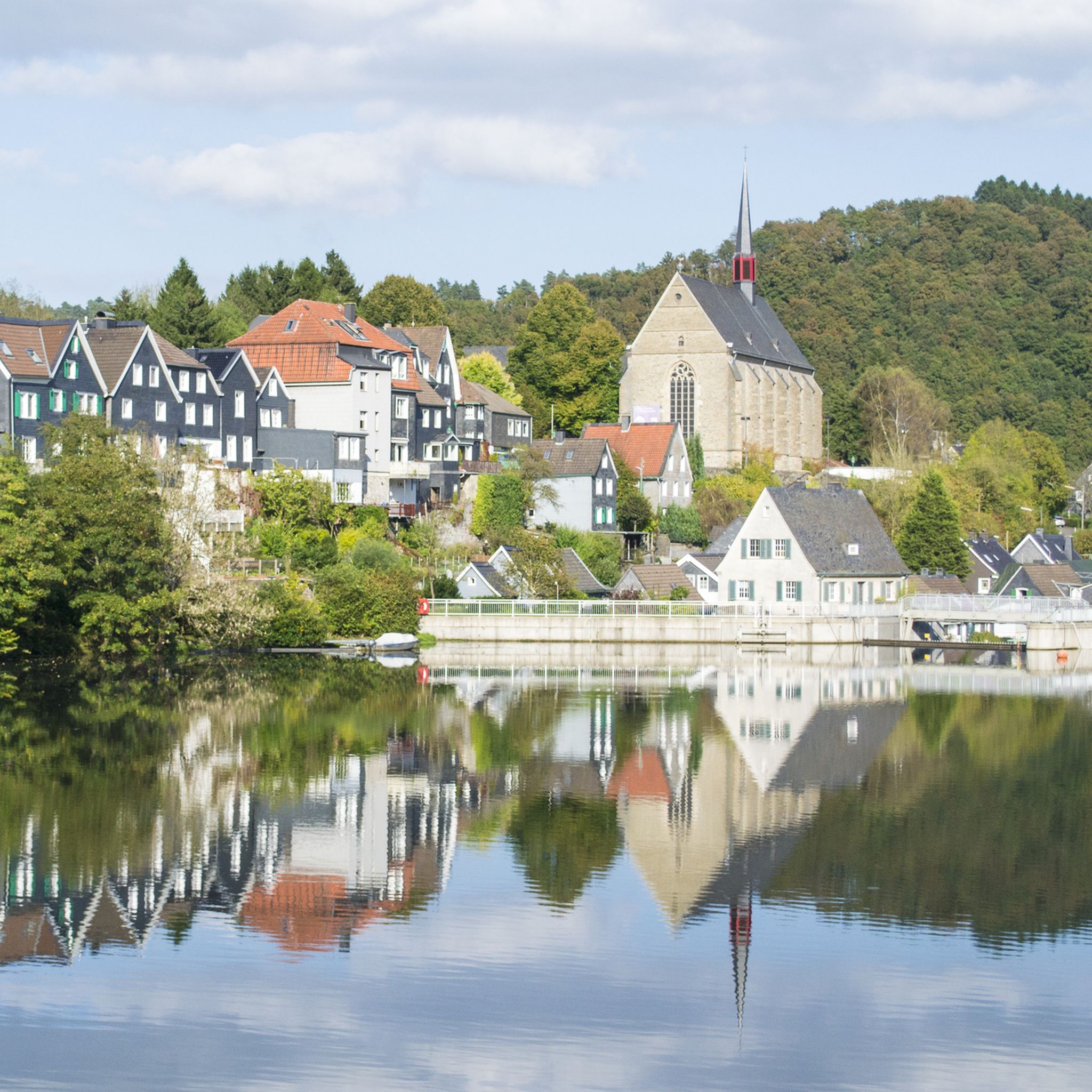
The town of Volmarstein is definitely worth a visit, both because of the castle and the beautiful old half-timbered houses.
1
0

Nice little village but a lot of car traffic.
1
0

Waldstein is still written in large letters on the tower today. Definitely worth a visit, a beautiful old showpiece, unfortunately somewhat spoiled by a concrete extension. It's unbelievable how beautifully people once built and lived! The name Mercklinghaus should be familiar to many Wuppertal residents: Mercklinghausstrasse is in the middle of Langerfeld, named after the family who lived in their Langerfelder Factory distilled schnapps. Friedrich Wilhelm Mercklinghaus in particular was considered He was a committed Langerfelder during his lifetime community leaders and officials Home community. In the second half of the 19th century The manufacturer Richard Mercklinghaus bought it large plots of land on Steinhauser Berg. He acquired the site on which today Hedtberghaus stands, as well as the surrounding forest and meadow plots. The story of the beautiful building begins with the change of ownership. HOUSE WALDSTEIN The now 145 year old villa is located at the Hölkesöhder Bach, Richard left Mercklinghaus as a residence for his family build. The stones for the foundation masonry were made from the rock walls of the Steinhauser Mountain broken for the exposed brickwork Ruhr sandstone was used. After completion in 1878 received the property is called Haus Waldstein; This title still stands today with metal Letters on the outside of the facade. MERCKLINGHAUS CASTLE The villa is in the Wilhelminian style. This can be seen in the playful design of the north tower and the typical ancient and classicist design elements with plaster and stone work. The building soon received given the nickname by the Langerfelders Mercklinghaus Castle. In addition to building the villa, the family left Mercklinghaus to perfect the Create a large park on the property. The highly decorated garden artist was chosen for this purpose Heinrich Siesmayer commissioned. The result was a wildly romantic landscape park. Still Today, huge copper beeches, cypresses, Conifers and exotic trees in the design Siesmayers. Richard Mercklinghaus lived until 1910 retired in his villa. → HENKELS LOCKS Max Henkels, co-partner of the Langerfeld lace factory Henkels with factory locations as far away as the USA, acquired the property in 1912 for 365,000 gold marks. This corresponds to a current value of almost three million euros. It was supposed to be the summer residence of the entire family of the commercial councilor Albert Henkel, a nearby relatives of Max Henkels. As was common at that time, many factory owners had their residential villas on or next to the factory site and their summer homes in the surrounding area. The Henkels family was one of the richest families in Langerfeld in the early 20th century. The Commerce Council had support important to the Langerfeld population: He not only had houses for the unmarried winders of his factory A.&E. Henkels built, but also financed one gym and was committed to the well-being of his community, which at that time still belonged to Schwelm. The building, formerly known as Mercklinghaus Castle, quickly became popularly known as Henkel's Schlösschen. AFTER HENKELS UNTIL TODAY After Max Henkels' death, the castle came into the possession of the city of Wuppertal, which could find neither tenants nor buyers decided to use the building himself. From 1939 to 1943 it was a colonial home for young people from the German colonies. It has been that way for almost 75 years now, since 1949 Municipal retirement home that received a large extension in the late 1970s because the building was no longer sufficient. Incidentally, the name Henkels Schlösschen is just a dialect. The official name of the building is and remains Haus Waldstein today.
1
0

From the small park you have a beautiful view of the castle.
4
0
Frequently Asked Questions
What are the most notable castles and historical sites around Schwelm?
The region around Schwelm offers a blend of historical structures. Key sites include the Ruins of Volmarstein Castle, known for its impressive remains and expansive views over the Ruhr Valley. Another significant site is Haus Martfeld, a 14th-century moated castle that now functions as a local museum with a castle café. Additionally, the Historic village of Volmarstein, with its charming half-timbered houses, leads up to the castle ruins.
Are there any moated castles near Schwelm?
Yes, Haus Martfeld in Schwelm is a prominent example of a moated castle. Originally built in the 14th century as a knight's seat, it was converted in the 18th century and now houses a local museum and a castle café, offering a unique historical experience.
What kind of views can I expect from the castle ruins in the area?
The Ruins of Volmarstein Castle are situated on a steep hill and provide expansive, panoramic views over the Ruhr Valley and beyond, especially on clear days. It's a highly recommended spot for enjoying the scenery.
Are there family-friendly castles to visit near Schwelm?
Yes, Haus Martfeld is considered family-friendly. It functions as a local museum, offering educational insights into the region's history, and also features a castle café, making it a pleasant stop for all ages.
Are there cafes or restaurants near the castles?
Yes, Haus Martfeld in Schwelm has a castle café on its premises, providing a convenient spot for refreshments and a break during your visit. The Ruins of Volmarstein Castle are near the historic village of Volmarstein, where you might find local establishments.
What is the best time of year to visit the castles around Schwelm?
The castles and historical sites around Schwelm can be enjoyed year-round. Spring and autumn offer pleasant temperatures for exploring the outdoor ruins and surrounding nature. Summer allows for longer daylight hours and enjoying outdoor cafes, while winter can offer a unique, serene atmosphere, especially for walks around the sites.
Are there hiking opportunities near the castles?
Yes, the region around Schwelm offers numerous hiking opportunities that can include castle visits. For example, the Ruins of Volmarstein Castle are often incorporated into local walks. You can find various routes, including those around the hiking trails around Schwelm, that pass by historical points of interest.
Is parking available near the castles?
For the Ruins of Volmarstein Castle, it's advisable to look for parking in the village below, as the Burghotel Volmarstein's parking is for guests only. The “Nettmanscher Hof” car park, opposite the church, is a good option. For Haus Martfeld, there is usually parking available nearby due to its function as a museum and public park.
Are there other outdoor activities besides hiking near the castles?
Beyond hiking, the Schwelm area provides options for gravel biking and mountain biking. You can explore various routes, such as those found in the Gravel biking around Schwelm guide or the MTB Trails around Schwelm guide, which might lead you through scenic landscapes near historical sites.
Can I take a historical tour at any of the castles?
Haus Martfeld functions as a local museum, housing the regional and city history museum. This means you can explore its exhibits and learn about its past as a knight's seat and its transformation over centuries, which serves as a self-guided historical tour.
What makes the Historic village of Volmarstein special?
The Historic village of Volmarstein retains its old charm with beautiful half-timbered houses. It serves as a picturesque approach to the Ruins of Volmarstein Castle, offering a glimpse into the region's architectural heritage before reaching the castle ruins.
Are there any lesser-known historical sites or 'hidden gems' near Schwelm?
Yes, Haus Waldstein, located on the city limits of Langerfeld/Schwelm, is described as a hidden treasure. This old castle, built in 1878, offers a beautiful view from its small park and is particularly appealing for photography enthusiasts.
Most popular routes around Schwelm
Most popular attractions around Schwelm

Get inspired with the komoot mobile app


Explore more
Looking for the best castles somewhere else? Discover other guides around Schwelm:
