The best cycling routes around Alvora
5.0
(1)
31
riders
4
rides
Touring cycling routes around Alvora traverse a landscape characterized by river valleys, rolling hills, and historical points of interest. The region features a mix of paved roads and paths suitable for touring bicycles, with varying elevation changes. Cyclists can expect routes that pass through rural areas, connecting small villages and natural settings.
Best touring cycling routes around Alvora
- The most popular touring cycling route is Vilarinho Medieval Bridge – Bar Kay's de Vez loop from Arcos de Valdevez, a 35.6 miles (57.4 km) trail that takes 5 hours 21 minutes to complete. This difficult route features significant elevation gain through varied terrain.
- Another top favourite among local touring cyclists is Lapela Tower – Brejoeira Palace loop from Trute, a moderate 15.1 miles (24.3 km) path. This route offers a mix of ascents and descents, passing by historical landmarks and scenic countryside.
- Local touring cyclists also love the Ecovia of Arcos de Valdevez – Pelourinho de Ponte da Barca loop from Arcos de Valdevez, an 8.3 miles (13.4 km) trail leading through riverine landscapes, often completed in about 1 hour 4 minutes.
- Touring cycling around Alvora is defined by river valleys, historical bridges, and rural roads. The network offers options for different ability levels, from easier paths to more challenging climbs.
- The routes in Alvora are highly rated by the komoot community with an average score of 5.0 stars from 1 review. More than 30 touring cyclists have used komoot to explore Alvora's varied terrain.
Last updated: May 6, 2026
15
riders
57.4km
05:21
1,320m
1,320m
Hard bike ride. Very good fitness required. Mostly paved surfaces. Suitable for all skill levels.
6
riders
24.3km
01:34
280m
280m
Moderate bike ride. Good fitness required. Mostly paved surfaces. Suitable for all skill levels.

Sign up for free
5.0
(1)
6
riders
Easy bike ride. Great for any fitness level. Mostly paved surfaces. Suitable for all skill levels.
3
riders
34.3km
02:20
580m
580m
Hard bike ride. Very good fitness required. Mostly paved surfaces. Suitable for all skill levels.
1
riders
36.8km
02:56
960m
960m
Hard bike ride. Very good fitness required. Mostly paved surfaces. Suitable for all skill levels.
Our route recommendations are based on thousands of hikes, rides, and runs completed by other people on komoot.
Start today with a free account
Your next adventure awaits.
Login or Signup
Popular around Alvora

Tips from the Community

The pillory of Ponte da Barca, originally erected in Largo da Misericórdia after the granting of the "Foral Novo" in 1513 by D. Manuel I, the monument was later moved to its current location, in the Pombaline Market square, next to the Garden of the Poets. 👍🥾
0
0

Fantastic area for cycling or walking
1
0
Barbeita Bridge - Mouro River - Monção - Portugal The bridge over the Mouro River is located in Ponte de Mouro, connecting Barbeita to Ceivães over the Mouro River, in Monção. It is known that a bridge existed at this location at least as early as 1386. It was here that, in that year, the historic meeting between King John I and the Duke of Lancaster, pretender to the throne of Castile, took place. The marriage of the Portuguese king to Philippa of Lancaster, the duke's daughter, was also arranged. The old bridge visible today underwent renovations in 1627.
0
0


It is the seat of the municipality of Arcos de Valdevez, with a total area of 447.60 km2, 20,718 inhabitants in 2021 and a population density of 46 inhabitants per km2, subdivided into 36 parishes. The municipality is bordered to the north by the municipality of Monção, to the northeast by Melgaço, to the east by the Spanish region of Galicia, to the south by Ponte da Barca, to the southwest and west by Ponte de Lima and to the west by Paredes de Coura. The so-called Tournament of Arcos de Valdevez, also known as the "Recontro de Valdevez", was an important and decisive episode in the History of Portugal linked to the early days of the nation, and was the precedent for the celebration of the Treaty of Zamora in 1143. In 1662, during the Restoration War, the town was burned down by the general governor of arms of Castile, D. Baltazar Rojas Pantoja, who established his headquarters in the Paço de Giela, in an energetic offensive on the Minho. The highest point in the municipality is located in Pedrada, at an altitude of 1,416 metres, in the Serra de Soajo.
1
0
Made entirely of cast bronze, it is one of the most beautiful examples of Portuguese equestrian art of the 20th century. Designed by the sculptor José Rodrigues, it masterfully depicts two knights in imminent confrontation, mounted on horses and armed with long lances, defensive helmets and shields, thus representing, in an allegorical way, the conflict that in 1141 pitted the armies of Afonso Henriques against those of his cousin Afonso VII of León and Castile, and which became known as the “Recontro” or “Torneio de Valdevez”, one of the most important moments in the formation of Portugal, forever marking national history and thus giving substance to the phrase that symbolizes the municipality: Arcos de Valdevez Onde se Fez (Arcos de Valdevez, Where Portugal was Made).
2
0
The current bridge that connects the two banks of the town of Arcos de Valdevez is a 19th century construction, begun in 1876 and completed in 1880, which completely replaced a medieval example. No architectural elements remain of this original construction, so knowledge of its original structure is based on a scarce bibliography and a few engravings. The monument was composed of four round arches, supported by strong piers, without eyelets, and with piers. There were also two access ramps, which rose from the banks to a flat platform. No acronyms are mentioned on any of the stone elements of the construction, although their existence was almost certain, as is typical of known examples of medieval bridges. The entire structure is markedly Romanesque. The period of its construction is believed to be somewhere between the end of the 12th century and the beginning of the 13th century, since the place name Arcos is already mentioned in the Inquiries of 1258. The existence of the bridge and its association with the local fair, of significant size and importance in the 15th century, as well as an important road network to and from the outside, were the basis for the historical, economic and social development of the town of Arcos.
2
0

Possibly one of the only bars located right next to the Ecovia do Vez. Well-kept space. You can rent kayaks and sun loungers.
0
0
Frequently Asked Questions
How many touring cycling routes are available around Alvora?
There are 4 touring cycling routes around Alvora listed on komoot. These routes offer a variety of experiences, from moderate to difficult, traversing river valleys and historical landscapes.
What kind of terrain can I expect on touring cycling routes in Alvora?
Touring cycling routes in Alvora feature a mix of paved roads and paths, characterized by river valleys, rolling hills, and historical points of interest. You can expect varying elevation changes, with some routes including significant climbs.
Are there any easy touring cycling routes in Alvora suitable for beginners?
Yes, for those seeking an easier ride, the Ecovia of Arcos de Valdevez – Pelourinho de Ponte da Barca loop from Arcos de Valdevez is an 8.3-mile (13.4 km) trail that leads through riverine landscapes and is generally completed in about 1 hour 4 minutes.
What are some of the more challenging touring cycling routes in Alvora?
For experienced cyclists looking for a challenge, routes like the Vilarinho Medieval Bridge – Bar Kay's de Vez loop from Arcos de Valdevez offer significant elevation gain over 35.6 miles (57.4 km). Another difficult option is the Ponte da Barbeita – Longos Vales Monastery loop from Merufe.
What historical landmarks or natural features can I see along the touring cycling routes?
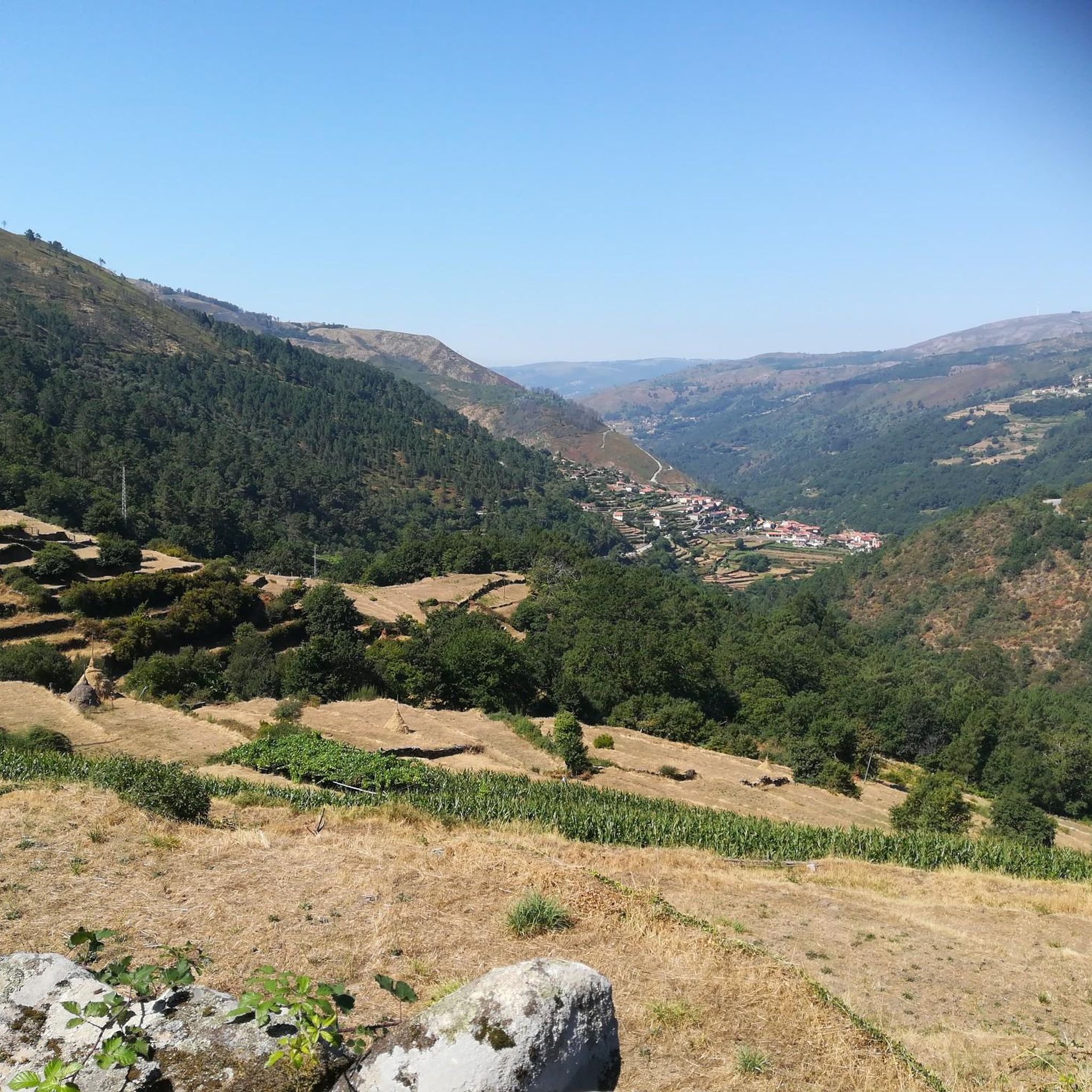
Alvora's routes pass by several interesting features. You can encounter the Vilarinho Medieval Bridge, the scenic Vez River, and the unique Terraced Fields of the Vez Valley. Some routes also feature a wooden boardwalk along the river in the Transboundary Gerês–Xurés Biosphere Reserve.
Are there any circular touring cycling routes in Alvora?
Yes, many of the touring cycling routes in Alvora are designed as loops. Examples include the moderate Lapela Tower – Brejoeira Palace loop from Trute and the more challenging Vilarinho Medieval Bridge – Bar Kay's de Vez loop from Aboim das Choças.
What do other touring cyclists say about the routes in Alvora?
The touring cycling routes in Alvora are highly rated by the komoot community, with an average score of 5.0 stars. Cyclists appreciate the varied terrain, historical points of interest, and the opportunity to explore rural areas and natural settings.
What is the average distance and duration for touring cycling routes in Alvora?
The routes vary significantly in length and time. For instance, the Ecovia of Arcos de Valdevez – Pelourinho de Ponte da Barca loop from Arcos de Valdevez is 8.3 miles (13.4 km) and takes about 1 hour 4 minutes, while the Vilarinho Medieval Bridge – Bar Kay's de Vez loop from Arcos de Valdevez covers 35.6 miles (57.4 km) and typically requires around 5 hours 21 minutes.
Are there any routes that pass by medieval bridges?
Yes, the Vilarinho Medieval Bridge – Bar Kay's de Vez loop from Arcos de Valdevez and the Vilarinho Medieval Bridge – Bar Kay's de Vez loop from Aboim das Choças both feature the historic Vilarinho Medieval Bridge.
Can I find routes that follow riverine landscapes?
Absolutely. The Ecovia of Arcos de Valdevez – Pelourinho de Ponte da Barca loop from Arcos de Valdevez is a great option for experiencing riverine landscapes, often following the course of the Vez River.
Are there any routes that explore the Vez Valley?
Many routes in Alvora offer views or pass through the Vez Valley. You can specifically find highlights like the Terraced Fields of the Vez Valley and the terraces of the Vez Valley along various tours, showcasing the region's agricultural heritage and natural beauty.
Most popular routes around Alvora
Most popular attractions around Alvora

Get inspired with the komoot mobile app


Explore more
Browse the best Cycling routes in other regions.
