Attractions and Places To See around gmina Nur - Top 19
Best attractions and places to see around gmina Nur include a rich tapestry of historical sites, cultural landmarks, and natural features. The region is characterized by its long history, evidenced by archaeological findings and a unique cultural landscape. Notable geographical features include the Bug River, the Nadbużańska escarpment, and the Nurzec River. Gmina Nur offers a blend of historical urban layouts, traditional wooden architecture, and significant cultural elements.
Best attractions and places to see around gmina Nur
- The most popular…
Last updated: July 15, 2026
Museum of Agriculture in Ciechanowiec
Highlight • Historical Site
Translated by Google •
Tip by

Ossoliński Palace in Sterdyń
Highlight • Historical Site
Translated by Google •
Tip by

Sign up now to discover places like this
Get recommendations on the best single tracks, peaks, & plenty of other exciting outdoor places.
Sign up for free
Graves of Home Army Soldiers in Kiełpiniec Parish Cemetery
Highlight • Historical Site
Translated by Google •
Tip by
Home Army Square in Sterdyń
Highlight • Monument
Translated by Google •
Tip by
Home Army Memorial Square
Highlight • Monument
Translated by Google •
Tip by
Sign up for free to discover even more attractions around gmina Nur.
Sign up for free
Already have an account?
Start today with a free account
Your next adventure awaits.
Login or Signup
Popular around gmina Nur
Tips from the Community

Contrary to what Google says, you can enter the museum grounds with a bicycle. I emphasize: enter, not ride in.
0
0

Entrance to the grounds is after purchasing tickets. The ticket office is opposite the gate. Parking, restrooms, and a souvenir shop are located nearby.
0
0

Home Army, a military organization that fought against the Germans during World War II
2
0
Sterdyń, as a small town located far from the main communication routes, never played a major historical role. However, we know that the inhabitants of the Sterdyń land took part in the January Uprising and also provided selfless help to the insurgents, for which the tsarist authorities imposed severe repressions on them. For this reason, Sterdyń lost its city rights in 1869. In the second half of the 19th century, persecution of the Uniates took place, and in 1905 peasant uprisings were recorded. In 1863, the tsarist authorities carried out the emancipation of the peasants. On the hundredth anniversary (1963), a monument commemorating this event was erected on the Sterdyń market square. During World War I, Russian troops burned down over 1/3 of the buildings in Sterdyń. During World War II, the inhabitants helped or participated in actions organized by the AK districts "Sęp" and "Proso". For this reason, the Germans shot about 400 people. During the occupation, there was also a ghetto in Sterdyń. 400 people of Jewish origin died there. The remaining Jewish population was transported to the nearby extermination camp in Treblinka. In the first years after the war, the residents of Sterdyń also experienced dramatic events at the hands of the people's government. An example of this is the execution of Józef Myszko, the village mayor of Sewerynówka. Józef Myszko helped unknown partisans. Accused of aiding bandits and considered an enemy of the people, he was sentenced by a "court" in the form of UB officers to death by shooting. The sentence was carried out immediately in front of the forcibly gathered residents of Sterdyń. The "trial" and the sentence took place in the market square on December 28, 1946. The murdered man was 37 years old.
2
0
The village was mentioned in 1446. In the 16th century, it was the property of Brykcy Chądzyński, then Kiszków. In 1622, Sterdyń was inherited by Anna Iwanowska from Kiszków, the wife of the cup-bearer of Drohicz Jakub Iwanowski of the Łodzia coat of arms, and then, as a dowry, it was received by the daughter of Anna and Jakub Iwanowski, Barbara, the wife of the starost of Drohicz, the castellan of Czersk Zbigniew Ossoliński. In this way, from 1643 to 1706, the village remained in the hands of the Ossolińskis. From 1709 to around 1726, it was the property of Wiktoryn Kuczyński, the castellan of Podlasie. Wiktoryn Kuczyński (born 1668), active in many fields, a participant in the political events of his time, a supporter of King Stanisław Leszczyński, exposed himself to Russian persecution - the devastation of his estates and the imprisonment of his son. Active in the field of economy, he floated grain on the Nurzec, Bug and Vistula rivers to Gdańsk with his own ships. He died in 1738 and was buried with the Benedictine nuns in Drohiczyn. In the 18th and early 19th centuries Sterdyń belonged to the Ossolińskis again, including the starost of Sulejów Stanisław Ossoliński. In 1809 Józef Wawrzyniec Krasiński married Emilia Ossolińska and received the Sterdyń estates from her hand. Józef Wawrzyniec Krasiński (1783–1845) was a writer, translator and memoirist, an activist of the Warsaw Charitable Society, decorated for his Napoleonic campaigns with the Golden Cross of Virtuti Militari and the French Legion of Honour, senator castellan of the Kingdom of Poland. Together with the hand of his daughter Paulina Sterdyń it passed in 1849 to Ludwik Górski (1818–1908), an outstanding agricultural activist, socially engaged, founder of the Agricultural Society, publicist. A devout Catholic, through his connections among cardinals he had considerable influence in Rome. Pope St. Pius X personally decorated him with the Knight's Cross of the Order of Pius IX. After Ludwik Górski's death the estate was taken over by Kazimierz Krasiński, and then by his son Franciszek Krasiński. The estate remained in the hands of the Krasińskis until the end and around 1930 it had 2,300 hectares.
2
0
The following died at that time: the commander of the 3rd squadron of the 6th Brigade, Senior Sergeant Józef Babicz Żwirko, Corporal Franciszek Januszkiewicz Zbieg, Private Jan Małyszko Grom and Private NN Serdeczny. In November 2005, thanks to the efforts of the "Pamiętamy" Foundation, a monument commemorating these soldiers was erected next to the chapel in Kiełpiniec. Symbolic crosses of the fallen are also located on both sides of the road at the entrance to the village. A concrete grave fenced with a low wooden fence is dedicated to the unknown Home Army soldier who died in 1941 or 1942. On the edge of the village on the opposite side of the road, there is only a wooden cross without an inscription commemorating the death of two uhlans from 1920. The bodies of these two soldiers were ceremoniously transported to the Tomb of the Unknown Soldier in Sterdyń on the fifteenth anniversary of regaining independence. R. Murawski says: "The exhumation was accompanied by crowds of people.
2
0
In Kiełpiniec, a strong and well-armed Home Army unit was formed under the command of a teacher, Lieutenant Lucjusz Gawryś, pseudonym "Ryś". The activities of the Home Army and life in Kiełpiniec during the war are described in detail by a member of the unit, Juliusz Lemke, in his book "Było, minęła". Landed estates played a significant role in the functioning of military structures. In the Sokołów district, the "Uprawa" organization operated. Within its framework, Władysław and Józef Murawscy from Zagórze provided assistance in providing provisions to the units. The surrounding forests provided shelter to the fighting men and civilians. During the march of the front, Father Marian Podstawka, Sister Sebastian Moskwa, and many residents of Chądzyn and the surrounding areas found shelter in the Smolarnia forester's lodge with Paweł Andrzejewski. During the march of the front, the residents of Kiełpiniec, usually with all their belongings, waited out these difficult days in mounds in the forests near the village. On August 10, 1944, Kiełpiniec was liberated. Unfortunately, the dissolution of the Home Army did not mean the end of the war. Fighting continued. On February 17, 1947, in buildings outside the village belonging to Franciszek Goworek, four partisans of the 6th Wilno Brigade of the Home Army, commanded by Captain Władysław Łukasiuk Młot, were killed.
2
0
The Parish Cemetery contains the graves of heroes who fought during World War II and those who died fighting against the communist authorities after 1945.
2
0
Frequently Asked Questions
What historical sites can I explore in gmina Nur?
Gmina Nur is rich in history. You can visit the Museum of Agriculture in Ciechanowiec, which features an open-air museum, a carriage collection, and a botanical garden. Another significant historical site is the Ossoliński Palace in Sterdyń, known for its 17th-century architecture and unique oval courtyard design. The region also has numerous archaeological sites, indicating continuous settlement from ancient times, with findings from the Bronze Age, Roman period, and early medieval settlements.
Are there any cultural landmarks or monuments in the area?
Yes, gmina Nur offers several cultural landmarks. The Graves of Home Army Soldiers in Kiełpiniec Parish Cemetery commemorate soldiers from World War II and those who fought against communist authorities. You can also find the Home Army Square in Sterdyń and the Home Army Memorial Square, both dedicated to the memory of Home Army soldiers. The Parish Church in Zuzela, a neogothic structure, houses valuable artifacts including a Renaissance chalice and an 18th-century Rococo monstrance.
What natural features can I see around gmina Nur?
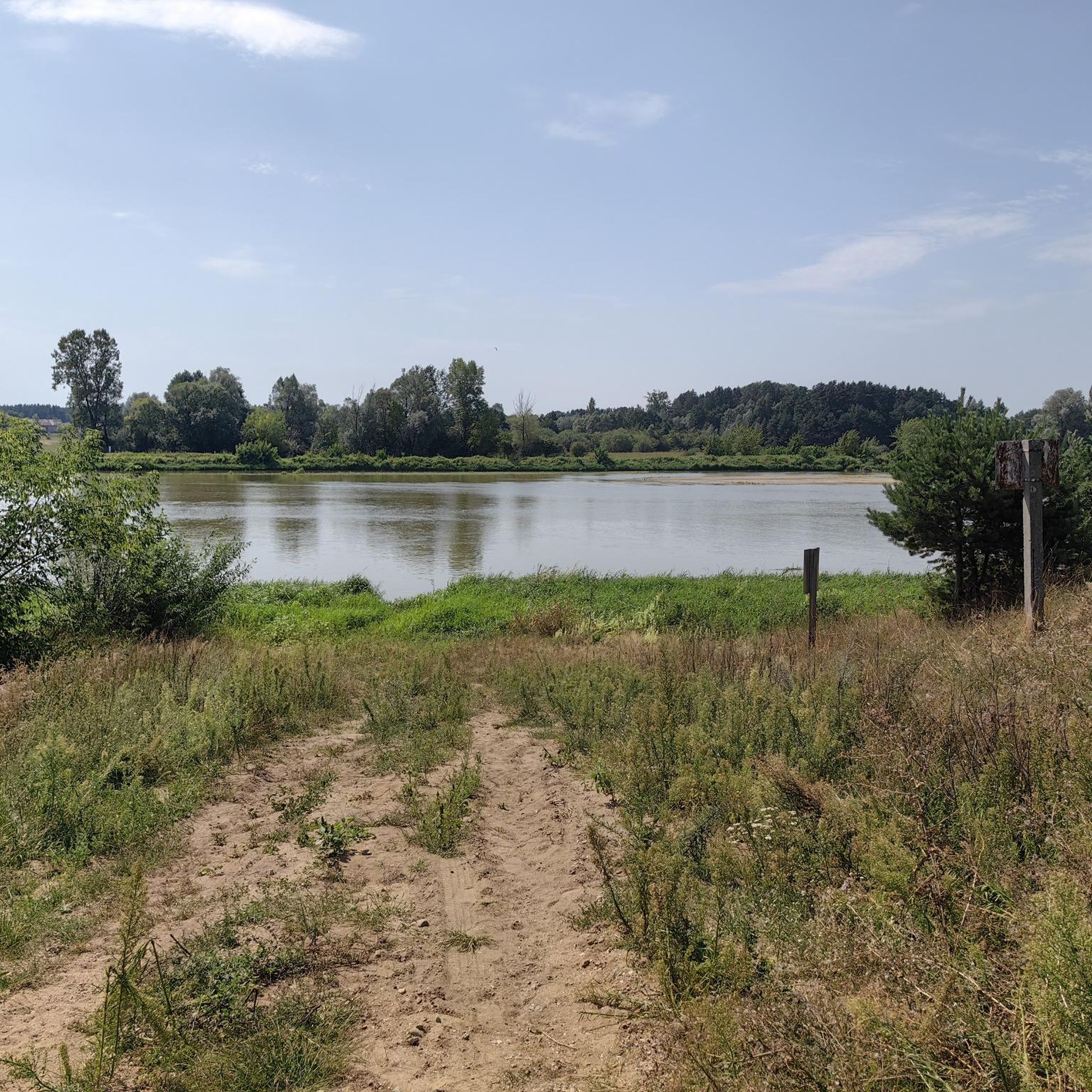
The region is characterized by its natural beauty, including the Bug River, which historically served as a crucial trade route. The Nadbużańska escarpment (Bug river escarpment) is a notable geographical feature. The Nurzec River, which once bore the name Nur, is another important natural element, where watermills historically operated.
What kind of traditional architecture can be found in gmina Nur?
Gmina Nur preserves examples of traditional wooden architecture. These include a wooden rectory in Nur and a former public school in Zuzela. Several farmhouses also stand as testaments to past building traditions, such as farmhouse No. 12 in Godlewo-Milewek with a late 19th-century wooden cowshed, and farmhouse No. 62 in Żebry-Laskowiec, featuring a wooden house and granary from the turn of the 19th and 20th centuries.
Are there cycling routes near the attractions in gmina Nur?
Absolutely! There are several cycling routes available. You can explore options like the 'Bridge over the Bug River – Nadbużański Landscape Park loop from Ceranów' (52.8 km, moderate) or the 'Statue of John Paul II – Holy Trinity Church loop from Ciechanowiec' (27.9 km, easy). For more details and other routes, check out the Cycling around gmina Nur guide.
What is the best time of year to visit gmina Nur?
While specific seasonal recommendations aren't provided, the region's historical sites, cultural landmarks, and natural features can be enjoyed throughout much of the year. Spring and autumn generally offer pleasant weather for exploring outdoor attractions and cycling routes. Summer is ideal for river-related activities, while winter might appeal to those interested in a quieter, snow-covered landscape.
Are there any family-friendly attractions in gmina Nur?
Many of the historical sites and outdoor areas can be enjoyed by families. The Museum of Agriculture in Ciechanowiec, with its open-air exhibits and botanical garden, is particularly suitable for families. Exploring the historic urban layout of Nur and its market square can also be an interesting experience for all ages.
What kind of archaeological discoveries have been made in gmina Nur?
Gmina Nur is rich in archaeological findings, indicating continuous settlement from ancient times. Sites in Kamianka, Kossaki, Myślibory, Nur-Kolonia, Obryte, Ślepowrony, and Zuzela have yielded Bronze Age findings, including a Lusatian culture cemetery in Kamianka. Nur is also home to a Wielbark culture cemetery, and evidence of Roman period settlements has been found in various locations like Kamianka, Łęg Nurski, and Zuzela.
Can I find information about significant Polish figures in gmina Nur?
Yes, you can visit the Museum of the Childhood Years of Primate of the Millennium Cardinal Stefan Wyszyński. This museum offers insights into the early life of this significant Polish historical figure, providing a unique cultural experience.
What do visitors enjoy most about the attractions in gmina Nur?
Visitors appreciate the rich historical context and the variety of sites. For instance, the Museum of Agriculture in Ciechanowiec is often highlighted as a very interesting museum with its diverse collections and park. The historical significance of places like the Ossoliński Palace and the memorials to Home Army soldiers also resonate deeply with visitors.
Are there any castle remains in the gmina Nur area?
Historical evidence suggests the existence of a castle near Kamianka Nadbużna. This castle, believed to have been present from the 13th to 15th centuries, played a vital role in the Mazovian defense system, offering a glimpse into the region's medieval past.
Most popular routes around gmina Nur

Get inspired with the komoot mobile app


Explore more
Still not found the Highlight you’re looking for? See guides of the top attractions in other regions:
