Top 20 Castles around Lubbeek
Castles around Lubbeek offer a glimpse into the rich history of Flemish Brabant, a region characterized by its rolling hills and cultural landmarks. The area features a collection of historical castles, ranging from medieval defensive structures to Renaissance estates. These landmarks provide insight into the architectural evolution and past significance of the region.
Best castles around Lubbeek
- The most popular castles is Horst Castle, a castle that is an idyllic moated castle from the 13th century. It is known…
Last updated: July 4, 2026
Horst Castle
Highlight • Castle
Translated by Google •
Tip by

Ter Heyden Keep
Highlight • Castle
Tip by

Sign up now to discover places like this
Get recommendations on the best single tracks, peaks, & plenty of other exciting outdoor places.
Sign up for free
Ter Heiden Tower
Highlight • Castle
Translated by Google •
Tip by

Information board Domain Castle of Horst
Highlight • Rest Area
Translated by Google •
Tip by

Arenberg Castle
Highlight • Castle
Translated by Google •
Tip by

Sign up for free to discover even more castles around Lubbeek.
Sign up for free
Already have an account?
Start today with a free account
Your next adventure awaits.
Login or Signup
Tips from the Community


Information board with a map of the Horst castle estate, there is also parking here.
0
0

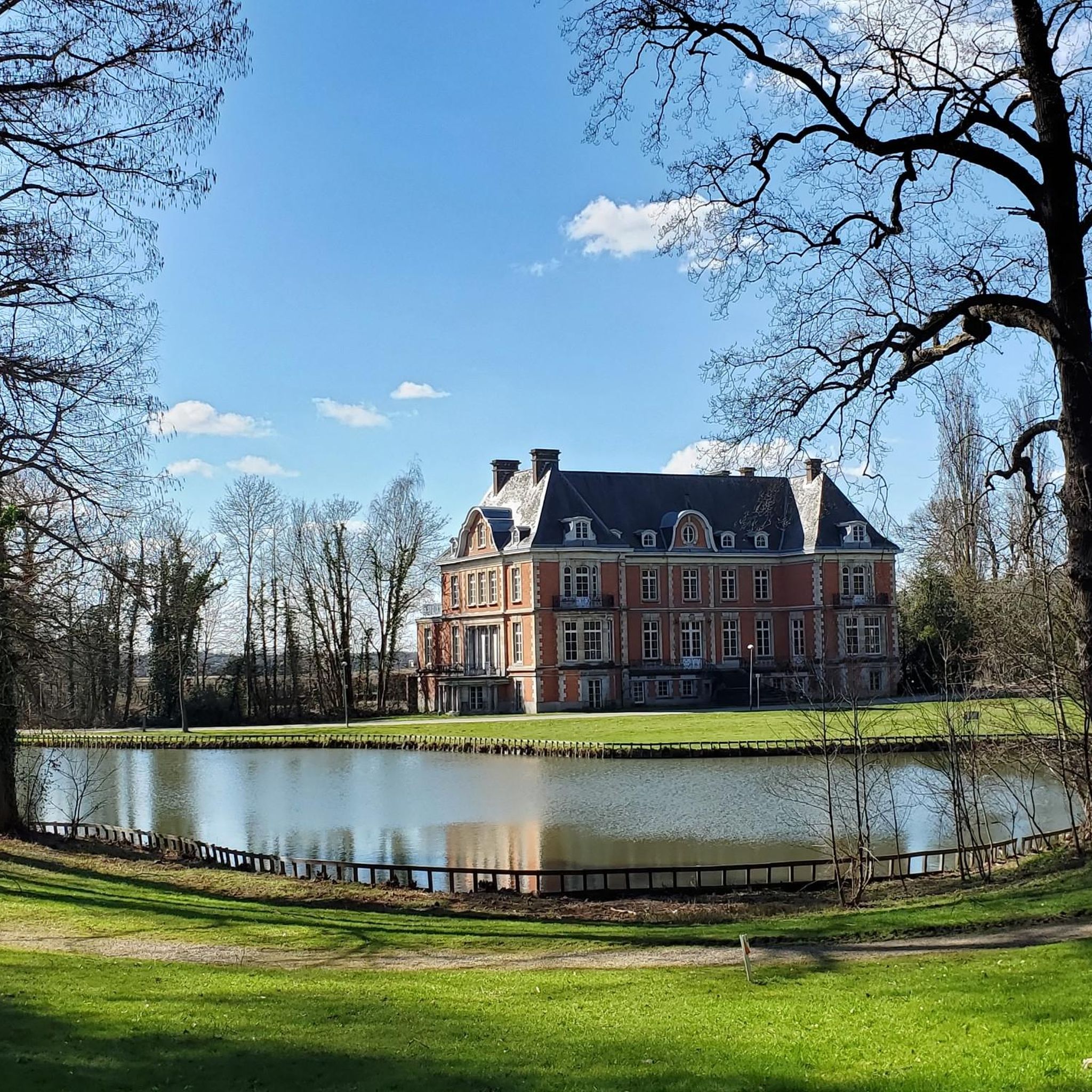
The core of Horst Castle probably dates back to the 13th century and is characterised by a square keep. The keep probably belonged to the oldest core that was further expanded into a fortified castle in the 15th century. During the troubles under Maximilian of Austria in 1489, the castle of Horst was taken by the people of Leuven and set on fire. According to literary sources, only the keep, part of the entrance gate and a defensive wall remained standing. The residential and east wing were renovated and expanded in the 16th century. The round tower also dates from this period. The outer wall was provided with a rectangular bay window. The castle lost its military character and became more of a pleasant residential area with a view of the moat, the ponds and the inner courtyard. Brick construction with sandstone layers characterise these buildings. In 1587, however, the castle was set on fire again during the raids of the Geuzen. It was not until the beginning of the 17th century that restoration work began. It is difficult to deduce from the available sources to what extent this involved restoration or an embellishing conversion of the castle complex. Presumably nothing changed in the internal structure, but only after the structurally necessary repairs were the interiors completely refinished. Maria-Anna Van den Tympel had a new chapel built against the keep in the 17th century. At the beginning of the 19th century, the complex must have been damaged by plundering and neglect, and it is possible that it also suffered from plundering during the Brabant Revolution of 1830. Around 1850, the castle must have been habitable again, but the castle buildings only served as a farm. In the land registry, the site around the castle is called "De Notelaren Boomgaerd". Around that time, the most dilapidated part must have been demolished, namely the southern part and the superstructure of the gate. The rest of the complex was probably restored with reused demolition material and in traditional style. The castle was divided in 1880, with one part being registered as a school house. In 1897, a further division followed, with two plots being designated as houses. Several restoration campaigns followed in the 20th century. Inventory of Immovable Heritage: Horst Castle, https://id.erfgoed.net/erfgoedobjecten/43619
6
0
Since December, there has been a spire on the castle again after the unstable spire was removed more than four years ago and could be viewed on a wooden platform in the pond. Now it is back. And the other works are also progressing quickly. More about the replaced spire on https://www.vrt.be/vrtnws/nl/2024/12/10/torenspits-staat-weer-op-kasteel-van-horst-holsbeek/
6
0

The Donjon Ter Heyden, also known as the tower of Ter Heyden, is a residential tower in the Belgian town of Rotselaar (province of Flemish Brabant) from the mid-fourteenth century. The donjon was built between 1350 and 1363 by order of Gerard van der Heyden, the then bailiff of the Duchy of Brabant, when he acquired the status and funds through a marriage with a noblewoman to erect a building of such calibre.
3
0
The watermill at Arenberg Castle was probably rebuilt around 1636 on a watermill site known before 1286, which was then equipped with two waterwheels. Major repairs were carried out on the locks around 1722-23 and 1733-35, and images of the mill also indicate modifications to the mill building in the 18th century. Around 1875, the watermill underwent a facade restoration and extension according to the then prevailing views, under the direction of architect Claes. At the same time (1870-80), the mill was equipped with a new bluestone lock and two wooden waterwheels. The waterwheels were replaced by metal wheels at the end of the 19th century, and the locks were also modified in the early 20th century. In 1940, the mill was demolished and the mill was converted into a drawing room; externally the mill was preserved, as well as the lock and the two water wheels. Source and more information: https://inventaris.onroerenderfgoed.be/erfgoedobjecten/42570
7
0
The first mention of a castle dates from 1371 when it was a heavy keep built by Rasse de Grez, also known as Raes van Graven, a knight who lived from 1368 to 1450 and was lord of Heverlee, Vaalbeek, Bertem, Blanden, Malève and Terbruggen, among other things. The castle was demolished and the domain was ceded to the Croys (family of Croÿ) in 1446. During the first half of the sixteenth century, the reconstruction of the castle was restarted under Guillaume II de Croÿ (Willem II van Croÿ). His successor and nephew, Philip II van Croÿ, had it completed and finished, including a moat. He also had the park laid out and the avenue to Leuven extended. After the death of Charles III of Croÿ in 1612, the castle went via his sister, Anna, to the Dukes of Arenberg who lived there until the First World War. In 1920 the university acquired the domain. Sources and more info: - https://inventaris.onroerenderfgoed.be/erfgoedobjecten/42570 - https://www.kuleuven.be/erfgoed/gebouwen-en-monumenten/arenbergkasteel
7
0
Frequently Asked Questions
What are the most notable castles to visit near Lubbeek?
The region around Lubbeek features several captivating castles. Among the most prominent are Horst Castle, an idyllic 13th-century moated castle, and Arenberg Castle, known for its blend of Renaissance and neo-Gothic architecture. You can also explore Ter Heyden Keep, a unique residential tower from the 14th century, and Kwabeek Castle and Park, which offers a tranquil setting.
Are there any moated castles in the Lubbeek area?
Yes, Horst Castle is a prime example of a picturesque moated castle in the region. It's surrounded by an impressive moat and is wonderful to behold from a distance. Ter Heyden Keep also stands in the middle of an artificial lake, giving it a similar water-surrounded appearance.
What historical periods do the castles around Lubbeek represent?
The castles around Lubbeek showcase a rich historical evolution. You can find medieval defensive structures like the 13th-century origins of Horst Castle and the 14th-century Ter Heyden Keep. There are also 16th and 17th-century Renaissance estates, such as the current form of Arenberg Castle and the additions to Horst Castle, with some even featuring 19th-century neo-Gothic makeovers.
Can I visit Horst Castle, and what should I know about it?
Horst Castle is a significant historical site, famously known as the 'Rode Ridder' (Red Knight) castle from a popular Belgian comic. It features a robust square donjon and 17th-century Renaissance elements. However, it is currently undergoing extensive restoration work. You can check for updates on its visitor status and future developments, including plans for a hospitality area and heritage accommodations, on the official regional tourism website: visitvlaamsbrabant.be.
Are there family-friendly castles or activities near Lubbeek?
Many castles in the region are considered family-friendly for viewing their exteriors and grounds. Horst Castle is a popular spot, and its association with the 'Rode Ridder' comic can be engaging for children. Kwabeek Castle and Park provides a relaxing environment with fish ponds, perfect for a family stroll or cycling break.
What kind of outdoor activities can I do near the castles around Lubbeek?
The area around Lubbeek offers various outdoor activities. You can find numerous hiking and cycling routes that pass by or near these historical sites. For specific hiking trails, explore the Hiking around Lubbeek guide. If you prefer mountain biking, check out the MTB Trails around Lubbeek guide for routes like 'In the forest of Linden'.
Is Arenberg Castle accessible to the public?
Arenberg Castle is located on the outskirts of Leuven and is now part of KU Leuven, serving as its campus for Science and Technology. While the interior might have restricted access due to its university function, the castle's exterior and the surrounding green park are generally accessible for viewing and enjoying the pleasant surroundings.
Are there any castles that offer a good place to rest during a walk or cycling tour?
Yes, Kwabeek Castle and Park is specifically highlighted as a perfect place to rest during a walk or cycling tour. Its castle domain with fish ponds provides a tranquil and scenic environment to take a break.
What are the architectural highlights of Ter Heyden Keep?
Ter Heyden Keep is a residential tower from the mid-14th century, built by Gerard van der Heyden. It stands 30 meters high with six levels, connected by a stone spiral staircase. The tower rests on a white sandstone base and is constructed from brick with layers of iron sandstone. Its unique design, directly surrounded by a moat rather than on a motte, makes it a distinctive example of medieval architecture.
What do visitors enjoy most about the castles around Lubbeek?
Visitors particularly appreciate the historical significance and scenic beauty of the castles. Horst Castle is loved for its idyllic moated setting and its connection to the 'Rode Ridder' comic. The variety of architectural styles, from medieval keeps to Renaissance estates, and the opportunity to combine castle visits with walks or cycling tours in the beautiful Flemish Brabant landscape are also highly valued.
Are there any viewpoints or natural features near the castles?
Many castles are set within scenic natural environments. Horst Castle is nestled between the hills of Hageland and features a large pond. Kwabeek Castle and Park offers views of its domain and fish ponds, providing a peaceful natural setting. The green area surrounding Arenberg Castle also provides pleasant natural surroundings.
Can I find information about the history of the castles in the region?
Yes, the castles offer a deep dive into the region's history. For example, Horst Castle dates back to the 13th century with significant 17th-century embellishments. Ter Heyden Keep was built in the mid-14th century as a status symbol. Each castle has a unique story of evolution, ownership, and architectural changes that reflect the historical periods of Flemish Brabant.
Most popular routes around Lubbeek
Most popular attractions around Lubbeek

Get inspired with the komoot mobile app


Explore more
Looking for the best castles somewhere else? Discover other guides around Lubbeek:
