Top 11 Caves around Drena
Best caves around Drena offer a glimpse into the region's geological and historical past. This mountain village, situated in a landscape influenced by prehistoric, Roman, and medieval periods, presents a variety of underground sites. The area's terrain, including features formed by postglacial landslides, contributes to its unique character. These sites provide insights into ancient human activity and historical resourcefulness.
Best caves around Drena
- The most popular caves is The Statuary Stone Quarries of Vastrè, a historical quarry that served…
Last updated: August 9, 2026
The Statuary Stone Quarries of Vastrè
Highlight • Cave
Translated by Google •
Tip by

La Cosina Cave
Highlight • Cave
Translated by Google •
Tip by

Sign up now to discover places like this
Get recommendations on the best single tracks, peaks, & plenty of other exciting outdoor places.
Sign up for free
Via Ferrata Giulio Segata – Upper Section
Highlight • Climb
Translated by Google •
Tip by

Grotta Camerona
Highlight • Cave
Translated by Google •
Tip by

Old Quarries
Highlight • Cave
Translated by Google •
Tip by

Sign up for free to discover even more caves around Drena.
Sign up for free
Already have an account?
Start today with a free account
Your next adventure awaits.
Login or Signup
Other adventures around Drena

Tips from the Community

The grotto can be reached from Ballino in about 30 minutes. The path leads along a road into the forest. From there it is partly steeply uphill. The grotto is really impressive. The path to the upper part of the grotto is very slippery and not without danger.
0
0

Oolite stone quarries dug in the Vastrè hills. The extracted stone, called "statuary stone", was used above all for portals, fountains and statues as it is easily workable. The stone extracted from the quarries was used to create statues that adorn the Taro bridge in Parma, the fountain in Piazza Duomo in Trento, the statues that adorn the Prato della Valle in Padua, some statues found in the Collegiate Church of Arco and the statue of Moses located in the square of Arco. I advise you to enter the quarries and tackle the route inside. The location is truly very suggestive and I would say unique. The extraction planes are inclined about 30° towards the west and in the middle there are rock columns which were used to prevent the roof from collapsing.
1
1

Have you ever thought about what you would do in a cave? The one you see was used as a shelter by shepherds for a very long time. Inside there is a natural fireplace, perhaps for this reason it was called "Cosina", which in our dialect means "kitchen". In 1912, during an archaeological excavation, Don Felice Vogt and Giacomo Roberti, an important Trentino scholar of ancient history and archaeology, discovered some very ancient tombs... but I had seen them a long time before! The bones date back to prehistoric times: think, they are more than 4000 years old! Together with bones found a beautiful blade of a flint dagger, a weapon which in the funerary rites of the time probably served to accompany the deceased into the afterlife.
0
0

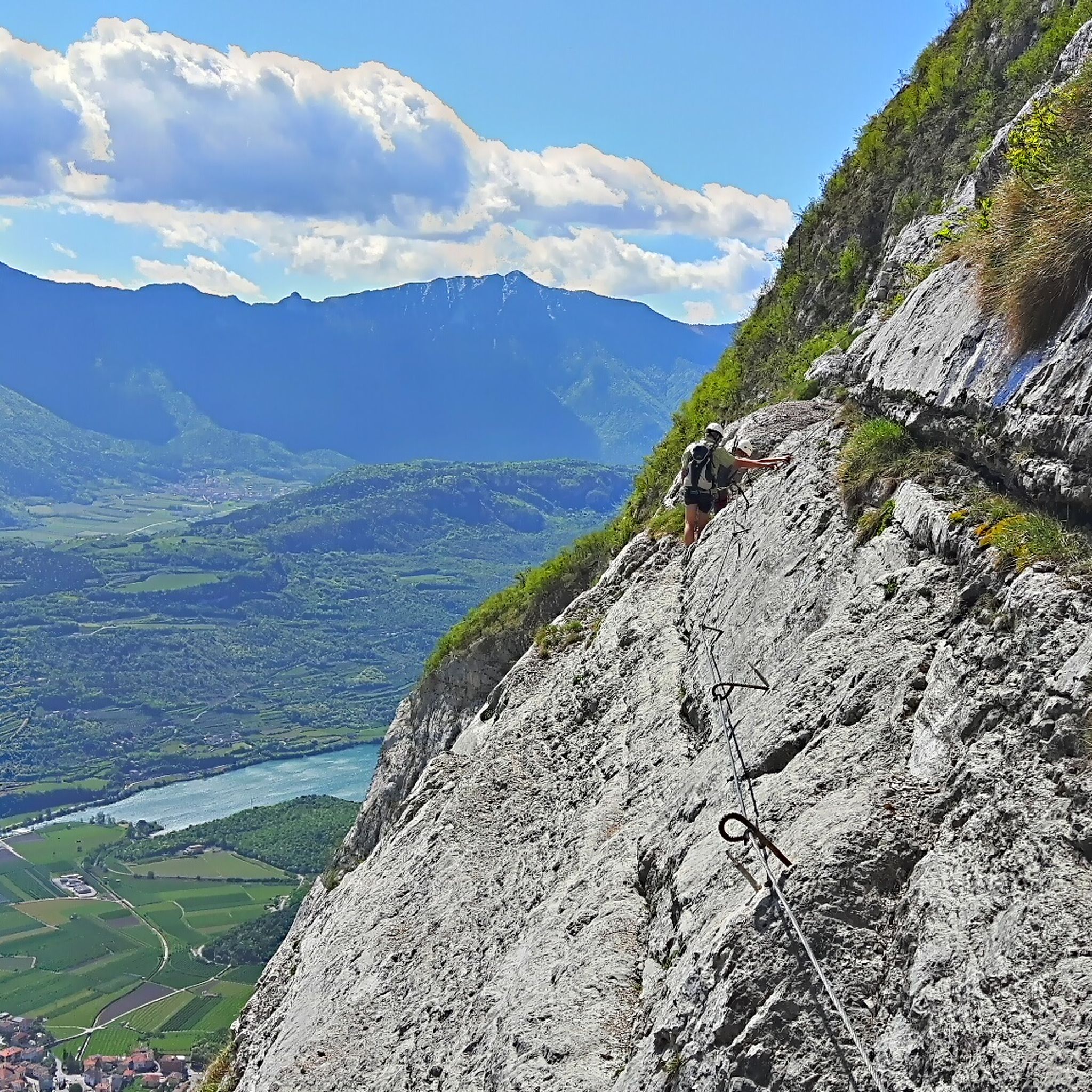
The Vis Ferrata Giulio Segata is a short, tough via ferrata that is divided into two sections. The second section is even harder than the first section, but becomes easier again as you go up. It starts over long smooth steep walls (E). At the top you climb through a cave with all kinds of stepping aids (C).
2
0

The cave has a 20m wide and 12m high cave portal after about 50m you are in front of a compact wall which can be climbed. There are clear traces of excavation at the top, but these have not led to any success. This is the end.
6
0

extremely difficult via ferrata and not signposted the approach ... personally I did not find the start, I traveled back through the life of escape and climbed the second stretch .... do not contend with the nearby aided path .... you can see immediately when it goes up that this via ferrata is not trivial
2
0

Nice quiet place with interesting rocks.
0
0
Frequently Asked Questions
What historical or archaeological significance do the caves around Drena hold?
The caves and cave-like sites in the Drena area are rich in history. For instance, La Cosina Cave served as a shelter for shepherds and was the site of archaeological excavations in 1912, revealing ancient tombs with bones over 4000 years old and a flint dagger blade, indicating prehistoric funerary rites. The Statuary Stone Quarries of Vastrè, while not natural caves, are historically significant for providing protection during wartime and for the unique 'statuary stone' extracted there, used in notable sculptures and architectural elements across the region.
What kind of natural formations can be found in the caves around Drena?
The Drena area offers a mix of natural and man-made cavernous spaces. At Old Quarries, you can explore interesting rock formations shaped by glaciers and water. Grotta Camerona is a natural cave featuring an impressive 20-meter-wide and 12-meter-high entrance portal.
Are there impressive natural grottoes to explore in the Drena area?
Yes, Grotta Camerona is a notable natural grotto near Drena. It boasts a large entrance portal, 20 meters wide and 12 meters high. The path to reach it from Ballino is partly steeply uphill, offering a challenging ascent to an impressive natural feature.
What outdoor activities can I do near the caves in Drena?
Beyond exploring the caves, the Drena area is excellent for various outdoor activities. You can find numerous hiking trails, including routes like the Monte Stivo Ring Trail or the Marocche Dinosaur Trail. For cycling enthusiasts, there are gravel biking routes, such as loops around Lake Cavedine. More challenging options include mountain hikes and via ferratas like the Via Ferrata Rio Sallagoni.
Are there hiking trails that lead to or near the caves?
Yes, several trails provide access to the caves. For example, Grotta Camerona can be reached via a path that is partly steeply uphill from Ballino. The Drena area generally offers a variety of hiking routes, some of which pass by or lead to these unique geological and historical sites.
What is the difficulty level of exploring the caves or trails around them?
The difficulty varies. Some sites like The Statuary Stone Quarries of Vastrè and Old Quarries are generally considered intermediate. Accessing Grotta Camerona involves a partly steeply uphill path, requiring good shoes and potentially hiking poles, especially after rain. For more adventurous explorers, the Via Ferrata Giulio Segata – Upper Section offers a challenging climb through two caves with some difficult sections.
When is the best time to visit the caves around Drena?
The Drena area, being a mountain village, experiences seasonal weather. Visiting during spring, summer, or early autumn generally offers the most pleasant conditions for exploring both the caves and the surrounding outdoor trails. Always check local weather forecasts before your visit, as conditions inside and around the caves can be affected by rain, making some paths slippery.
Is there parking available near the caves in Drena?
While specific parking details for every cave are not always highlighted, the Drena area is generally accessible, and visitors often find parking options in or near the villages close to the cave sites. It's advisable to check local signage or visitor information upon arrival for the most convenient parking for your chosen cave.
Are there any permits required for caving or hiking in the Drena area?
For general hiking on established trails around Drena, permits are typically not required. However, for specialized caving activities or challenging routes like via ferratas, specific equipment and potentially guided tours or permits might be necessary for safety and access. Always research the specific requirements for the activity you plan to undertake.
Are there family-friendly options for exploring caves or trails in Drena?
While some cave explorations and trails in Drena can be challenging, there are options suitable for families. The historical quarries like The Statuary Stone Quarries of Vastrè and Old Quarries offer interesting, less strenuous exploration. For hiking, the hiking guide for Drena includes easier routes like the 'Drena Castle – Drena loop from Drena' which can be enjoyed by families.
What do visitors particularly appreciate about the caves in Drena?
The komoot community appreciates the unique blend of history, geology, and natural beauty. Visitors enjoy the suggestive atmosphere inside sites like The Statuary Stone Quarries of Vastrè and the impressive scale of Grotta Camerona. The interesting rock formations at Old Quarries and the archaeological significance of La Cosina Cave also draw considerable interest, making these sites highly upvoted and photographed.
Most popular routes around Drena
Most popular attractions around Drena

Get inspired with the komoot mobile app


Explore more
Extend your search for the best caves by checking out these guides of the top ones around Drena:
