Top 5 Caves around Borgone Susa
Best caves around Borgone Susa are primarily characterized by their historical and geological significance within the Val di Susa. The area features a mix of natural formations and man-made excavations, often referred to locally as caves. These sites offer insights into ancient trades, geological processes, and historical human activity. Borgone Susa is situated in a region where the landscape has been shaped by both natural erosion and quarrying.
Best caves around Borgone Susa
- The most popular caves is Antica Cava…
Last updated: June 30, 2026
Pera Furà Millstone Cave
Highlight • Cave
Translated by Google •
Tip by

Sanctuary of Our Lady of Lourdes
Highlight • Religious Site
Translated by Google •
Tip by

Sign up now to discover places like this
Get recommendations on the best single tracks, peaks, & plenty of other exciting outdoor places.
Sign up for free
Antica Cava di Rocaforte
Highlight • Cave
Translated by Google •
Tip by

Le Voute Caves
Highlight • Cave
Source: parchialpicozie.it/page/view/sentiero-delle-voute
Translated by Google •
Tip by

The Wolf's Den
Highlight • Cave
Translated by Google •
Tip by

Start today with a free account
Your next adventure awaits.
Login or Signup
Popular around Borgone Susa
Other adventures around Borgone Susa

Tips from the Community

Natural cavity in the fractures of serpentinite, called a "cave" with some optimistic - but interesting - character.
0
0

Beautiful sanctuary, too bad it was located in a context in which it loses due to the structures built around it
3
0

A few minutes' detour from the main path leads to an ancient millstone quarry. There are some iron steps planted in the rock to overcome and after a short climb over rubble you enter the quarry where you can see some millstones carved into the rock, but no longer finished.
0
0

Ancient stone quarry, cliff with some climbing routes
0
0

Sanctuary and via Crucis in Forno di Coazze, continuing on you arrive at Colletto del Forno
1
0

The Virgin Mary depicted and venerated here is that of Lourdes. This well-known Marian pilgrimage site is located in the French Pyrenees and is visited by a large number of people every year, including many sick people hoping for healing. The devotional image of the Mother of God has spread widely, not only in France, and believers have built Lourdes chapels and grottos everywhere. The ecclesiastical memorial day "Our Lady of Lourdes" is on February 11th, this is the anniversary of the apparition of Mary (1858), when the Mother of God appeared to the 14-year-old Bernadette Soubirous in a rock grotto not far from Lourdes. Bernadette later became a nun and died at the age of only 35. On December 8 (the feast of the Immaculate Conception of Mary) 1933, she was canonized by Pope Pius XI. The commemoration of the Lourdes Madonna is also World Day of the Sick.
4
0

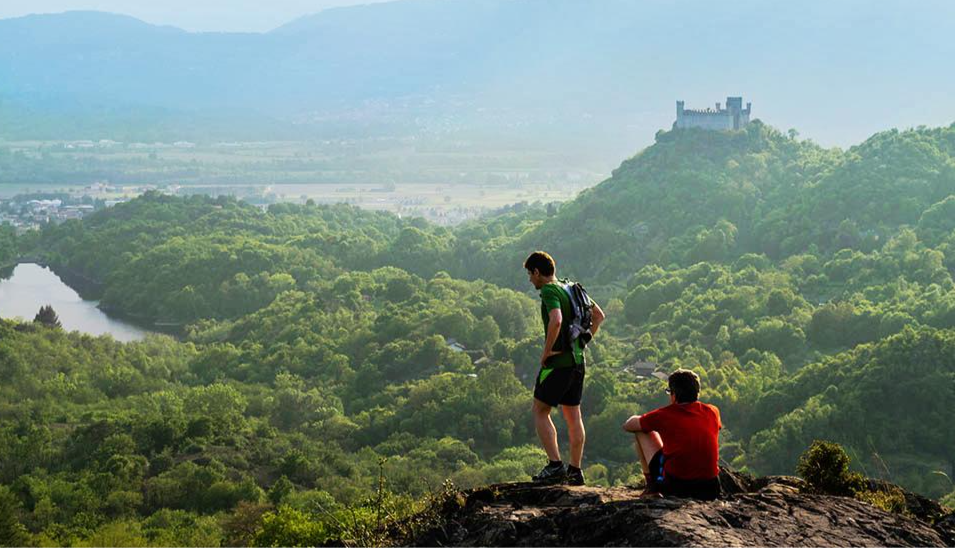
The "pera furà" is an ancient quarry of millstones, obtained in a rocky wall clearly visible from the locality Chiampano, which in turn rises just above another even more evident granite formation overlooking Borgone, where for years there has been a cliff of climbing. To reach the quarry, starting from the car park of the climbing wall, one follows the two existing paths on either side of the cliff, with both of them reaching Chiampano, while with the path on the right access is direct, with the one on the left it is necessary, once in the hamlet, turn right onto the main street thus reaching the signs for pera furà. Access to the quarry is carried out with a short stretch of aided path (metal pegs driven into the rock) and a stretch of path where you need to be careful not to slip. In five minutes you arrive at the cave, on the walls of which the marks left by the quarrymen and some millstones, well hewn, still set in the rock and never completed again, are clearly visible. continuing the climb towards Roccabruna (or Pietrabruna) you arrive, after a steep stretch of path, on the top of the "pear", with an exceptional view over the Susa valley. The hamlet, not far away, is abandoned. In the basements are found old vats, remains of barrels and some presses, witnesses of an ancient exploitation of the surrounding land as vineyards, where the remains of dry stone wall terraces are found (the toponym "vigne del rocco" is not chosen at random .. ..)
0
0

Upstream of the ford on the Rocciamelone stream, on the left orographic side, you can see two caves, called “Voute”, the result of erosive phenomena (area of geological interest) which hosted seasonal settlements of Neolithic shepherds. Source: https://www.parchialpicozie.it/page/view/sentiero-delle-voute/
0
0
Frequently Asked Questions
What types of caves and geological sites can I explore around Borgone Susa?
The Borgone Susa area offers a mix of historical quarries, natural erosive caves, and sites with evidence of ancient human settlements. You'll find fascinating locations like the Pera Furà Millstone Cave, which is an ancient quarry, and the Le Voute Caves, formed by natural erosion.
What is the historical significance of the caves and quarries in this region?
Many sites around Borgone Susa, such as the Antica Cava di Rocaforte and the Pera Furà Millstone Cave, are ancient quarries where millstones were extracted. These locations provide a unique glimpse into ancient trades and the hard work of stonecutters. The Le Voute Caves also hosted seasonal settlements of Neolithic shepherds, adding to the region's rich history.
What should I know about visiting the Pera Furà Millstone Cave?
The Pera Furà Millstone Cave is an ancient quarry where you can still see marks left by quarrymen and unfinished millstones. To reach it, you'll follow a path from the climbing wall car park, which includes a short aided section with metal pegs and a stretch where careful footing is needed. Continuing past the cave offers an exceptional view over the Susa valley.
Are there any natural caves to explore in the area?
Yes, beyond the historical quarries, you can find natural formations. The Le Voute Caves are a result of erosive phenomena, offering a natural geological interest. There's also The Wolf's Den, a natural cavity formed in serpentinite fractures.
What is the Cava abbandonata di Roca Furà, and what makes it unique?
The Cava abbandonata di Roca Furà (Abandoned Quarry of Roca Furà) is a historically significant man-made 'cave' near Borgone Susa, where millstones were extracted. It's unique for its evocative landscape, visible grooves from stone workers' tools, and semi-finished millstones left behind. The journey to it involves some rock climbing and an iron ladder, offering a sense of adventure and spectacular views over the lower Val di Susa.
What is the difficulty level for exploring these cave sites?
Many of the sites, such as the Pera Furà Millstone Cave and the Antica Cava di Rocaforte, involve intermediate to challenging paths, sometimes with aided sections or unstable terrain. The Cava abbandonata di Roca Furà is also suitable for experienced hikers due to its path requiring some rock climbing and an iron ladder.
Are there any family-friendly options for visiting caves or similar sites?
While many sites involve intermediate to challenging terrain, the Sanctuary of Our Lady of Lourdes is listed as family-friendly. It features a faithful reproduction of the famous Lourdes grotto, offering a beautiful and accessible place for reflection amidst nature.
What outdoor activities can I combine with a visit to the caves?
The region around Borgone Susa is excellent for outdoor activities. You can find numerous hiking routes, including challenging ones like the 'Antica Cava di Rocaforte – Chapel of Prarotto loop from Borgone di Susa'. There are also cycling and mountain hiking opportunities. For more details on routes, you can explore the Hiking around Borgone Susa guide.
Is there a cave or grotto with religious significance nearby?
Yes, the Sanctuary of Our Lady of Lourdes is a significant religious site. It features a faithful reproduction of the grotto where the Virgin Mary appeared in Lourdes, France, offering a peaceful place for meditation and prayer.
What is the best time of year to visit the caves and quarries in Borgone Susa?
The best time to visit is generally during the spring and autumn months when the weather is milder, making hiking and exploration more comfortable. Summers can be hot, and some paths might be more challenging in wet or icy winter conditions.
Where can I find more information about the Cava abbandonata di Roca Furà?
For more details on the Cava abbandonata di Roca Furà and a circular route that includes it, you can consult resources like visitvaldisusa.it, which describes a loop trail exploring legends, caverns, hamlets, and ancient trades of the Val di Susa.
Most popular routes around Borgone Susa
Most popular attractions around Borgone Susa

Get inspired with the komoot mobile app


Explore more
Extend your search for the best caves by checking out these guides of the top ones around Borgone Susa:
