Top 6 Natural Monuments around Umbertide
Best natural monuments around Umbertide are found in a region characterized by its blend of scenic beauty and historical significance. Umbertide, located in Umbria, Italy, is surrounded by a fertile green valley shaped by the Tiber River. The area features prominent natural landmarks such as Mount Acuto and Mount Corona, offering diverse outdoor activities. These natural features provide a backdrop for historical sites and extensive hiking opportunities.
Best natural monuments around Umbertide
- The most popular natural monuments is Monte Tezio…
Last updated: September 4, 2026
Monte Acuto Summit Cross
Highlight • Summit
Translated by Google •
Tip by

Monte Tezio
Highlight • Summit
You can move along the ridge from Tezino to the north but be careful because not the whole route is well defined …
Translated by Google •
Tip by

Sign up now to discover places like this
Get recommendations on the best single tracks, peaks, & plenty of other exciting outdoor places.
Sign up for free
Castelliere of Cima Cerchiaia and View over the Umbertide Valley
Highlight • Historical Site
Translated by Google •
Tip by

Sasso di San Donnino
Highlight • Natural Monument
Translated by Google •
Tip by
Ancient Chestnut Tree on Monte Ginezzo Trail
Highlight • Natural Monument
Translated by Google •
Tip by
Sign up for free to discover even more natural monuments around Umbertide.
Sign up for free
Already have an account?
Start today with a free account
Your next adventure awaits.
Login or Signup
Other adventures around Umbertide

Tips from the Community

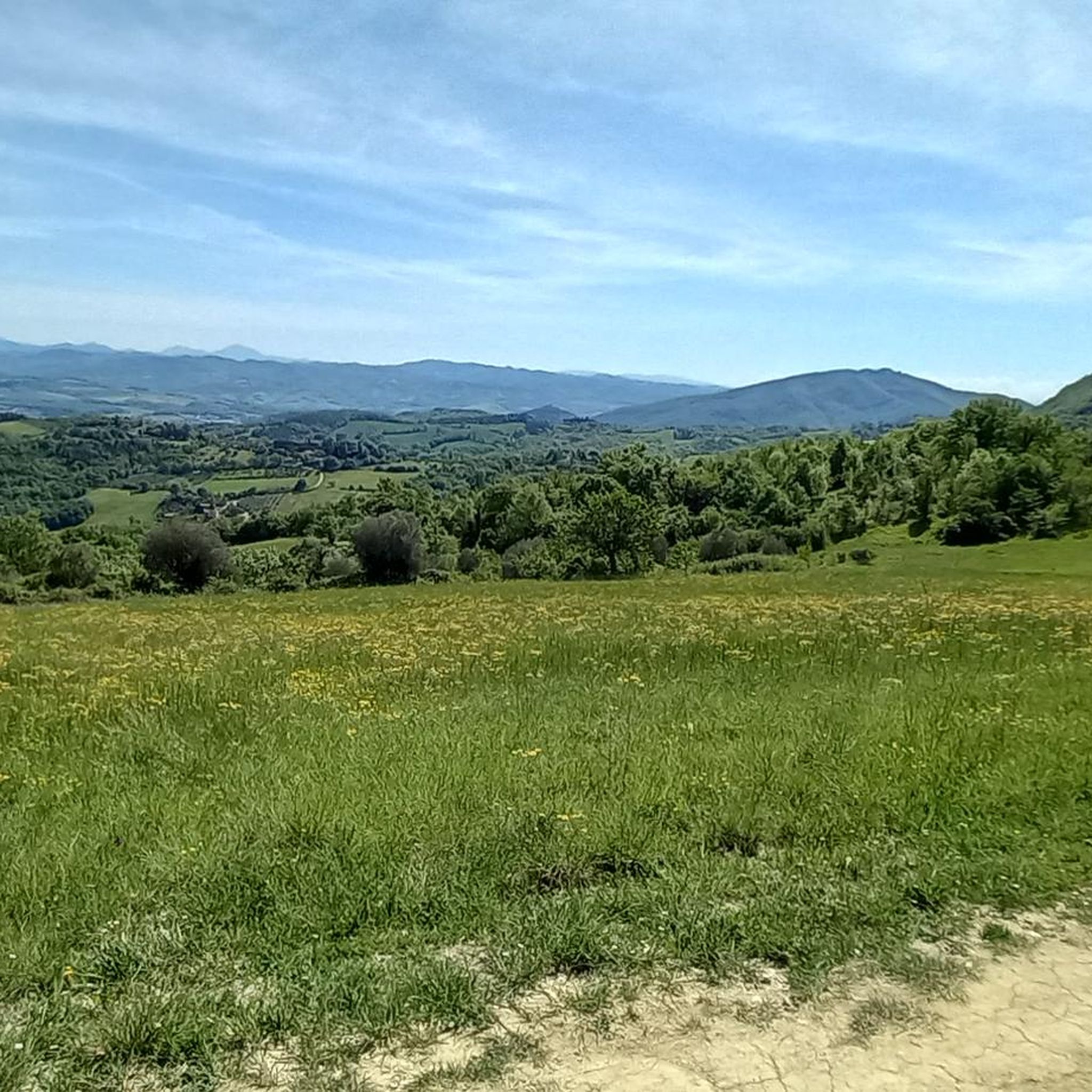
An evocative place, both for the piles of stacked stones that create a Zen and meditative context, and above all for the surprising panorama towards Umbertide and the valley below.
0
0

Here there is one of the castles that characterize some peaks in the region. Of protohistoric age, they are a rare testimony of the pre-Etruscan Umbrian civilization. They were masonry fortifications made of stones obtained on site, usually located on peaks with a strategic view.
0
0

This high summit cross has crowned Monte Acuto like a steel colossus for around 100 years. The fact that the construction appears very filigree despite the enormous dimensions is due to the open steel construction, which in turn takes up the basic principle of the half-timbered construction with horizontal and vertical beams and cross braces - which has been tried and tested for centuries. The builders of the cross dedicated it to the victims of the First World War, and so it towers over the heights as a warning to peace that can be seen from afar.
2
0

Along the path that passes under Mount Ginezzo, in the middle of a chestnut wood, there is this particular centuries-old chestnut which unfortunately has dried up.
0
0

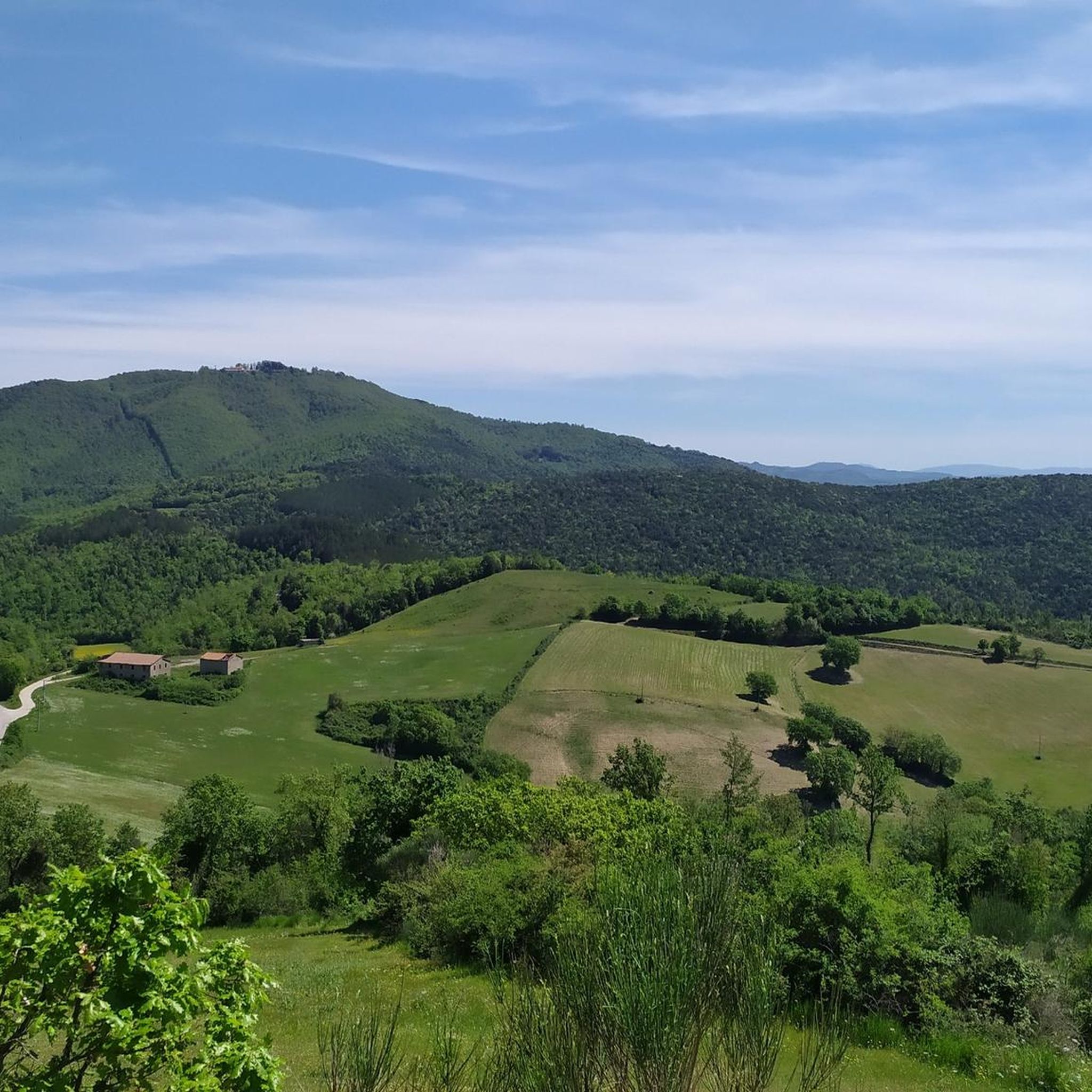
Stunning view from the top of Monte Acuto. You can also see the Trasimeno.
0
0
Sasso di San Donnino”, including the source, is known because it is the object of great devotion to San Donnino di Città di Castello, or San Donino, as he is called by the local faithful. A conspicuous number of saints with this name are known, starting with San Donnino di Fidenza, then a bishop of Dijon and one of Grenoble with the same name, two Greek martyrs, one of which from Thessalonica, an Irish holy abbot who died shortly after the 600 as our Donnino (died in 610), and others of minor importance. The scholars of San Donnino of Città di Castello usually draw their information from the ancient Legend of Tiferna (2) and from a manuscript by Alessandro Certini (3). From these documents it can be deduced that Donnino was a companion of the illustrious castellan saints Florido and Amanzio and that after the death of Amanzio, Donnino, "despising the frequency of men, and every worldly vanity, he began to live a hermitic and solitary life in a cave in a mountainous forest in a place called Robbiano (...) where he lived for a long time in great austerity of life feeding on apples wild and grassy, engaging in prayer and continuous contemplation…” (4). The hermit, however, was discovered by some peasants intent on collecting acorns, who disclosed his presence, so much so that from that moment many people flocked to him. Donnino, to defend his solitude, was forced to negotiate with his visitors, yes, accepting their help in building a "hut" to be able to live there, but on the condition that he would receive only one or two people every Saturday, accepting from them also something to eat. Only in this way was he able to continue to live his life of prayer and penance for the rest of the years. Tradition attests in various ways that people, however, flocked to visit the saint above all for his thaumaturgical qualities. The debate among historians to identify the "place known as Robbiano" has not yet ended (5), but the most plausible hypothesis is that the said "hut" was not located near our "Sasso", but in the immediate vicinity of the primitive place where the parish church of Santa Maria del Monte Rubbiano was located. The primitive place of the said parish was recognized by Angelo Tafi in a dilapidated farmhouse belonging to the Gnagnetti family, in Val di Pierle about three km from Mercatale; there was the ancient parish church, which since the seventh century was in the Diocese of Città di Castello and in 1325, with the establishment of the Diocese of Cortona, passed to said Diocese (6). It must be said that, after the seventh century, in an unspecified period, this parish church was transferred to a higher place about 800 meters away from there, where today the Church of S. Maria della Croce is located, and that after the transfer and until 29 January 1781 it was called Pieve di S. Maria e S. Donnino7. Very close to the Gnagnetti cottage there is still today the "fountain" to which, according to historians, the life and thaumaturgical activity of San Donnino is linked, and in whose vicinity there would have been the "cave" or "hovel" in which he lived the holy hermit. Not to be confused with the source located at the Sasso di San Donnino. In fact, we are dealing with the site called "Sasso di San Donnino", distinct from the places just described, located only a few kilometers away from them, but in the Diocese of Città di Castello, even at present. The site is not attested by any document; the attendance of the holy hermit at the "Sasso" is instead attested by a consolidated popular tradition, which historians tend not to take into consideration. Indeed, it is not easy to unravel the age-old problem relating to the San Donnino residence, perhaps to a certain extent polluted by obvious parochialism. From a lady who has always lived near the "Sasso" and who wishes to remain anonymous, I have gathered a substantial part of this popular tradition. According to his "oral source", San Donnino di Città di Castello would have originated in Romagna (obvious contamination of the tradition concerning San Donnino di Fidenza), would have landed near the ancient Pieve di Rubbiano and at a later time, due to the too many visits from the faithful, he would have moved to the "Sasso" to live more in isolation. In the last years of his life, now ill and close to death, the Bishop of Città di Castello would have come to get him, giving him more comfortable accommodation, in order to end his days (this last addition logically intends to justify the absence of burial at the locality the "Sasso" (8). In fact, a pious tradition links San Donnino to the "Sasso" and is reported in writing by Don Alfonso Marchesini: “It is said that S. Donnino often went to pray and worked various miracles there. This is confirmed by the fact that the faithful who are sick with kidneys go and lean on that stone and are healed. Sick children brought to this place recover after a few days..." (9).
0
0

Panorama Umbro really recommended!
0
0

Frequently Asked Questions
What are some of the most notable natural monuments to explore around Umbertide?
Umbertide is surrounded by several significant natural monuments. You can explore the prominent Monte Tezio, known for its expansive views over Umbria. Another key site is Monte Acuto Summit Cross, a historic monument on a summit offering panoramic vistas. The Tiber River, flowing through a fertile green valley, also offers numerous natural attractions, including the Tiber River Park.
Are there challenging hiking trails to natural monuments near Umbertide?
Yes, for those seeking a challenge, Mount Acuto offers demanding hiking opportunities. The ascent to its summit, where the Monte Acuto Summit Cross is located, can take approximately four hours with a significant elevation gain. Similarly, the ridge from Tezino to the north on Monte Tezio provides a challenging route with varied and sometimes rough terrain.
What are some easier natural monuments to visit for a relaxed experience?
The Tiber River and its surrounding park offer an easy and enjoyable experience, perfect for relaxed walks or gentle cycling. The Assino Valley also provides picturesque landscapes for scenic drives or leisurely strolls. For a blend of nature and history, the area around Sasso di San Donnino offers a tranquil forest setting with historical significance.
When is the best time of year to visit the natural monuments around Umbertide?
The spring and autumn months are generally ideal for visiting Umbertide's natural monuments. During these seasons, the weather is pleasant for outdoor activities like hiking and cycling, and the landscapes are particularly vibrant with spring blooms or rich autumn colors. The beech and chestnut forests of Mount Corona and Mount Acuto are especially beautiful in autumn.
Do any natural monuments near Umbertide have historical significance?
Many natural monuments in the area are rich in history. Mount Acuto features the Cima Cerchiaia, remains of a protohistoric fortified borough, and was once home to a mountain sanctuary. Mount Corona hosts the Hermitage of Montecorona, connected by an ancient path to the Camaldolese Abbey. The Castelliere of Cima Cerchiaia and View over the Umbertide Valley is a rare testimony of pre-Etruscan Umbrian civilization. The Sasso di San Donnino is also known for its deep religious and historical traditions.
What outdoor activities are available near Umbertide's natural monuments?
The region around Umbertide offers a variety of outdoor activities. You can enjoy extensive hiking trails on Mount Acuto and Mount Corona, or explore the Tiber River Park for easy cycling, canoeing, and horseback riding. For more structured routes, you can find numerous MTB trails, road cycling routes, and gravel biking routes that pass through these natural areas.
Are the natural monuments around Umbertide suitable for families or those with dogs?
Many areas are suitable for families and dogs, especially the less strenuous routes. The Tiber River Park, with its easy cycling paths and scenic walks, is a great option for families. Always ensure dogs are kept on a leash and follow local regulations, particularly in protected areas. Some trails, like those on Mount Acuto, can be challenging due to steep slopes and rocky terrain, so assess suitability for younger children or less agile dogs.
What natural features can I discover around Umbertide beyond mountains?
Beyond the prominent mountains like Mount Acuto and Monte Tezio, the region is defined by the Tiber River, which creates a fertile green valley. The Tiber River Park is a protected area showcasing rich flora, including oaks, willows, and poplars, and diverse fauna like ospreys and herons. You can also find ancient forests, such as the beech and chestnut woods on Mount Corona, and the picturesque Assino Valley.
What do visitors particularly appreciate about the natural monuments in Umbertide?
Visitors frequently praise the breathtaking panoramic views, especially from summits like Monte Tezio and the Castelliere of Cima Cerchiaia. The blend of natural beauty with historical intrigue, such as ancient fortifications and monastic sites, is also highly valued. The tranquility of the forests and the opportunities for diverse outdoor activities are often highlighted as key attractions.
Is public transport available to reach the natural monuments around Umbertide?
Public transport options directly to the trailheads of many natural monuments may be limited. It is often recommended to use a car to reach the starting points for hiking and exploring. However, Umbertide itself is accessible, and from there, local taxis or cycling can help you reach some closer natural attractions like the Tiber River Park.
Are there parking facilities near the natural monuments?
For most major natural monuments and trailheads, you will typically find designated parking areas. However, it's always advisable to check specific locations beforehand, especially for more remote sites. Parking availability can vary, particularly during peak seasons.
Can I find ancient trees or unique flora among Umbertide's natural monuments?
Yes, the region is home to ancient and diverse flora. The forests of Mount Acuto and Mount Corona feature thick beech and chestnut trees. You can also find specific notable trees, such as the Ancient Chestnut Tree on Monte Ginezzo Trail, which, despite having dried up, remains a significant landmark along the path.
Most popular routes around Umbertide
Most popular attractions around Umbertide

Get inspired with the komoot mobile app


Explore more
Extend your search for the best caves by checking out these guides of the top ones around Umbertide:
