Top 9 Natural Monuments around Le Pecq
Best natural monuments around Le Pecq include diverse natural and landscaped areas along the Seine River and near the Saint-Germain-en-Laye Forest. This region offers a mix of historical sites, expansive parks, and tranquil waterscapes. Visitors can explore significant river confluences, protected natural areas, and trails designed for appreciating local flora. The landscape provides opportunities for relaxation, recreation, and connecting with the local environment.
Best natural monuments around Le Pecq
- The most popular natural monuments is Bassin de Flore, a…
Last updated: July 4, 2026
Grande Cascade of Saint-Cloud Park
Highlight • Waterfall
Ducks, swans and nutria everywhere!
Translated by Google •
Tip by

Latona Fountain
Highlight • Monument
Translated by Google •
Tip by

Sign up now to discover places like this
Get recommendations on the best single tracks, peaks, & plenty of other exciting outdoor places.
Sign up for free
Old Chestnut Tree at Place Audran
Highlight • Natural Monument
Translated by Google •
Tip by

Etang de Saint-Cucufa
Highlight • Lake
Translated by Google •
Tip by

Bosquet of the Baths of Apollo
Highlight • Monument
Translated by Google •
Tip by
Sign up for free to discover even more natural monuments around Le Pecq.
Sign up for free
Already have an account?
Start today with a free account
Your next adventure awaits.
Login or Signup

Tips from the Community

Added to the collection: komoot.com/de-de/collection/3600632/-naturdenkmaeler-besondere-baeume-und-weitere-schaetze-der-natur
0
0

This 200-hectare forest was acquired by Joséphine de Beauharnais in 1800, the first wife of Emperor Napoleon I. The estate extended over a thousand hectares as far as the woods of La Celle-Saint-Cloud. The Empress particularly appreciated this walking area and often took her guests there for horse-drawn carriage rides. Near the Saint-Cucufa pond, she had a sheepfold and a stable built. The latter is still visible and today houses the forest rangers of the National Forestry Office. After Joséphine's death, the estate was divided up and partially deforested. It was her great-nephew, Napoleon III, who saved the forest from fragmentation through exchanges. He bought it in 1856 and incorporated it into his civil list. In 1870 and 1871, the Malmaison State Forest was the site of fierce assaults by Captain de Nisme's artillery against the Prussians entrenched behind the Buzenval wall. In 1871, the forest became state-owned when it became part of state property. Since 1966, it has been managed by the National Forestry Office. It is composed mainly of trees such as chestnut, oak, ash, cherry, sycamore, beech, and birch. You descend to the beautiful pond on the left (be careful, there is a steep descent with many walkers and dogs—usually kept on leashes) where you can admire numerous birds (woodpecker, moorhen, heron, etc.). Access to the pond is via an unpaved path for 100 meters. Access to the Château de la Malmaison and its park in Rueil-Malmaison (bicycle racks in front of the castle entrance): 2 km. You will then join trail no. 4 "From the Empress to the Impressionists." Go back up to the right until you reach the entrance to the woods (the way you came in). On the way up, on the left: you can complete the fitness trail on foot. At the exit of the Bois de St. Cucufa: restaurant and bakery. Head towards the old village of Garches, a steep descent. You can admire the St. Louis Church, the Sidney Bechet Cultural Center, the town hall (restrooms accessible on weekdays), and its park. There are many shops but no bicycle racks.
1
0

The Grande Cascade (1856) is a 14-metre-high artificial waterfall made of Fontainebleau rocks. The waterfall is fed by the Etang de reservoir.
0
0

The children are delighted to go under the waterfall
0
0

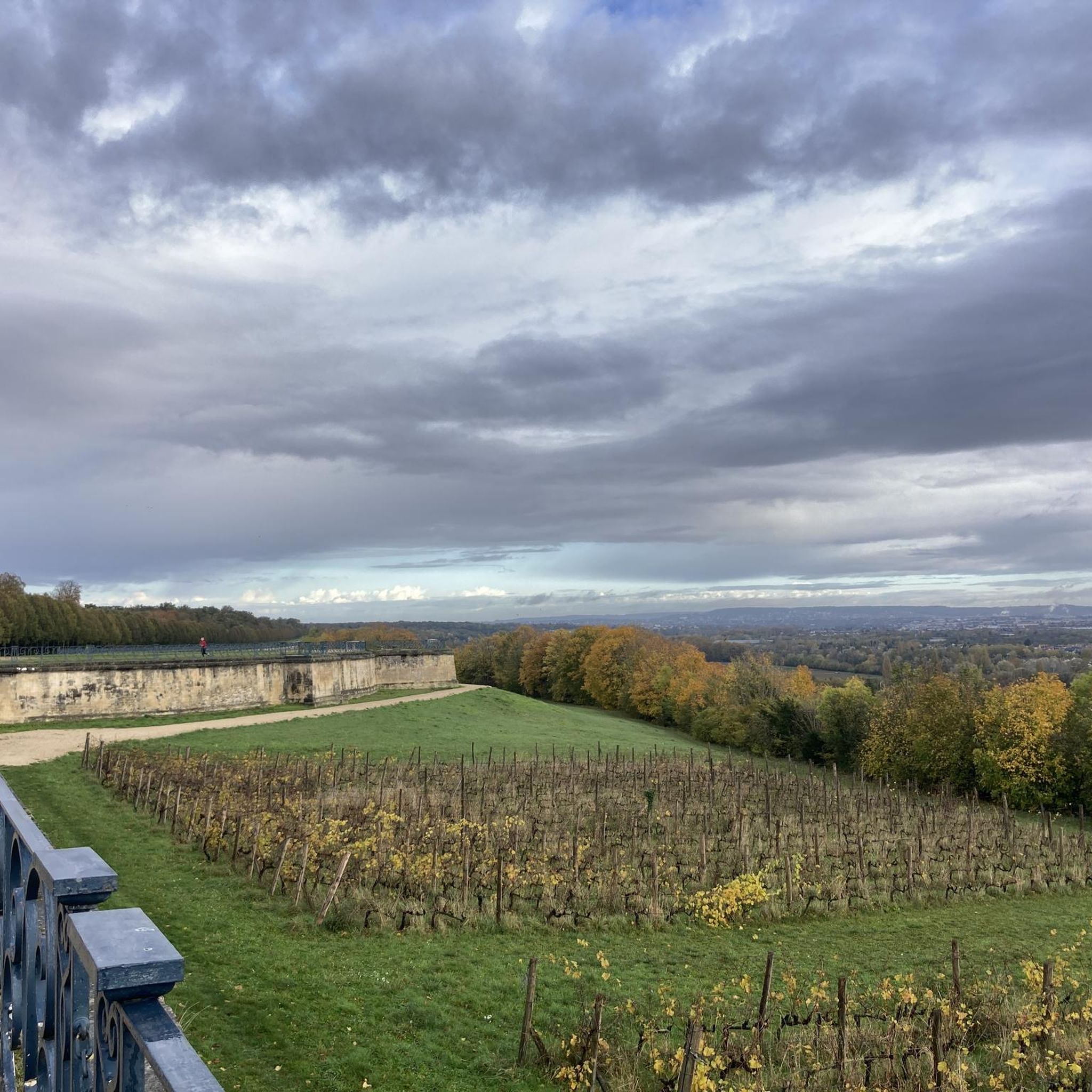
The current grove dates from the reign of Louis XVI, laid out between 1778 and 1781. Its center is occupied by a lake dominated by a huge fake rock embellished with waterfalls and hollowed out with a cave. This hosts the sculptures of the Horses of the Sun placed on either side of the group of Apollo served by the nymphs, created by François Girardon and Thomas Regnaudin. https://bienvenue.chateauversailles.fr/fr/jardins/bienvenue/304_bosquet-des-bains-d-apollon#!panel-46
6
0
The Latona basin results from the desire of Louis XIV to create, in the center of his Garden, a fountain which recounts the childhood of Apollo, the sun god he chose as his emblem. To create this fountain, Louis XIV transformed a pool dug by Louis XIII by gradually installing water features and decorations sculpted by the Marsy brothers. The Latona basin went through several states before adopting its current form. In 1667, it was the Toad Fountain. From 1668 to 1670, a first Latona basin appeared; Latona is then at the same level as the other figures and turned towards the Castle. From 1687 to 1689, Jules Hardouin-Mansart created the current pool, by making Latona turn around and hoisting her to the top of a marble pyramid. http://latone.chateauversailles.fr/page/le-bassin-de-latone/histoire-du-bassin
11
0


An article if you are interested in the subject: https://france3-regions.francetvinfo.fr/paris-ile-de-france/paris/grand-paris/un-chataignier-des-yvelines-elu-plus-bel-arbre- of-the-year-2424739.html
1
0
Frequently Asked Questions
What natural features can I expect to see around Le Pecq?
Le Pecq, situated along the Seine River, offers a mix of natural and landscaped areas. You'll find tranquil riverbanks, green spaces like Parc Corbière and Parc du Peuple de l'Herbe, and notable individual trees such as the Old Chestnut Tree at Place Audran. While some highlights are man-made monuments within grand gardens, they often incorporate natural elements like waterfalls and lakes, such as the Grande Cascade of Saint-Cloud Park and the Bosquet of the Baths of Apollo.
Do these natural monuments have historical significance?
Yes, many of the natural monuments around Le Pecq are deeply intertwined with history. For instance, the Latona Fountain and the Bassin de Flore are integral parts of the historic Versailles gardens, reflecting the grandeur of Louis XIV's era. Even natural elements like the Old Chestnut Tree at Place Audran have centuries of history, having been planted during the reign of Louis XIV and witnessing significant historical events.
Are there family-friendly natural monuments around Le Pecq?
Absolutely! Several natural monuments are great for families. The Grande Cascade of Saint-Cloud Park is particularly child-friendly, with visitors enjoying exploring secret passages behind the waterfall and spotting ducks and swans. Parc Corbière, mentioned in region research, is also a much-loved relaxation area for families, featuring a playground and a mini-farm. The Bosquet of the Baths of Apollo and Bassin de Flore are also categorized as family-friendly.
What outdoor activities can I do near the natural monuments around Le Pecq?
The area around Le Pecq offers a variety of outdoor activities. You can enjoy strolls along the Seine Riverbanks, explore the extensive Forêt de Marly by foot, bike, or horseback, or embark on cruises from the port of Le Pecq. For more structured activities, there are numerous routes for mountain biking, hiking, and running. You can find detailed routes and guides for MTB Trails around Le Pecq, Hiking around Le Pecq, and Running Trails around Le Pecq.
Are there hiking trails near these natural monuments?
Yes, there are many hiking opportunities. The Forêt de Marly, easily accessible from Le Pecq, offers diverse landscapes for walking. You can also find specific hiking routes around the region, such as the 'Forest of Saint-Germain-en-Laye Loop' or 'View of Paris and La Défense – Reed Pond loop from Saint-Germain-en-Laye'. These trails vary in difficulty from easy to moderate. For a comprehensive list of routes, check out the Hiking around Le Pecq guide.
Are the natural monuments and nearby trails dog-friendly?
While specific rules for each monument vary, many natural outdoor areas and trails around Le Pecq are generally dog-friendly, especially if dogs are kept on a leash. The Seine Riverbanks and larger green spaces like Parc du Peuple de l'Herbe are popular for walks with pets. Always check local signage for specific restrictions within parks or protected areas.
What is the best time of year to visit the natural monuments around Le Pecq?
The natural monuments around Le Pecq can be enjoyed year-round, but spring and autumn often offer the most pleasant weather for outdoor exploration. Spring brings blooming flowers and lush greenery, while autumn provides beautiful foliage. Summer is also popular, especially for activities along the Seine. Winter can be charming, though some water features might be less active.
How accessible are the natural monuments around Le Pecq by public transport or car?
Le Pecq is well-connected, making its natural monuments relatively accessible. Public transport options, including local buses and RER lines, can get you to the vicinity of many sites. For those traveling by car, parking is generally available near major parks and attractions, though it might be limited in some residential areas or during peak times. The region research mentions the installation of a station nearby the Old Chestnut Tree, indicating good transport links.
What do visitors enjoy most about the natural monuments in Le Pecq?
Visitors particularly enjoy the blend of natural beauty and historical grandeur. The majestic waterfalls like the Grande Cascade of Saint-Cloud Park are often highlighted for their beauty and interactive elements. The serene views from places like the Latona Fountain, extending over vast gardens, are also a favorite. The unique character and historical depth of sites like the Old Chestnut Tree at Place Audran, which won the Public Prize for 'Tree of the Year', also captivate visitors.
Are there any hidden natural gems or unique natural features in the area?
Beyond the well-known sites, the Le Pecq Bird Island on the Seine is a notable natural diversity spot. The Forêt de Marly, while not directly in Le Pecq, is a significant 'green lung' nearby, offering surprisingly hilly terrain, over 50 ponds, and rich flora and fauna, including 80 bird species. It's classified as a ZNIEF (Zone of Ecological, Faunal, Floral, and Landscape Interest), making it a valuable destination for nature lovers seeking less crowded spots.
How much time should I allocate to visit these natural monuments?
The time needed varies greatly depending on the monument. For individual highlights like the Old Chestnut Tree at Place Audran, a short stop of 15-30 minutes might suffice. However, exploring larger areas like the Saint-Cloud Park (home to the Grande Cascade) or the Forêt de Marly could easily take several hours or even a full day, especially if you plan to combine your visit with hiking or cycling.
Most popular routes around Le Pecq
Most popular attractions around Le Pecq

Get inspired with the komoot mobile app


Explore more
Extend your search for the best caves by checking out these guides of the top ones around Le Pecq:
