Attractions and Places To See around Grandfontaine - Top 20
Best attractions and places to see around Grandfontaine, a mountainous commune in the Bas-Rhin department of France, offers a variety of sites for visitors. The area is known for its connection to the Donon massif, a significant peak in the Lower Vosges. This region features historical landmarks, natural features, and cultural sites. Visitors can explore locations with ancient pasts and enjoy viewpoints across the landscape.
Best attractions and places to see around Grandfontaine
- The most popular attractions is Porrentruy Castle…
Last updated: July 6, 2026
Passerelle de Clairbief
Highlight • Bridge
Translated by Google •
Tip by

Notre-Dame-du-Mont Chapel
Highlight • Religious Site
Translated by Google •
Tip by

Sign up now to discover places like this
Get recommendations on the best single tracks, peaks, & plenty of other exciting outdoor places.
Sign up for free
Porrentruy Castle
Highlight • Castle
Tip by

Porrentruy Botanical Garden
Highlight • Natural Monument
Translated by Google •
Tip by

Moulin Jeannottat
Highlight • River
Translated by Google •
Tip by
Sign up for free to discover even more attractions around Grandfontaine.
Sign up for free
Already have an account?
Start today with a free account
Your next adventure awaits.
Login or Signup
Tips from the Community

Many churches in France, including this chapel, are dedicated to the Virgin Mary under the widely used title "Notre-Dame" (in German: "Our Dear Lady"). A brief thought on the Mother of God from Albino Luciani (Pope John Paul I): "Mary is indeed our sister, as Saint Ambrose says. She led a life very similar to ours. It is of course beautiful to venerate Mary as the Virgin and Mother of God, as the one conceived immaculately by original sin and taken up into heaven; but she is also the Madonna of plates, brooms and cooking pots..." Every visitor to this small Marian shrine can decide for themselves which "Notre-Dame" they would like to venerate here.
2
0

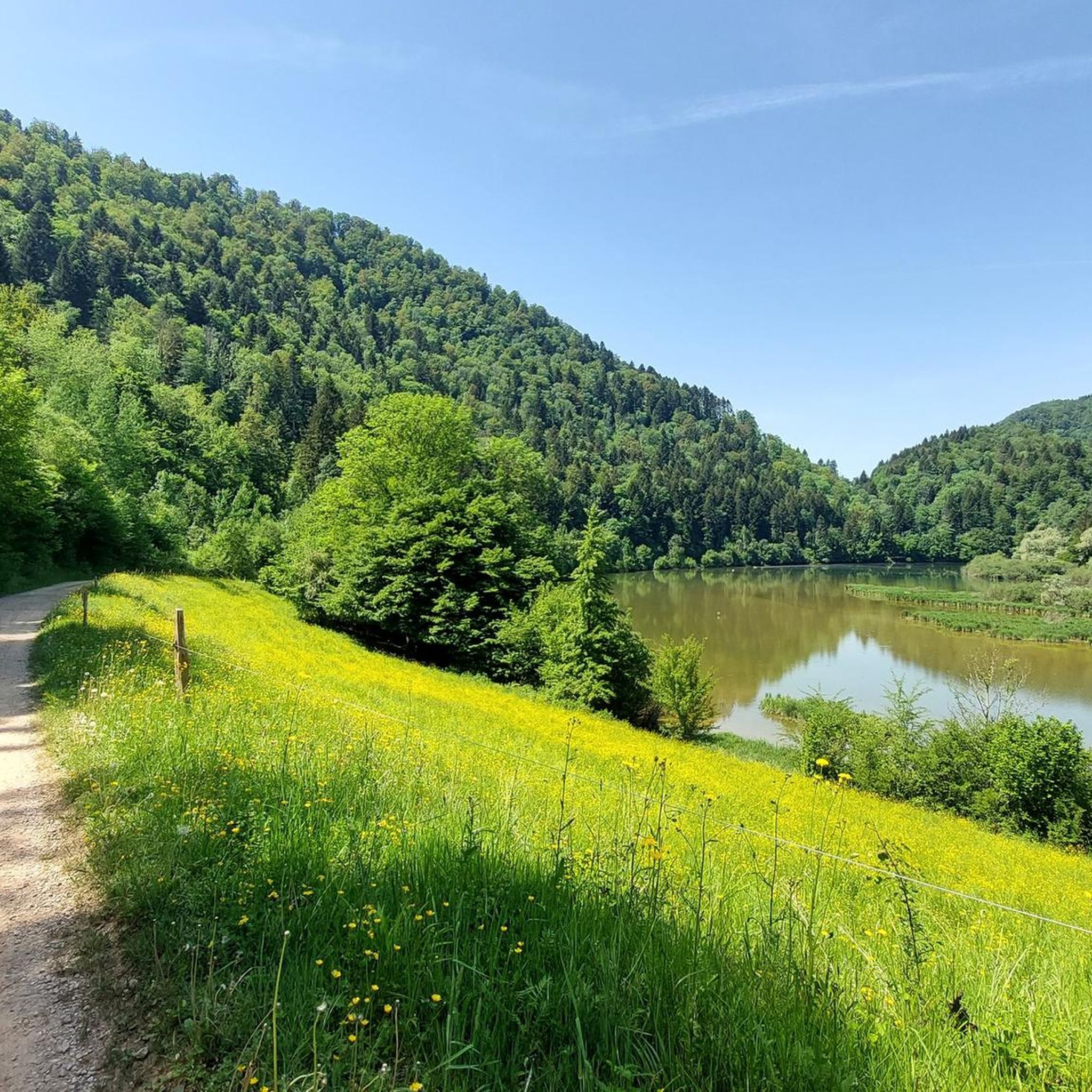
Moulin Jeannottat is a picturesque site located in the Jura region of Switzerland where you can indulge in a challenging trail run. You will follow the Doubs, cross forests and meadows and pass this historic mill dating from the 17th century and used for grinding grain and sawing wood. It also served as a border post between France and the Principality of Basel until 1780. The mill is now privately owned, but you can admire its architecture and surroundings.
2
0
This bright red suspension bridge spans the Doubs near the village of Enfers. Be careful not to lose your balance on the deck, as it can sway in the wind.
3
0

Very simple but stable construction!
1
0

The small campsite (300m away) is private. There is a sign there telling you to go to the Moulin Jeannottat restaurant. However, this no longer exists. It is best to inquire directly with the resident / owner of the house.
1
1

In 1542, construction of a first oratory to house a statue of the Virgin reputed to be miraculous. The chapel, which had become a place of pilgrimage, was enlarged in 1721 and burned down during the German attack in June 1940. Bell tower and nave are destroyed, but the choir is saved. Rebuilt in September 1940. The chapel is located directly on the GR5 and offers a drinking water point 👍
1
1

Porrentruy Castle is certainly the highlight of any city tour. Large parts of the castle are open to the public. From up here you can enjoy a fantastic view over the medieval town and its surrounding area. The centerpiece of the castle is the mighty Réfus Tower. It can be climbed up to the top of the tower roof, with a spiral-like external staircase leading to the entrance, which is 9 m above the ground. If you want to go up here, you should have a head for heights. Numerous "bilingual" information boards pass on their knowledge about the history of the castle to visitors. Behind the castle, there are lush meadows that invite you to take a walk. Anyone who is unable to walk can easily park their car behind the palace complex. There were even pitches for campers with electricity, etc. thought and behind the castle wall there is a clean toilet block. If you want to leave the castle towards the city, you can either do so via a spiral staircase or use the elevator.
1
0
If you stop in Porrentruy, if you are a herb, plant and flower enthusiast, you should definitely pay a visit to the Parc du Jardin Botanique. After the botanical garden in Basel, it is the second oldest in Switzerland. It is striking that in addition to the almost inexhaustible variety of plants, one or the other sundial on several house fronts shows the time in a shadowy way. A particularly idiosyncratic and modern example can be seen at the end of the park when you enter the area through the main portal. Right next to the botanical garden, there is a public car park that is subject to a fee. From the botanical garden, you can continue your journey of discovery in the direction of the old town, or pay your respects to the castle above the city.
0
0
Frequently Asked Questions
What historical sites can I visit around Grandfontaine?
The region around Grandfontaine is rich in history. You can explore the ruins of the 13th-century Château de Salm, which offers panoramic views from its ancient keep. Another significant historical site is the Temple du Donon, a cult site with archaeological finds and sublime views. The Mines de Grandfontaine, once the richest iron deposit in the Vosges massif, is also a redeveloped historical monument. Additionally, the Notre-Dame-du-Mont Chapel, a Marian shrine first constructed in 1542, holds historical significance.
Are there any natural attractions or viewpoints in the Grandfontaine area?
Yes, the area boasts several impressive natural features and viewpoints. Mont Donon, one of the highest peaks in the Lower Vosges, offers exceptional viewpoints in all directions. La Chatte Pendue also provides superb views of the Champ du Feu massif and Climont. The Porte de Pierre is a beautiful rock gate made of red sandstone with impressive vistas, serving as a starting point for paths to other natural features. You can also visit the Source de la Sarre Blanche, where the Sarre River originates.
What outdoor activities are available near Grandfontaine?
Grandfontaine is an excellent base for outdoor enthusiasts. You can find numerous routes for various activities. For hiking, explore trails like the 'Tour Faux d'Enson' or the 'Church of Roche-d'Or – Daffodil Meadow loop'. Cyclists can enjoy road cycling routes such as the 'Col de la Croix via Seleute' or 'Saint-Amand Church of Bure – Château de Porrentruy loop'. Gravel biking is also popular, with routes like the 'Gravel loop from Porrentruy' or the 'Technical and enjoyable route'. For more details on these and other routes, visit the Hiking around Grandfontaine, Road Cycling Routes around Grandfontaine, and Gravel biking around Grandfontaine guides.
Are there family-friendly attractions around Grandfontaine?
Absolutely! Families can enjoy the Porrentruy Botanical Garden, one of Switzerland's oldest, featuring over 600 local plant species and now part of the Nature Museum. The Porrentruy Castle is also considered family-friendly, offering historical exploration and views. Additionally, the picturesque Moulin Jeannottat, a historic mill along the Doubs, is a great spot for families to explore trails and enjoy the riverside.
What cultural sites are there to visit in and around Grandfontaine?
Beyond historical landmarks, the region offers several cultural sites. The Musée du Donon, located on the Donon massif, preserves the history and archaeological findings related to the mountain. The Église Saint-Jacques-le-Majeur is part of Grandfontaine's local cultural heritage. Further afield, you can visit the Struthof - Former Natzweiler-Struthof Concentration Camp Memorial in Natzwiller, the Mémorial Alsace-Moselle in Schirmeck, and the Musée Oberlin in Waldersbach, honoring Pastor Oberlin.
Where can I find a botanical garden in the area?
The Porrentruy Botanical Garden is a notable attraction. It is one of the oldest botanical gardens in Switzerland, established in 1798. It showcases over 600 local plant species, with a focus on more than 70 varieties of roses and 180 varieties of irises. It is now part of the Nature Museum.
Are there any castles to visit near Grandfontaine?
Yes, you can visit the well-preserved Porrentruy Castle, a late medieval to early baroque structure. It offers fantastic views over the medieval town and its surroundings. The mighty Réfus Tower is a centerpiece, and parts of the castle are open to the public. Additionally, the ruins of the 13th-century Château de Salm provide a glimpse into the region's ancient past.
What is the Moulin Jeannottat?
The Moulin Jeannottat is a picturesque and historic mill located in the Jura region. Dating from the 17th century, it was used for grinding grain and sawing wood, and also served as a border post. It's a great spot where several hiking trails meet, and the banks of the Doubs river nearby offer a wonderful place for rest or even a swim.
What do visitors enjoy most about the attractions around Grandfontaine?
Visitors particularly appreciate the blend of historical significance and natural beauty. The panoramic views from sites like Porrentruy Castle and the Temple du Donon are highly praised. The historical context of places like the Notre-Dame-du-Mont Chapel and the Mines de Grandfontaine also captivates many. The diverse plant species at the Porrentruy Botanical Garden and the tranquil riverside setting of Moulin Jeannottat are also frequently highlighted as enjoyable experiences.
Are there any significant mountains or peaks in the Grandfontaine area?
Yes, Mont Donon is a prominent feature, culminating at 1,009 meters and recognized as one of the highest peaks in the Lower Vosges. It has been a place of worship since Celtic times and offers exceptional viewpoints. Another notable summit is La Chatte Pendue, reaching 899 meters, which provides superb views of the surrounding massifs.
Can I find trails for cycling near Grandfontaine?
Yes, there are several options for cycling. The Gravel Path Along the Doubs is a good alternative for cyclists, offering a well-maintained track through forests and along the river. For more structured routes, you can explore the Road Cycling Routes around Grandfontaine or the Gravel biking around Grandfontaine guides, which list various routes with different difficulty levels.
Most popular attractions around Grandfontaine

Get inspired with the komoot mobile app


Explore more
Still not found the Highlight you’re looking for? See guides of the top attractions in other regions:
