The best traffic-free bike rides around Oberschlettenbach
4.6
(352)
4,293
riders
16
rides
No traffic road cycling routes around Oberschlettenbach traverse a landscape characterized by rolling hills, dense forests, and the transition into the Palatinate wine country. The region features distinctive red sandstone rock formations and historic castles, providing varied terrain for road cyclists. Elevations are generally moderate, with routes often including gentle inclines and some sections with short, steeper hills. The area offers a mix of shaded forest roads and open vineyard paths.
Best no traffic road cycling routes around Oberschlettenbach
- The…
Last updated: August 21, 2026
4.9
(23)
101
riders
Moderate road ride. Good fitness required. Some segments of this route may be unpaved and difficult to ride.
5.0
(1)
26
riders
Easy road ride. Great for any fitness level. Mostly well-paved surfaces and easy to ride.

Sign up for free
32
riders
Easy road ride. Great for any fitness level. Mostly well-paved surfaces and easy to ride.
18
riders
Moderate road ride. Good fitness required. Some segments of this route may be unpaved and difficult to ride.
5.0
(5)
17
riders
Moderate road ride. Good fitness required. Mostly well-paved surfaces and easy to ride.
Get access to more routes and recommendations from other explorers.
Sign up for free
Already have an account?
Our route recommendations are based on thousands of hikes, rides, and runs completed by other people on komoot.
Start today with a free account
Your next adventure awaits.
Login or Signup
Popular around Oberschlettenbach
Tips from the Community

Cool rock formation in the Dahner Felsenland.
1
0

A memorial stone erected on the occasion of the 90th birthday of Prince Regent Luitpold of Bavaria. Next to the memorial stone stands an oak tree planted on that day. From here, a path leads to the Weißenberg hill where the Luitpold Tower stands. Prince Regent Luitpold of Bavaria was born on March 12, 1821, the fifth child of King Ludwig I of Bavaria. Before assuming power on June 9, 1886, he rose through the ranks of the army to become Inspector General. During his twenty-five-year reign, the Kingdom of Bavaria experienced a golden age. The Palatinate belonged to Bavaria from 1816 to 1949. In honor of the Prince Regent, streets, theaters, parks, schools, observation towers, and even cakes were named after him. For example, Prinzregentenstraße, Prinzenweg (see Rittersteine No. 41), Prinzregententheater, Luitpoldpark, Luitpoldturm and the Prinzregententorte. He died on December 12, 1912.
1
0

The Hochstein remains one of the most impressive rock formations in the Palatinate, especially since it is less obscured by forest than others. From the top, there is a fantastic view (for climbers).
6
0

St. Anne's Chapel near Niederschlettenbach is a medieval pilgrimage chapel containing the tomb of the knight Hans von Droth (also known as Troth or Trotha). Saint Anne is the patron saint of miners and boatmen. This suggests that the chapel was built on this site to praise God, as mining was practiced in the Wasgau region from an early period. A former iron ore mine is also located in the immediate vicinity.
2
0

Knight's Stone "Prince Regent Luitpold, 90 Years Old, March 12, 1911" near Hermersbergerhof Knight's Stone No. 70 The Knight's Stone "Prince Regent Luitpold, 90 Years Old, March 12, 1911" (Knight's Stone No. 70) is located on the forest road between Hermersbergerhof and Weißenberg. The PWV markings "Blue-White Line," "Blue Cross," and "Blue-Red Line" lead past the Knight's Stone. "Prince Regent Luitpold, 12 March 1911, 90 Years Old" is a Knight's Stone from the category "Honors of Personalities." Knight's Stones in this category are intended to honor individuals who have rendered outstanding services to the Palatinate or the Palatinate Forest (according to Eitelmann 2005). The Knight's Stone was erected in honor of the 90th birthday of Prince Regent Luitpold Karl Joseph Wilhelm of Bavaria on March 12, 1911 (1821-1912). An oak tree was planted next to the Knight's Stone on the same day. Even as a young man, Prince Regent Luitpold served as a soldier in the army and later in all ranks of the service, up to Inspector General. He witnessed the consecration ceremony in 1871, when King Wilhelm of Prussia was awarded the imperial title of the new German Empire. In 1886, his nephew, King Ludwig II, was deposed from his office as King of Bavaria. When he drowned in Lake Starnberg a few days later, Prince Regent Luitpold assumed his office at the age of 65 (Eitelmann 2005, pp. 65/66). "Formally, Ludwig's brother Otto was proclaimed King of Bavaria, but since he was mentally ill and thus incapable of governing, Luitpold took over the office." (hdgb.eu, October 20, 2020). At the beginning of Luitpold's reign, he was suspected of being responsible for his nephew's death, which is why he was initially unpopular with the people. Until his death, he brought Bavaria years of peace through his political restraint, modesty, efficiency, and popular appeal. "With the dutiful "exercise" of his representative role, with With his popular appeal and friendliness, the Prince Regent quickly won over the population..." (hdgb.eu, October 20, 2020). The Ritterstein is an upright, almost rectangular sandstone boulder. It bears the inscription: PRINZREGENT / LUITPOLD / 12. MARCH 1911 / 90 YEARS OLD. At the bottom right is the abbreviation P. W. V. for Pfälzerwald-Verein (Palatinate Forest Association). Source: https://www.kuladig.de/Objektansicht/KLD-279008
0
0
The Dreiherrenstein (Knight's Stone No. 57), located in a saddle south of the Weißenberg towards Hermersbergerhof, is a historical border marker. It is somewhat hidden in the forest near County Road 56 and a hiking trail marked with a "blue cross." It is a flat boulder that documents the border situation in 1773 between the converging estates of the Wittelsbach Dukes of Palatinate-Zweibrücken, the Leiningen Counts (Leiningen-Hardenburg-Dagsburg line), and the Gräfenstein Lordship, which belonged to the Margraviate of Baden. For this purpose, not only the coats of arms of these estates but also the boundaries of the historical forest districts were carved into the surface of the rock. The Baden coat of arms with the letters "MB" (Margraviate of Baden), as well as the coat of arms of Palatinate-Zweibrücken with its diamond structure and the suffix "PZ" (Palatinate-Zweibrücken), are still clearly visible. The letters "KW" (Royal Forest) were added after 1831 during the Bavarian period of the Palatinate and served to mark the Bavarian state forest. Furthermore, during the development of the rock into the Ritterstein (Knight's Stone) by the Palatinate Forest Association, the inscription "Dreiherrenstein" (Three Gentlemen's Stone) and the abbreviation "PWV" were engraved on its front—as is customary in such cases. Source: https://de.wikipedia.org/wiki/Dreiherrenstein_(Frankenweide)
0
0

Saint Anne is the mother of the Blessed Virgin Mary, the grandmother of Jesus Christ—not attested in the biblical texts. She is mentioned, however, in apocryphal (i.e., not included in the canon of the Bible) writings, for example, in the so-called "Protoevangelium of James." There is no historically verified information about Anne's life, but numerous traditional stories exist, summarized, for example, in the medieval "Legenda Aurea" by the Dominican monk Jacobus de Voragine. Among many other places of worship—such as this one—she is the patron saint of St. Anne's Church in Düren (North Rhine-Westphalia), where a piece of her skullcap has been kept and venerated as a relic since the early 16th century. In the church calendar, Saint Anne's feast day—together with her husband Joachim—is July 26th.
0
0

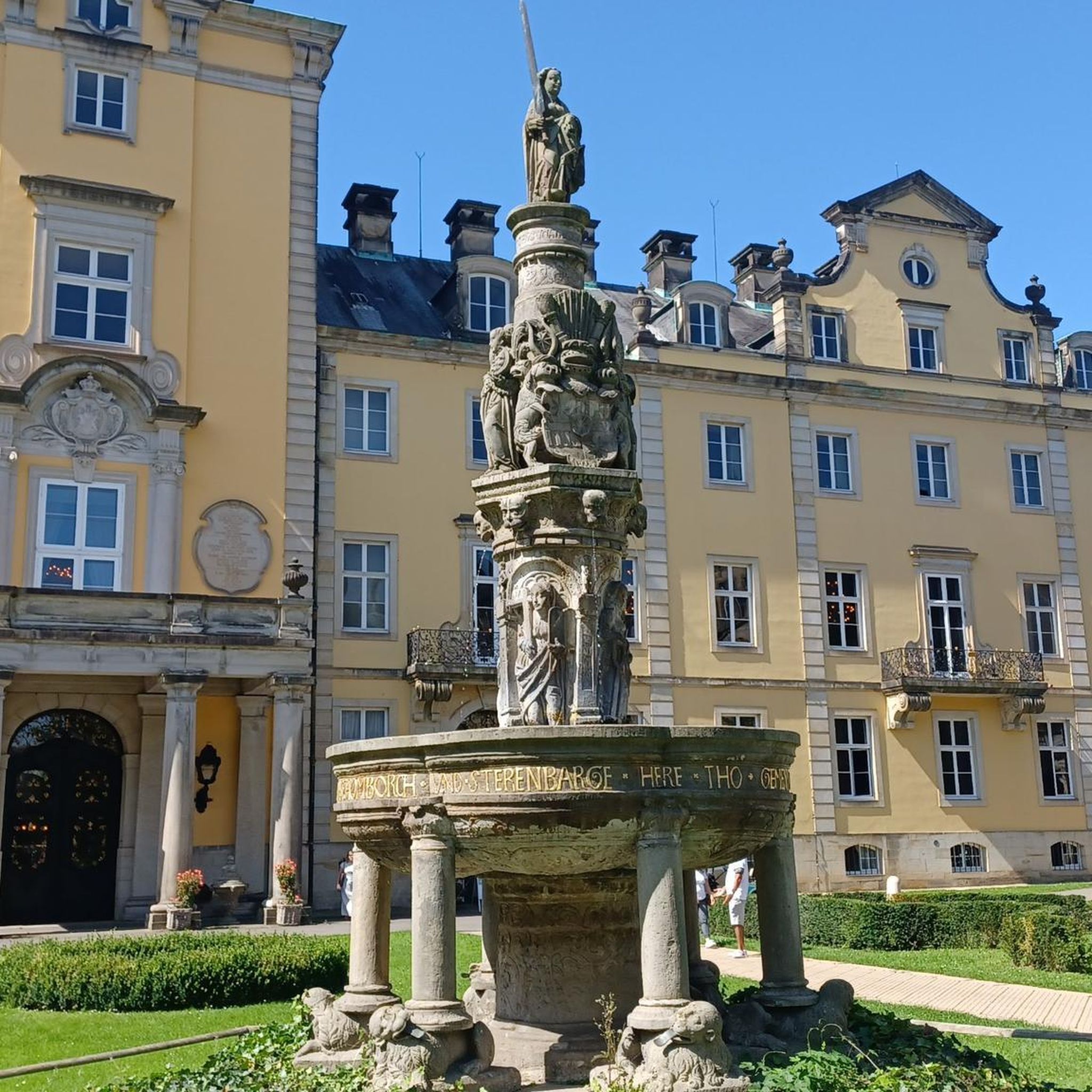
Historic stone fountain from 1909, unfortunately no drinking water.
9
0
Frequently Asked Questions
How many no traffic road cycling routes are available around Oberschlettenbach?
Komoot offers 13 dedicated no traffic road cycling routes around Oberschlettenbach. These routes are carefully curated to provide a serene cycling experience away from busy roads, allowing you to fully enjoy the Palatinate landscape.
Are there easy no traffic road cycling routes for beginners or families?
Yes, there are several easy routes perfect for beginners or families looking for a relaxed ride. For example, the Rock Formation Near Dahn – View of Hochstein Rock Formation loop from Bruchweiler-Bärenbach is an easy option, covering just under 10 km with minimal elevation gain. Many routes in the region offer gentle inclines, especially through the wine country sections.
What kind of natural features can I expect to see on these routes?
The region is famous for its striking red sandstone rock formations, particularly in the nearby Dahner Felsenland. You can encounter impressive structures like the Ungeheuer Rock or the Bride and Groom Rock Formations. Many routes also traverse the dense Palatinate Forest and picturesque vineyards of the Südliche Weinstraße, offering diverse scenery. For specific viewpoints, consider visiting the Rötzen Cliffs or the Rehberg Tower.
Are there any challenging no traffic road cycling routes for experienced riders?
While there are no routes classified as 'difficult' in this selection, there are 7 moderate routes that offer a good challenge. The Hermersbergerhof climb loop from Hauenstein Mitte, for instance, features a significant climb of over 450 meters, providing a more demanding experience amidst the quiet roads.
What do other road cyclists enjoy most about cycling in Oberschlettenbach?
The komoot community highly rates the cycling experience in Oberschlettenbach, with an average score of 4.58 stars. Reviewers often praise the region's diverse landscapes, from tranquil forest roads to scenic vineyard paths, and the opportunity to discover impressive rock formations and historic castles while enjoying traffic-free cycling.
Are there historical sites or castles accessible from these routes?
Yes, the Palatinate region is rich in history. While cycling, you might spot various historic castles, such as Trifels Castle, Burg Berwartstein, Madenburg Castle, or Drachenfels Castle. These often sit atop hills, offering panoramic views and serving as intriguing destinations for a break. The routes themselves focus on natural beauty, but these historical landmarks are often nearby.
What is the best time of year to go road cycling in Oberschlettenbach?
Spring and autumn are generally ideal for road cycling in Oberschlettenbach. In spring, the vineyards burst into life, and the forests are lush. Autumn offers vibrant foliage and pleasant temperatures, perfect for longer rides. Summer can also be enjoyable, especially on shaded forest roads, but be mindful of warmer temperatures. Winter cycling is possible, but some paths might be less accessible or require more caution due to weather conditions.
Are there any circular no traffic road cycling routes?
Yes, many of the no traffic road cycling routes around Oberschlettenbach are designed as circular loops, allowing you to start and end at the same point. Examples include the Rock Formation Near Dahn – View of Hochstein Rock Formation loop from Dahn Süd and the View of the Schillerfelsen – Rock Formation Near Dahn loop from Dahn, which offer convenient round trips.
Can I find places to eat or drink along these routes?
Absolutely. The region, particularly the Südliche Weinstraße, is known for its winegrowers' estates, many of which offer opportunities to stop for local cuisine and wine tasting. You'll also find traditional huts, like the Dahner PWV hut "Im Schneiderfeld" or the Paddelweiher Hut at Paddelweiher, which are popular stops for cyclists and hikers alike.
Is parking available near the starting points of these routes?
Yes, for many routes, especially those starting from towns like Dahn, Bruchweiler-Bärenbach, or Hauenstein, you will find designated parking areas. It's always a good idea to check the specific route details on komoot for recommended starting points and parking information to plan your trip effectively.
Are there routes that offer views of the Palatinate Forest?
Many of the no traffic road cycling routes around Oberschlettenbach immerse you directly into the Palatinate Forest, one of Germany's largest forested areas. You'll cycle through shaded roads, enjoying the lush, green environment. Routes often transition between dense forest sections and more open landscapes with panoramic views, especially from higher elevations or near rock formations.
Most popular routes around Oberschlettenbach
Most popular attractions around Oberschlettenbach

Get inspired with the komoot mobile app


Explore more
Browse the best Road cycling routes in other regions.
