The best traffic-free bike rides around Meursac
4.3
(25)
907
riders
40
rides
No traffic road cycling routes around Meursac traverse a landscape characterized by vineyards, agricultural fields, and gentle rolling hills, making it suitable for various skill levels. The region benefits from its proximity to the Atlantic coast and several forests, offering diverse scenery for road cyclists. Elevations around Meursac generally range from 7m to 41m, indicating a relatively gentle terrain ideal for enjoyable cycling. This area provides access to well-paved rural roads and established cycling networks within the Charente-Maritime department.
Best…
Last updated: May 6, 2026
15
riders
Moderate road ride. Good fitness required. Some segments of this route may be unpaved and difficult to ride.
6
riders
Moderate road ride. Good fitness required. Some segments of this route may be unpaved and difficult to ride.

Sign up for free
5
riders
49.5km
01:58
190m
190m
Easy road ride. Great for any fitness level. Mostly well-paved surfaces and easy to ride.
4
riders
Moderate road ride. Good fitness required. Some segments of this route may be unpaved and difficult to ride.
3.7
(3)
3
riders
27.0km
01:13
90m
90m
Easy road ride. Great for any fitness level. Mostly well-paved surfaces and easy to ride.
Get access to more routes and recommendations from other explorers.
Sign up for free
Already have an account?
Our route recommendations are based on thousands of hikes, rides, and runs completed by other people on komoot.
Start today with a free account
Your next adventure awaits.
Login or Signup
Popular around Meursac
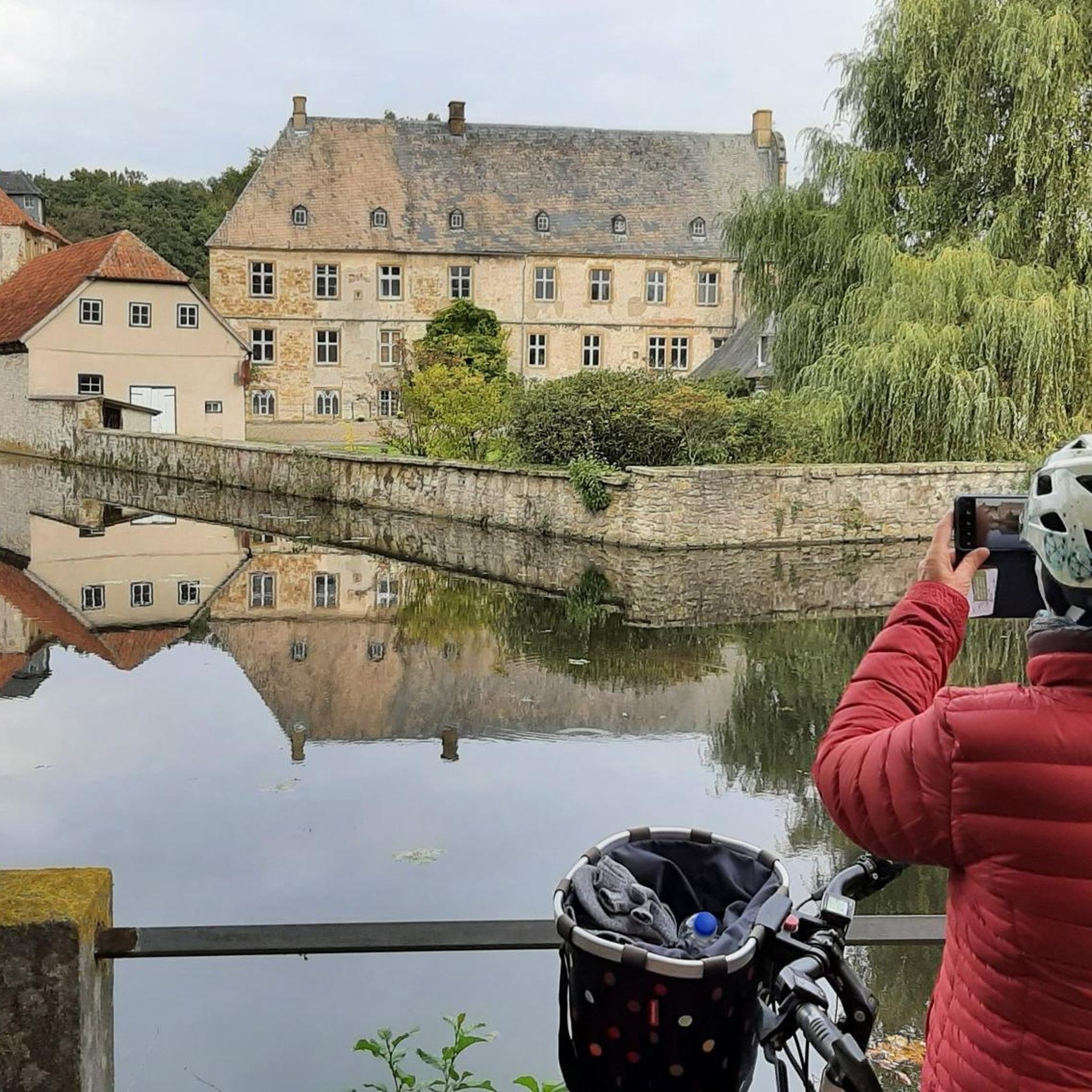
Tips from the Community

The church suffered little damage during the Hundred Years' War and the Wars of Religion. From the end of the 18th century, maintenance work was undertaken mainly inside the church. In 1822, the reconstruction of the bell tower framework began, followed in 1852 by the restoration of the west facade. A further restoration took place around 1860, and the sacristy was enlarged by the construction of a semicircular annex extending the Romanesque apse. Beginning in 1880, a roof repair campaign began, and a new belfry was installed in the bell tower. From 1890 to 1900, the cemetery surrounding the church was moved to the "Fief des Rentes," and the former burial site was transformed into a public square. Starting in 1926, the choir roof was replaced and the bell tower was made watertight. In 1971, the work program included the renovation of the exterior walls, the demolition of the false apse and the sacristy that concealed the apse of the south transept. In 1990, the main door was replaced with oak leaves, the stones were repointed, and the collapsed arch keystone was reinstalled. In the 2000s, the municipality repaired the mechanism of the two belfry bells, and the building was illuminated and maintenance work was carried out.
0
0
The Church of Our Lady of Corme-Écluse, the seat of a former Benedictine priory of the Abbey of the Ladies of Saintes, was donated around 1104 by Ramnulfus Focaudi (Bishop of Saintes between 1083 and 1106) to the Royal Abbey of Saint-Jean-d'Angély "so that he might always enjoy it and possess it in perpetuity." This abbey was thus responsible for the reconstruction of the sanctuary in the mid-12th century in the Romanesque style. A plaque affixed to the south wall of the nave contains a few historical snippets, still legible: 1200, the Benedictines completed the construction and adorned the church with an oak statue of the Blessed Virgin; 1327, the Abbot of Saint-Jean-d'Angely and an envoy of Pope John XXII prayed before the venerated image; In 1628, a pilgrimage was established to venerate the statue; In 1733, the statue was mutilated. The desecrator was punished. The church's plan is a slightly asymmetrical Latin cross (the north arm of the transept is longer than the south arm). The nave consists of two bays covered by pointed barrel vaults. It is lit by three symbolic windows rebuilt in the 13th century. A transverse arch separates the nave from the transept, whose crossing, under the bell tower, is covered by a cupola on squinches. The south arm of the transept opens onto an apse with a semi-dome vault. However, the north arm, rebuilt in the 17th century in the Romanesque style, is slightly longer than the south arm, and is designed on a rectangular plan without an apse. This arm has a portal with columns and toric rollers. After passing the triumphal arch, the choir begins with a straight bay covered with a semi-circular barrel vault and ends with a semi-circular vaulted arch.
0
0
Upon arriving in Corme-Écluse, it's only natural to stop at the church square, the heart of the Cormillon village. On this square, facing the town hall, stands the Church of Notre-Dame. Walk around it to admire the architectural details characteristic of the 12th-century Saintonge Romanesque style. The church was the seat of a former Benedictine priory of the Abbey of the Ladies of Saintes. The sculpted decoration of the Abbey of the Ladies certainly inspired that of the church of Corme-Écluse. This was often the case; mother abbeys were taken as examples by the priories that depended on them in terms of architecture and sculpture. In some cases, it is even assumed that the sponsors, artists, or craftsmen were the same people or at least from the same circle, sometimes descendants. Since the 13th century, the monument has been the destination of numerous pilgrimages that continue to this day. The pilgrimage takes place on the third Sunday of July in the convent gardens, followed by a procession to the Church of Our Lady.
0
0

This magnificent church building - originally Romanesque - was dedicated to the patronage of "Saint-ETIENNE". He was one of the first seven deacons of the original Jerusalem community and, according to the biblical accounts in the "New Testament", was also the first martyr (martyr) of early Christianity. The church commemorates his death on the second day of Christmas, December 26th. As the Acts of the Apostles report: When Stephen expressed his vision of the open heavens "But he, filled with the Holy Spirit, looked up into heaven and saw the glory of God, and Jesus standing at the right hand of God" (Chapter 7, Verse 55), the people were so outraged that they drove him out of the city and stoned him.
0
0

It is an absolutely beautiful village.
0
0


Small town with a special charm along the Charente.
0
0

The Abbaye-aux-Dames is built around the church of Sainte-Marie, built in the twelfth century. Famous for its facade and its characteristic "pinecone" bell tower, it is one of the emblematic monuments of Saintonge's Romanesque art. After several wars and fires, the place was restored in the 1970s and 1980s and is now a hotel. When you walk through the long corridors you feel like you have been transported back to the time when the abbey was still alive.
4
0
Frequently Asked Questions
How many no-traffic road cycling routes are available around Meursac?
There are over 40 dedicated no-traffic road cycling routes around Meursac listed on komoot. These routes vary in length and difficulty, ensuring options for different skill levels.
What is the general difficulty level of no-traffic road cycling routes in the Meursac region?
The no-traffic road cycling routes around Meursac are generally considered easy to moderate. Out of the 40 routes, 18 are rated easy and 22 are moderate, making the area accessible for a wide range of cyclists. The region's elevation typically ranges from 7m to 41m, offering gentle rolling hills rather than strenuous climbs.
Are there any easy, family-friendly no-traffic road cycling routes near Meursac?
Yes, many routes are suitable for families. The region offers numerous marked cycling loops, including easy circuits typically ranging from 4-10 km. These often utilize quiet rural roads, towpaths, and dedicated cycle paths, providing a safe and enjoyable experience for all ages. An example of a moderate route that could be adapted for families is the St Romain de Benet Church – Pisany Market Halls loop from Grézac, which is 44.8 km long with minimal elevation gain.
What kind of landscapes can I expect on no-traffic road cycling routes around Meursac?
You can expect diverse and picturesque landscapes. Routes often traverse well-paved rural roads through vineyards and agricultural fields. You'll also find sections that wind through coastal forests, past beaches, and along riverbanks. The area is characterized by gentle rolling countryside, charming villages, and impressive French architecture.
What are some notable landmarks or attractions I can see along these routes?
The routes often pass by charming villages and historical sites. For example, you might encounter the Saint-Romain Church of Saint-Romain-de-Benet or the Notre-Dame Church of Corme-Écluse. The region is also close to Talmont-sur-Gironde, one of France's 'Most Beautiful Villages', featuring the 12th-century Romanesque Church Sainte-Radegonde.
Are there any circular no-traffic road cycling routes around Meursac?
Yes, many of the no-traffic road cycling routes around Meursac are designed as circular loops. This allows you to start and end your ride in the same location without needing to retrace your path. An example is the Château de Châtenet Ruins loop from Thaims, an easy 49.4 km route.
What is the best time of year for no-traffic road cycling in Meursac?
The Charente-Maritime department generally offers pleasant cycling conditions from spring through autumn. The warmer months allow you to fully enjoy the vineyards, coastal areas, and outdoor cafes. However, the region's mild climate can make cycling enjoyable even in early winter, though you should always check local weather conditions.
What do other road cyclists enjoy most about cycling in Meursac?
The komoot community highly rates the road cycling experience around Meursac, with an average score of 4.27 stars. Reviewers often praise the quiet, well-paved rural roads, the scenic beauty of the vineyards and agricultural fields, and the gentle terrain that makes for enjoyable rides without excessive climbing.
Are there longer, more challenging no-traffic road cycling routes available?
Yes, for those seeking a longer ride, there are moderate routes that extend further into the region. These routes, often between 40-70 km, allow for more extensive exploration of the diverse landscapes. An example is the Port of Mortagne-sur-Gironde – Abbaye aux Dames de Saintes loop from Rioux, which is 85.4 km long with moderate elevation gain.
Can I access major cycle routes like the Vélodyssée from Meursac?
While Meursac isn't directly on the Vélodyssée, its proximity means you can easily access sections of this major Atlantic coastal route. The Vélodyssée offers extensive traffic-free paths, particularly between Marennes and Royan, allowing you to experience coastal ambiance, pine forests, and fine sandy beaches. For more information on the Vélodyssée, you can visit France Vélo Tourisme.
Are there any routes that pass through forests or offer shaded sections?
Yes, the region around Meursac includes several forests that can offer shaded paths, especially welcome during warmer months. Nearby forests include the Forêt de Suzac, Forêt de Pons, Forêt de la Lande, and the extensive Forêt domaniale de la Coubre. Some routes may incorporate sections that pass through or near these wooded areas, providing a different cycling environment.
Most popular attractions around Meursac

Get inspired with the komoot mobile app


Explore more
Browse the best Road cycling routes in other regions.
