The best traffic-free bike rides around Saint-Hilaire-De-Riez
4.5
(981)
7,457
riders
56
rides
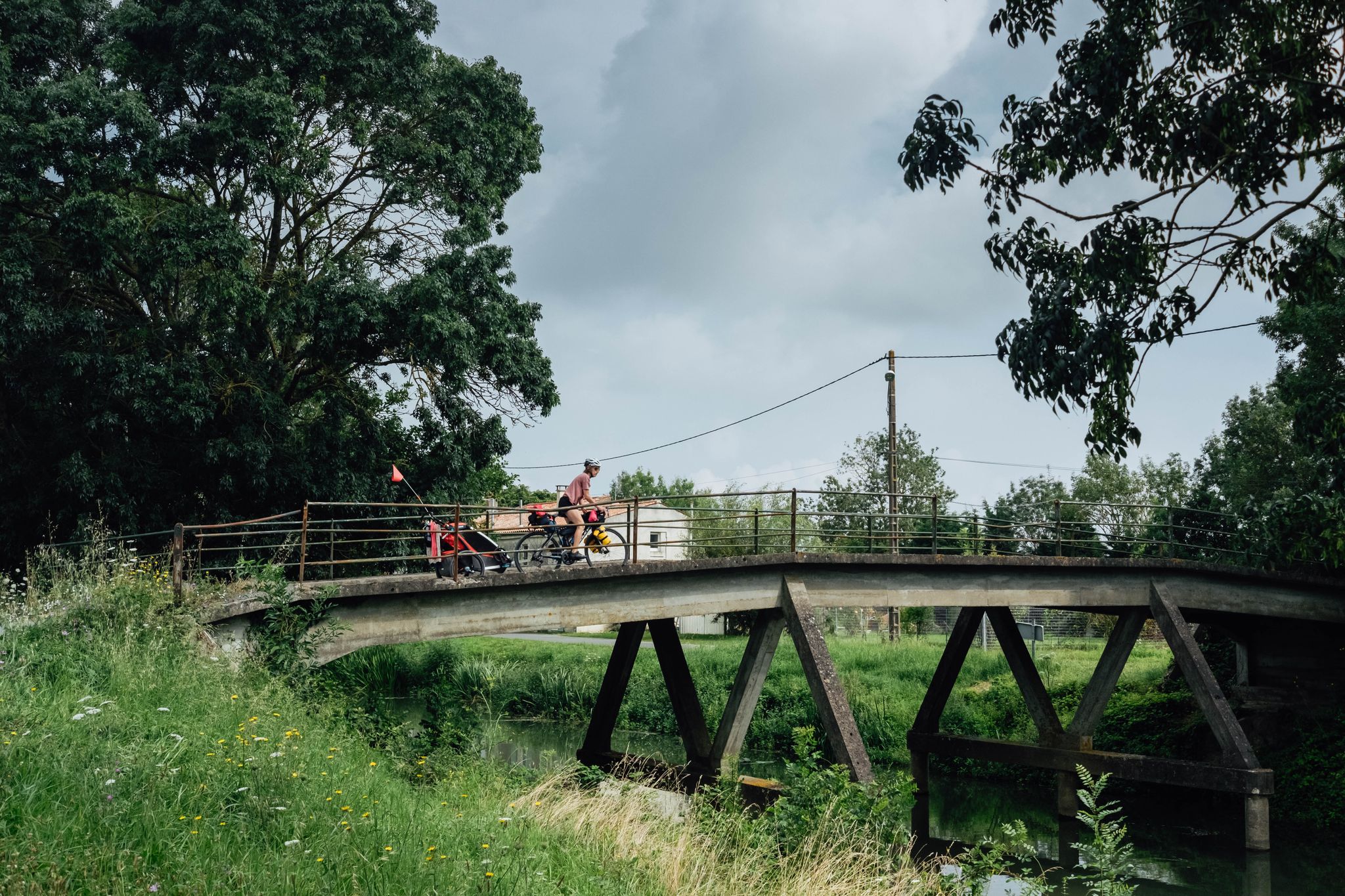
No traffic touring cycling routes around Saint-Hilaire-De-Riez traverse a diverse landscape, featuring a 13-kilometer coastline with sandy beaches and the rocky Corniche Vendéenne. Inland, routes lead through extensive dune systems and the shaded maritime pine forests of the Pays de Monts. The region also includes the unique Marais Breton Vendéen, characterized by marshes and rivers like the Jaunay and Vie, offering varied terrain for cyclists.
Best no traffic touring cycling routes around Saint-Hilaire-De-Riez
- The most popular no traffic touring cycling…
Last updated: November 4, 2026
4.6
(79)
604
riders
Hard bike ride. Good fitness required. You may need to push your bike for some segments of this route.
5.0
(2)
136
riders
Easy bike ride. Mostly paved surfaces.

4.8
(6)
48
riders
Moderate bike ride. Good fitness required. Mostly paved surfaces.
4.6
(10)
45
riders
Easy bike ride. Mostly paved surfaces.
4.3
(8)
20
riders
Easy bike ride. Mostly paved surfaces.
Get access to more routes and recommendations from other explorers.
Already have an account?
Our route recommendations are based on thousands of hikes, rides, and runs completed by other people on komoot.
Start today with a free account
Your next adventure awaits.


Other adventures around Saint-Hilaire-De-Riez

Tips from the Community

Passage through the forest. Even if there are fewer than south of the Vélodyssée, we still appreciate these sections!
0
0
Trail in the middle of the pine forest... It's so nice!!
0
0

There are many paths in the Saint Jean de monts forest. Prefer hard paths for cycling, but please use the equestrian paths with the ponies!
0
0

Small village worth a detour, especially for its beautiful, perfectly preserved medieval church and the Rairé mill.
0
0

The Saint-Martin church is a 11th and 12th century church located in Sallertaine, France. It belongs to the diocese of Luçon. It is dedicated to Saint Martin. This church is the remnant of an old priory founded at the beginning of the 11th century, dependent on the abbey of Marmoutier. Some masonry from the primitive church remains in the walls. The current state of the building is the result of a major reconstruction carried out at the end of the 12th century. The church was consecrated in 1173 by the bishop of Poitiers. The vaulting of the crossing of the transept presents a unique curiosity in the West of France. Clearly seeking to imitate the so-called Plantagenet Gothic style, the master mason, who does not seem familiar with this new technique, created a Romanesque dome, sufficient in itself, which he adorned with ribs, without structural necessity, but which gives it an appearance evoking the Angevin vaults. Some elements of frescoes remain in the nave, which was once entirely covered, particularly an exceptional crucifixion where Christ still has his eyes open. Part of the nave was demolished. The church suffered damage in 1568 during the Wars of Religion. Major restorations took place from 1617 onwards. The narrow Romanesque windows were enlarged, the crossing is surmounted by a timber spire. Three altarpieces adorn the apse and the transepts, leading to the destruction of the south absidiole and the installation of the sacristy in the south one, separated from the transept by a wall supporting the new altar. Damaged during the revolution, becoming too narrow in the 19th century, it was replaced by a new parish church in 1906. It should then have been destroyed, but Father Grelier, an archaeology enthusiast, managed to have it classified as a historical monument in 1910 and 1912. However, the classification did not include the western end of the nave, which the municipality had demolished in 1915. https://fr.wikipedia.org/wiki/Ancienne_%C3%A9glise_Saint-Martin_de_Sallertaine
0
0
The Saint-Martin church is an 11th and 12th century church located in Sallertaine, France[1]. It belongs to the diocese of Luçon. It is dedicated to Saint Martin. This church is the remainder of an old priory founded at the beginning of the 11th century, dependent on the abbey of Marmoutier. Some masonry from the primitive church remains in the walls. The current state of the building is the result of a major reconstruction carried out at the end of the 12th century. The church was consecrated in 1173 by the bishop of Poitiers. The vaulting of the crossing of the transept presents a unique curiosity in Western France. Clearly seeking to imitate the so-called Plantagenet Gothic style, the master mason, who does not seem familiar with this new technique, created a Romanesque dome, sufficient in itself, which he adorned with ribs, without structural necessity, but which gives it an appearance evoking the Angevin vaults. Some elements of frescoes remain in the nave, which was once entirely covered, particularly an exceptional crucifixion because Christ still has his eyes open. Part of the nave has been demolished. The church suffered damage in 1568 during the Wars of Religion. Major restorations took place from 1617. The narrow Romanesque windows were enlarged, the crossing is surmounted by a timber spire. Three altarpieces adorn the apse and the transepts, leading to the destruction of the south absidiole and the installation of the sacristy in the southern one, separated from the transept by a wall supporting the new altar. Damaged during the revolution, becoming too narrow in the 19th century, it was replaced by a new parish church in 1906. It should then have been destroyed, but Abbot Grelier, passionate about archaeology, managed to have it classified as a historical monument in 1910 and 1912. However, the classification only included the western end of the nave, which the municipality had demolished in 1915. https://fr.wikipedia.org/wiki/Ancienne_%C3%A9glise_Saint-Martin_de_Sallertaine
0
0
Do yourself a favour and, from the bridge, just look to the right, to the left and out to sea. The view of the coast is a sorry sight. French concrete architecture at its worst.
0
0
Beautiful trails for trail running without being bothered by crowds, even in high season. The scent of pine trees is very pleasant under a rising sun when you walk the countless forest paths.
1
0
Frequently Asked Questions
How many no-traffic touring cycling routes are available in Saint-Hilaire-De-Riez?
There are over 50 dedicated no-traffic touring cycling routes around Saint-Hilaire-De-Riez. These routes offer a variety of experiences, with 27 easy routes perfect for a relaxed ride and 23 moderate routes for those seeking a bit more challenge. Only one route is rated as difficult, ensuring options for all skill levels.
Are there easy no-traffic cycling routes suitable for families in Saint-Hilaire-De-Riez?
Yes, Saint-Hilaire-De-Riez is an excellent destination for family-friendly no-traffic cycling. Many routes are specifically reserved for cyclists and pedestrians, ensuring a safe and enjoyable experience away from cars. An example of an easy route is the Saint-Jean-de-Monts beach – Demoiselles Beach loop from Forêt domaniale des Pays de Monts, which is 18.5 km long and offers gentle terrain.
What kind of landscapes can I expect on no-traffic touring cycling routes in Saint-Hilaire-De-Riez?
The no-traffic touring cycling routes in Saint-Hilaire-De-Riez offer a remarkable diversity of landscapes. You can cycle along the stunning 13 km coastline, through extensive dune systems, and into the shaded maritime pine forests of the Pays de Monts national forest. The region also features unique marshlands like the Marais Breton Vendéen, with its traditional fishermen's huts and rich wildlife, providing varied and picturesque scenery.
Are there any circular no-traffic cycling routes in the area?
Yes, many of the no-traffic touring cycling routes in Saint-Hilaire-De-Riez are circular, allowing you to start and end at the same point. For instance, the Roman Way - Part1 – André Bénéteau Footbridge loop from Saint-Hilaire-de-Riez is a moderate 44.1 km circular route that takes you through diverse scenery.
What are some scenic points of interest along the no-traffic cycling routes?
Along the no-traffic cycling routes, you'll discover numerous scenic points of interest. The 3 km rocky coastline, known as the Corniche Vendéenne, offers dramatic views and natural curiosities like the Devil's Hole Natural Rock Arch. You can also visit the Grosse Terre lighthouse for panoramic views or explore the Bicycle path - Pays-de-Monts national forest for a refreshing ride through the woods.
Can I find routes that combine coastal views with other natural features?
Absolutely. Saint-Hilaire-De-Riez is unique for its blend of coastal and inland natural beauty. Routes often transition from sandy beaches and dunes to shaded forests or tranquil marshlands. The Corniche - Boulevard de la Mer – Dune path loop from Saint-Hilaire-de-Riez is a great example, offering stunning ocean panoramas along the Corniche Vendéenne and passages through dune paths.
What is the best time of year to go touring cycling in Saint-Hilaire-De-Riez?
The region is enjoyable for touring cycling throughout much of the year. Spring and autumn offer pleasant temperatures and fewer crowds, making them ideal for exploring the extensive cycle path network. Summer is also popular, especially for coastal rides, though it can be busier. The maritime climate generally provides mild conditions.
Are there any historical or cultural attractions accessible by no-traffic bike routes?
Yes, cycling in Saint-Hilaire-De-Riez allows you to discover local history and culture. The Marais Breton Vendéen, accessible via bike paths, offers insights into traditional life with its unique ecosystem and fishermen's huts. You can also find historical sites like Commequiers Castle or the Menhir of Pierre Levée, which are often near or along cycling routes.
What do other touring cyclists enjoy most about the no-traffic routes in Saint-Hilaire-De-Riez?
The no-traffic touring cycling routes in Saint-Hilaire-De-Riez are highly rated by the komoot community, with an average score of 4.48 stars. Reviewers often praise the extensive network of dedicated cycle paths, the stunning variety of landscapes from coast to forest, and the peaceful, car-free environment that makes for a relaxing and immersive cycling experience.
Are there options for longer no-traffic touring rides?
Yes, for those looking for longer no-traffic touring rides, the region offers routes that can be combined or are substantial in length themselves. The Vélodyssée, a major cycle route, passes through Saint-Hilaire-De-Riez, providing over 150 km of coastal paths. Routes like the Moulin de Rairé – Saint-Jean-de-Monts Beach loop from Forêt domaniale des Pays de Monts, at over 41 km, also offer a good distance for a day trip.
Are there any beaches accessible directly from no-traffic cycling paths?
Absolutely. The extensive network of cycle paths often leads directly to the coastline, allowing access to numerous sandy beaches and coves that are sometimes inaccessible by car. You can cycle to beautiful spots like Five Pineaux Beach or Pont d'Yeu Beach, making it easy to combine a ride with a stop by the sea.
Most popular routes around Saint-Hilaire-De-Riez
Most popular attractions around Saint-Hilaire-De-Riez

Get inspired with the komoot mobile app


Explore more
Browse the best Cycling routes in other regions.
