The best traffic-free bike rides around Hermonville
4.0
(1)
27
riders
15
rides
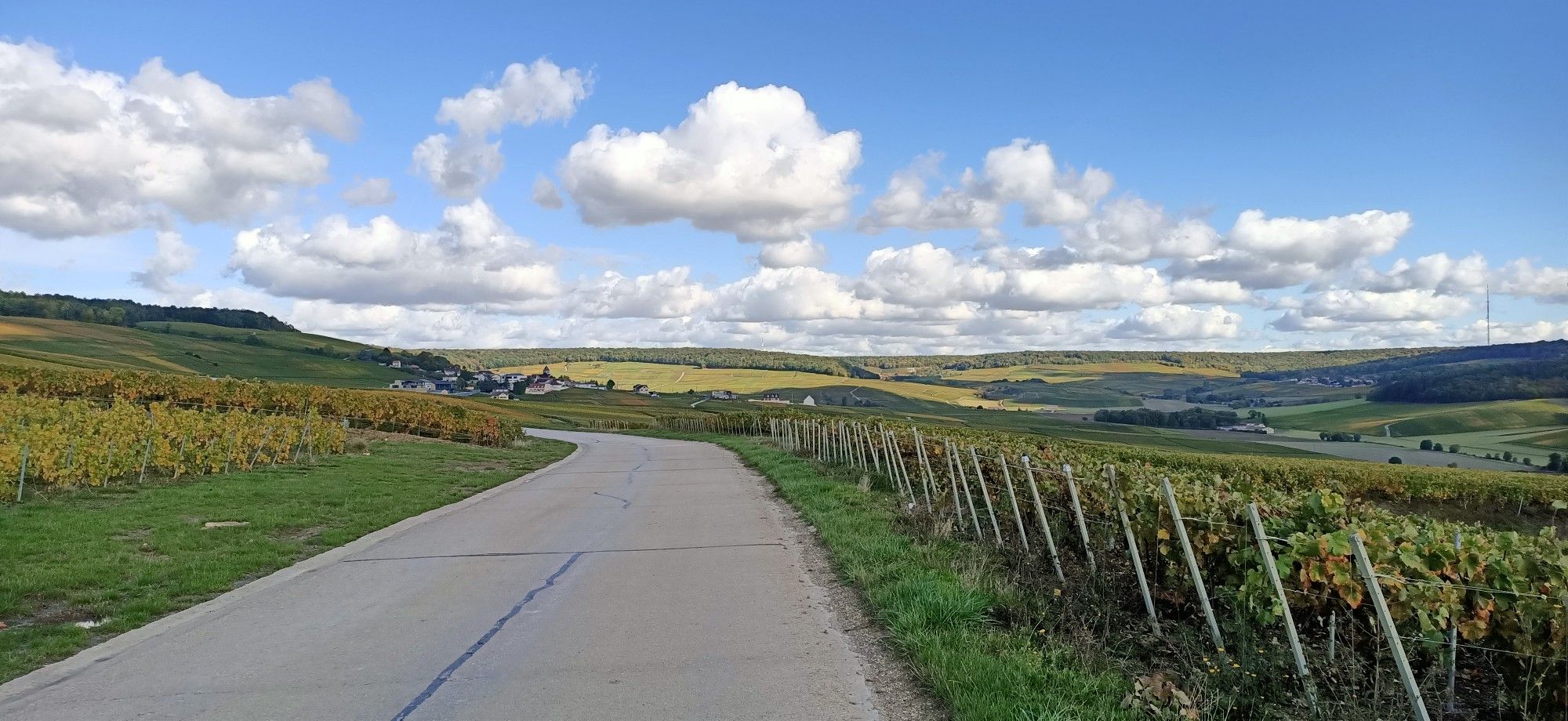
Gravel biking around Hermonville offers routes through the Champagne region, characterized by vineyards, forests, and rolling hills. The terrain features "Chemins Blancs," which are white gravel or limestone paths winding through vine rows and villages. This area, part of the Massif de Saint Thierry and near the Montagne de Reims Natural Regional Park, provides diverse landscapes for no traffic gravel bike trails.
Best no traffic gravel bike trails around Hermonville
- The most popular no traffic gravel bike trail is Saint-Hilaire…
Last updated: May 8, 2026
3
riders
23.8km
01:43
260m
260m
Moderate gravel ride. Good fitness required. Mostly paved surfaces. Suitable for all skill levels.
2
riders
21.8km
01:44
300m
310m
Moderate gravel ride. Good fitness required. Mostly paved surfaces. Suitable for all skill levels.

Sign up for free
2.0
(1)
4
riders
54.9km
03:17
130m
130m
Moderate gravel ride. Good fitness required. Mostly paved surfaces. Suitable for all skill levels.
1
riders
22.2km
01:40
300m
300m
Moderate gravel ride. Good fitness required. Mostly paved surfaces. Suitable for all skill levels.
3
riders
54.1km
03:33
520m
520m
Hard gravel ride. Very good fitness required. Mostly paved surfaces. Suitable for all skill levels.
Get access to more routes and recommendations from other explorers.
Sign up for free
Already have an account?
Our route recommendations are based on thousands of hikes, rides, and runs completed by other people on komoot.
Start today with a free account
Your next adventure awaits.
Login or Signup

Other adventures around Hermonville

Tips from the Community

While staying on the asphalt, you can cover more than 24 km. From the St. Brice Courcelles side, you can go up to La Neuvillette, then to Courcy, it's an unpaved road (passable but not for road bikes). After Courcy, there's asphalt up to Berry au Ferry (this allows you to discover the Sapigneul Owl, about 150 m on dirt road). On the other side, after Sillery, you can continue to Beaumont (asphalt). Then, on a dirt road passable by mountain bike, you can go to the Billy Arch, where the canal passes through a tunnel.
0
0

From its inauguration, residents criticized the fountain's weak water flow of only 12 liters per second, and the nude naiads representing the rivers caused public controversy. During World War II, German occupiers removed the bronze statue, but remarkably the fountain remained intact despite 60% of Reims being destroyed during the war.
4
3
The Subé Fountain stands in Place Drouet-d'Erlon in central Reims, funded by local benefactor Auguste Subé's donation of 200000 gold francs and inaugurated on July 15, 1906. The 17-meter tall column, made from Corgoloin and Chassignelles stone and decorated with vine motifs, represents the city of Reims and local industries including commerce, viticulture, industry, and agriculture. At its base, four naiads symbolize the rivers Suippe, Marne, Vesle, and Aisne that flow through the Marne department, while a golden Victory statue crowns the top.
4
2

Beautiful cycle path along the water.
0
0

The Moulin de Sapigneul refers to Lock 2 on the Canal de l'Aisne à la Marne, located near Berry-au-Bac in the Marne department. The lock is also known as Écluse n°2 du Moulin de Sapigneul and is operated by Voies Navigables de France (VNF). The lock has a chamber length of 38.50 metres, a chamber width of 5.05 metres and a maximum draught of 2.20 metres. Nearby attractions include the Forêt Dommainiale les Blanches Terres and the ruins of Entonnoir.
6
0

This fountain is a magnificent example of Belle Époque ornamentation, rich in symbolism about nature, economy and identity. Thanks to the donation of Subé, the artistic design of Narjoux c.s., and recent restorations, the monument is a beloved landmark and a reborn symbol of Reims.
4
1
This monumental fountain, the work of architect André Narjoux, was inaugurated in 1906. At the four corners of the pedestal are four statues symbolizing the rivers that supply the region with water: the Marne, the Vesle, the Suippe, and the Aisne. The bronze Winged Victory, taken by German soldiers in 1941, was replaced in an identical manner in 1989 thanks to a sponsored initiative.
4
1
A green vein of peace and movement that stretches for 24 kilometres along the Aisne-Marne canal. Once an old towpath, now a lively promenade for walkers, cyclists and nature lovers. This green corridor winds through Reims, connecting city life with nature, passing historic sites such as the old bathhouses, Port Colbert and charming parks. An unexpected oasis in the heart of the Champagne capital, where history, sport and relaxation come together.
8
0
Frequently Asked Questions
How many no-traffic gravel bike trails are available around Hermonville?
There are 16 dedicated no-traffic gravel bike trails around Hermonville, offering a variety of experiences for different skill levels.
What kind of terrain can I expect on these gravel bike trails near Hermonville?
The terrain around Hermonville is diverse, featuring the iconic "Chemins Blancs" – white gravel paths winding through extensive vineyards. You'll also find rolling hills and peaceful forest trails within the Massif de Saint Thierry and near the Montagne de Reims Natural Regional Park, providing a mix of surfaces and elevation changes.
Are there any family-friendly no-traffic gravel routes suitable for beginners?
Yes, there are routes suitable for beginners. For example, the Saint-Hilaire Church – Fort de Chenay loop from Saint-Thierry is an easy option, though it is rated as difficult due to its length and elevation. Generally, routes with lower elevation gain and shorter distances are more suitable for families and beginners.
What is the best season for gravel biking around Hermonville?
The Champagne region, including Hermonville, is beautiful for gravel biking from spring through autumn. Spring offers blooming vineyards, while autumn provides stunning fall colors. Summer is also pleasant, but it's always wise to check local weather conditions, especially for potential heat or rain.
Are there any circular no-traffic gravel bike routes?
Yes, many of the no-traffic gravel routes around Hermonville are circular, allowing you to start and end at the same point. Examples include the Reims TV Tower – High Point – Gravel Route loop from Tinqueux and the Trail Path 3 – The Forest Pond loop from Bouvancourt.
Where can I park my car when going for a gravel bike ride near Hermonville?
Parking is generally available in and around the villages that serve as starting points for these routes, such as Bouvancourt or Tinqueux. Look for designated parking areas or public spaces in these smaller towns.
What interesting landmarks or natural features can I see along the no-traffic gravel bike trails?
While riding, you'll pass through picturesque vineyard landscapes and peaceful forests. If you venture closer to Reims, you can find historical sites like the Mars Gate or the Subé fountain. The region's natural beauty, particularly the rolling hills and vine-covered slopes, is a constant highlight.
Are there any routes that follow historical paths?
Yes, the region around Hermonville is situated along historical paths like the Via Francigena, an ancient pilgrimage route. While specific komoot routes may not explicitly follow its entire length, the presence of such historical trails indicates well-established paths suitable for cycling, often offering a cultural dimension to your ride.
What do other gravel bikers enjoy most about the trails around Hermonville?
The area is highly rated by the komoot community, with an average score of 4.0 stars. Reviewers often praise the tranquility of the routes, the scenic beauty of the vineyards and forests, and the escape from urban traffic that these dedicated gravel paths provide.
Are there any cafes or pubs along the no-traffic gravel routes for a break?
While the routes themselves focus on natural and traffic-free paths, many pass through or near charming villages. These villages often have local cafes, bakeries, or small restaurants where you can stop for a break, refuel, and experience local hospitality.
What is the typical elevation profile for gravel biking near Hermonville?
The region features rolling hills, so you can expect varied elevation changes. Routes like the Vineyard view – Pévy Horse Wash loop from Bouvancourt have around 300 meters of elevation gain, offering a good workout without extreme climbs, while others like the Saint-Hilaire Church – Fort de Chenay loop from Saint-Thierry can have over 470 meters.
Most popular routes around Hermonville
Most popular attractions around Hermonville

Get inspired with the komoot mobile app


Explore more
Browse the best Gravel rides in other regions.
