The 19 Most Amazing Peaks around Sabbia
Best mountain peaks around Sabbia are found in Valle Sabbia, located in the eastern part of the Brescia province in Italy. This region features a diverse range of mountain peaks, offering varied experiences for visitors. The landscape includes prominent summits and pre-alpine plateaus, providing extensive views over surrounding lakes and valleys. The area is characterized by its natural beauty and opportunities for outdoor activities.
Best mountain peaks around Sabbia
- The most popular mountain peaks is Monte Mazzuccone Summit, a…
Last updated: May 11, 2026
Bec d'Ovaga
Highlight • Summit
Translated by Google •
Tip by

Rifugio Spanna-Osella
Highlight • Mountain Hut
Translated by Google •
Tip by

Sign up now to discover places like this
Get recommendations on the best single tracks, peaks, & plenty of other exciting outdoor places.
Sign up for free
Mount Cerano summit
Highlight (Segment) • Summit
Translated by Google •
Tip by

Monte Mazzuccone Summit
Highlight • Summit
Translated by Google •
Tip by

Monte Tre Croci (919 m)
Highlight • Summit
Translated by Google •
Tip by

Sign up for free to discover even more peaks around Sabbia.
Sign up for free
Already have an account?
Start today with a free account
Your next adventure awaits.
Login or Signup
Tips from the Community

Chapel, refuge and on the left, the white dot, is the summit cross.
0
0

Not just one cross greets the (mountain) hiker up here, but a group of three crosses – as the name "Monte TRE CROCI" suggests – we find on this mountain. A wayside cross or summit cross commemorates Jesus Christ, and always the one in the center. The two slightly smaller crosses standing to the sides were not erected here without reason: According to biblical tradition, Jesus Christ was not condemned to death by crucifixion and executed alone, but together with two criminals (see, for example, the Evangelist Luke 22:33): + "They came to the place called the Place of the Skull, and there they crucified him and the criminals, one on his right and the other on his left." +
0
0

Beautiful stretch, I will do it again when the weather is good
0
0

Spectacular view, just before going up from Saccarello there are some chains that facilitate the more delicate passages of the path (nothing particularly technical or dangerous)
0
0

My favorite route for both "training" climbs (when I was young) and, more frequently, to enjoy a climb all through the woods, therefore bearable even in July-August, with the arrival at the refuge that instead opens up to the eyes an unexpected panorama over a good stretch of the lower Valsesia. The climb to the summit, behind the refuge, then reveals, on clear days, M. Rosa and many other peaks. I tried two excursions, starting from the refuge. The first, continue to sella Vazzosa (short exposed sections, be very careful!) and then to Massale, then always on a trail on the crest to Castello del Gavala, there be very careful for short exposed sections and to find the right passage to descend from the summit to the path just below that will lead to Luotto and finally to Tovo or even just to sella Rosetta, and then go to the Gilodi-Ca'Mea refuge. Many km and altitude difference (1700 m approx.), to be organized in company and with two cars, one in Casavei and the other in Ca' Mea, with a lot of necessary training. An easier tour of approx. 1050 m of altitude difference, but which requires a good sense of direction, maps and GPS, is to go down the southern ridge in front of the Spanna refuge, always continue without going down the sides, paying attention to some rare paint on the trunks, until you come across a dirt road at an altitude of 1250, at the hairpin bend, not far from Alpe Passarina. From there the dirt road leads to Sella di Parone and finally to Casavei, altitude difference reduced to approx. 850 m. But at that storm the adventure becomes beautiful by leaving the dirt road and taking a path, always vs. south and remaining on the crest (wooded), which leads below partly maintained and partly ruined mountain pastures, first to Arcacce, from which you leave the crest to turn left and then find Tereggia, Pometto, Uccello alps, descending to the dirt road of Pra Personale that leads to Locarno, from there go back up to Casavei, and it is this climb to Casavei/Narpone that brings the difference in altitude to about 1050-1060 m Almost absolutely to be done with those who have already done this descent as it is easy to get lost. I did it and discovered it a first time with a few mistakes and retraced my steps to then find the right passages, all easy and always on wooded slopes, since then I have memorized it and once every year or two it gives me great satisfaction to do this ring again. Get a Geo4Map map n.2
0
0
I don't count the times... everything is easy, pay attention from the refuge to the summit, a few meters here and there of steep rock, no stumbling or getting distracted, very dangerous. Done well, however, it is for everyone. I have done the return trip several times along the southern ridge, right in front of the refuge, rare signs for almost 400 meters of altitude difference, stay on the ridge on the back of the ridge until you exit at 1250 meters of altitude on the road that ends on the right at Alpe Passarina and on the left goes down to Selle di Parone and further on to Casavei. Instead of going down the road, I have taken the path several times (on the hairpin bend where it comes out) that, here too, staying on the back of the ridge, turning left when it ends, and paying attention to the few signs on the plants, goes down to the ancient Arcacce Alps, then Pometto (ruins), Uccello (ruins), Pra, where the dirt road begins and some renovated farmhouses, then Parone etc.
1
0
Very rewarding route for the view.... and how many take-offs from m. Croce, with paragliding! I also continued up to m. MASSONE, then returning to the valley to the right (descending) of the ascent ridge, up to alpe Bagnone and then returning to Quaggione, beautiful. I recommend choosing a day of clear skies.
0
1

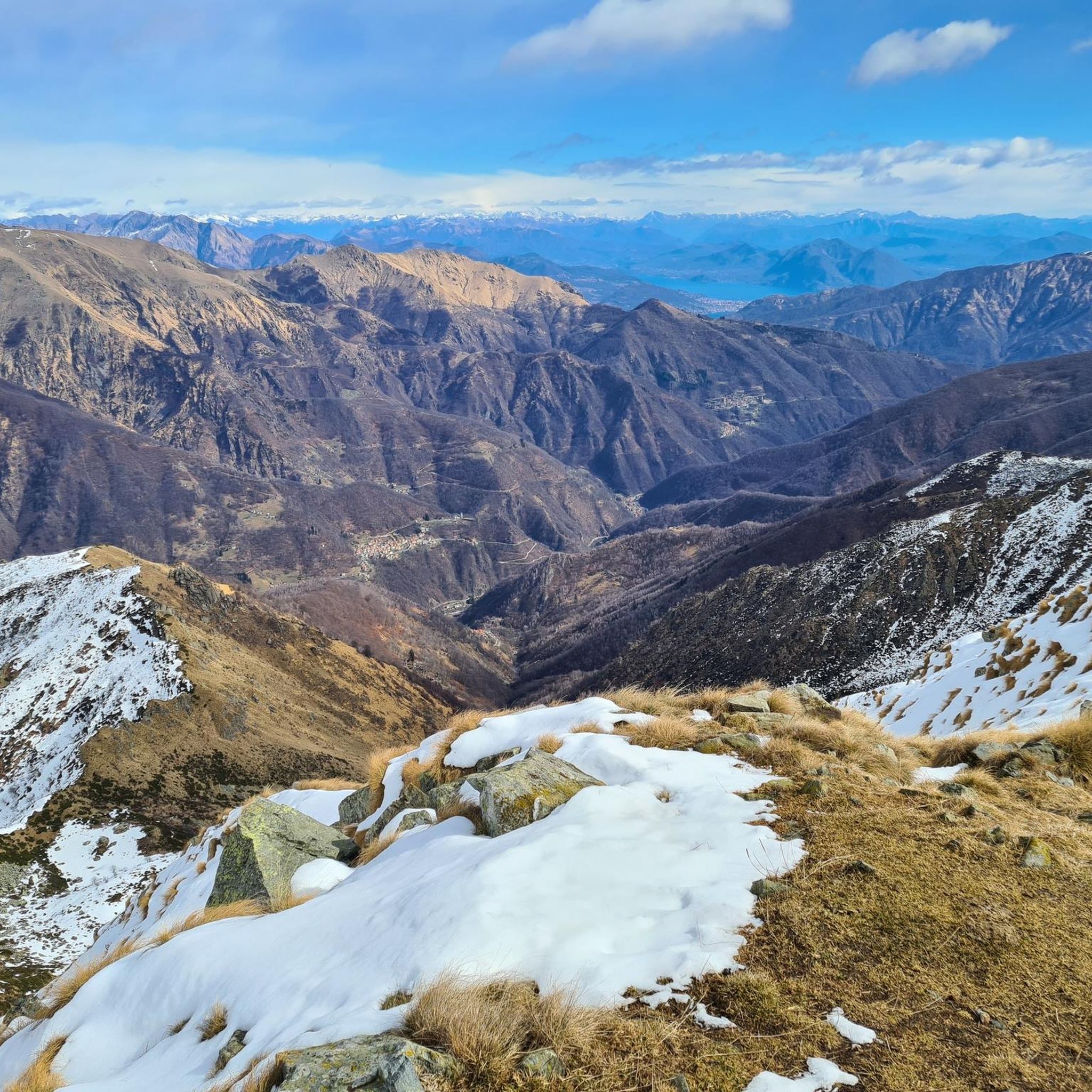
Peak in Cusio at 1424m above sea level
0
0
Frequently Asked Questions
What are some of the most prominent mountain peaks in the Sabbia region?
The Sabbia region, particularly Valle Sabbia, features several notable peaks. Among them are Monte Pizzocolo, known for its panoramic views over Lake Garda; Monte Stino, offering vistas of Lake Idro and a range of sports activities; and Monte Maniva, a popular destination for winter sports and authentic mountain experiences.
Which peaks offer the best panoramic views in Sabbia?
For breathtaking panoramic views, consider Monte Mazzuccone Summit, which provides an incredible 360-degree vista of Lake Orta, Mount Mottarone, and Vallestrona. Monte Pizzocolo also stands out, offering unparalleled views spanning Lake Garda, the Apennines, the Adamello group, Monte Baldo, and even the Brenta Dolomites. Additionally, Bec d'Ovaga provides exceptional views over Valsesia, Monte Rosa, and several lakes.
Are there any family-friendly mountain walks or accessible peaks in the Sabbia area?
While many peaks offer challenging routes, Monte Stino provides more accessible options. The Monte Stino Hut, located at 1,437 meters, is reachable by car, making it a convenient base for exploring. Its well-maintained mule tracks offer various routes, and the area supports activities like Nordic walking and snowshoeing, which can be suitable for families depending on the specific trail and conditions.
What kind of outdoor activities can I do near the mountain peaks in Sabbia?
The Sabbia region is a hub for diverse outdoor activities. Near the peaks, you can enjoy hiking, cycling, and running. For instance, there are challenging hiking routes like the Ascent to Monte Capio, and moderate options such as the Val Sabbiola Loop Trail. Cycling enthusiasts can explore routes like the Val Mastallone Loop Trail, while runners might enjoy the Bec d'Ovaga Loop. You can find more details on these activities in the Hiking around Sabbia, Cycling around Sabbia, and Running Trails around Sabbia guides.
Are there any historical sites or points of interest on the mountain peaks?
Yes, Monte Stino holds historical significance with a small World War I museum housed within two tunnels that once contained cannons. Monte Pizzocolo also features a small chapel dedicated to fallen soldiers and mountaineers, adding a historical and commemorative aspect to the ascent.
What is the best time of year to visit the mountain peaks around Sabbia?
The best time to visit depends on your desired activity. For hiking and enjoying panoramic views, late spring to early autumn (May to October) generally offers pleasant weather. For winter sports like skiing, snowboarding, and snowshoeing, Monte Maniva is ideal during the winter months when its slopes are covered in snow. Always check local weather conditions before your visit.
Are there any mountain huts or shelters available on the trails?
Yes, several peaks offer facilities for rest and refreshment. On Monte Pizzocolo, you can find the Bivacco Due Aceri, an always-open shelter, and the Rifugio Pirlo allo Spino on some routes. Near Bec d'Ovaga, there is Rifugio Spanna-Osella, which offers refreshment and unexpected panoramas. Monte Stino also has the Monte Stino Hut, providing local cuisine, though it does not offer overnight stays. Monte Maniva features hospitality options like Chalet Maniva and Locanda Bonardi.
What are the difficulty levels for hiking the peaks in Sabbia?
Hiking difficulties vary across the region. For instance, routes to Monte Pizzocolo can range from 'E' (Hiking) for those with good fitness to 'EE' (Experienced Hikers) for more challenging, exposed sections. Bec d'Ovaga is considered challenging, especially the final stretch from the refuge to the summit. Monte Mazzuccone Summit is generally considered intermediate and quite easy to reach from Alpe Camasca.
Can I go skiing or snowboarding in the Sabbia mountain region?
Absolutely. Monte Maniva is a renowned destination for winter sports, home to Maniva Ski. This resort offers 40 km of snow-covered pistes, 9 ski lifts, and caters to all skill levels with a mix of black, red, and blue runs. Beyond traditional skiing, you can also enjoy ski mountaineering, snowboarding, and snowshoeing there.
What makes the mountain peaks around Sabbia unique or a 'hidden gem'?
The mountain peaks around Sabbia offer a blend of natural beauty and diverse experiences. Monte Maniva, for example, is celebrated for its relatively untouched nature by mass tourism, providing an authentic mountain experience. The region's ability to offer everything from challenging climbs with vast panoramas to accessible routes and winter sports makes it a versatile destination for outdoor enthusiasts.
What do visitors particularly enjoy about the mountain peaks in Sabbia?
Visitors frequently praise the incredible panoramic views, such as the 360-degree vistas from Monte Mazzuccone Summit over Lake Orta, or the extensive views from Monte Pizzocolo. The sense of accomplishment after a challenging ascent and the unexpected panoramas from places like Rifugio Spanna-Osella are also highly valued. The diverse range of activities, from hiking to winter sports, and the presence of welcoming mountain huts, contribute to a rewarding experience.
Are there any specific natural features or landmarks to look out for?
Beyond the peaks themselves, keep an eye out for the natural spring water on Monte Maniva, recognized for its low sodium content. The rolling mountainous plateau of Monte Maniva, with its peaks and troughs, also offers spectacular pre-alpine walking. On Monte Pizzocolo, a compass rose at the summit helps identify the surrounding peaks visible from its vantage point.
Most popular attractions around Sabbia

Get inspired with the komoot mobile app


Explore more
See even more amazing summits around Sabbia with these guides:
