The best road cycling routes around Saint-Georges-Motel
4.3
(48)
833
riders
231
rides
Road cycling around Saint-Georges-Motel offers routes through the Eure Valley, characterized by gentle rolling terrain and a mix of open countryside and wooded sections. The region features historic towns and rural landscapes, providing varied backdrops for road cyclists. Routes often follow river courses or connect small villages, with minimal significant elevation changes.
Best road cycling routes around Saint-Georges-Motel
- The most popular road cycling route is Marcilly-sur-Eure – Sorel Castle loop from Carrefour de la Tasse ou du Carré, a…
Last updated: November 1, 2026
5.0
(1)
45
riders
42.2km
01:39
100m
100m
Moderate road ride. Some segments of this route may be unpaved and difficult to ride.
9
riders
45.4km
01:48
200m
200m
Easy road ride. Mostly well-paved surfaces and easy to ride.

9
riders
40.0km
01:36
180m
180m
Easy road ride. Mostly well-paved surfaces and easy to ride.
4.0
(2)
5
riders
44.4km
01:48
190m
190m
Moderate road ride. Some segments of this route may be unpaved and difficult to ride.
4
riders
32.9km
01:21
170m
170m
Easy road ride. Mostly well-paved surfaces and easy to ride.
Get access to more routes and recommendations from other explorers.
Already have an account?
Our route recommendations are based on thousands of hikes, rides, and runs completed by other people on komoot.
Start today with a free account
Your next adventure awaits.


Tips from the Community


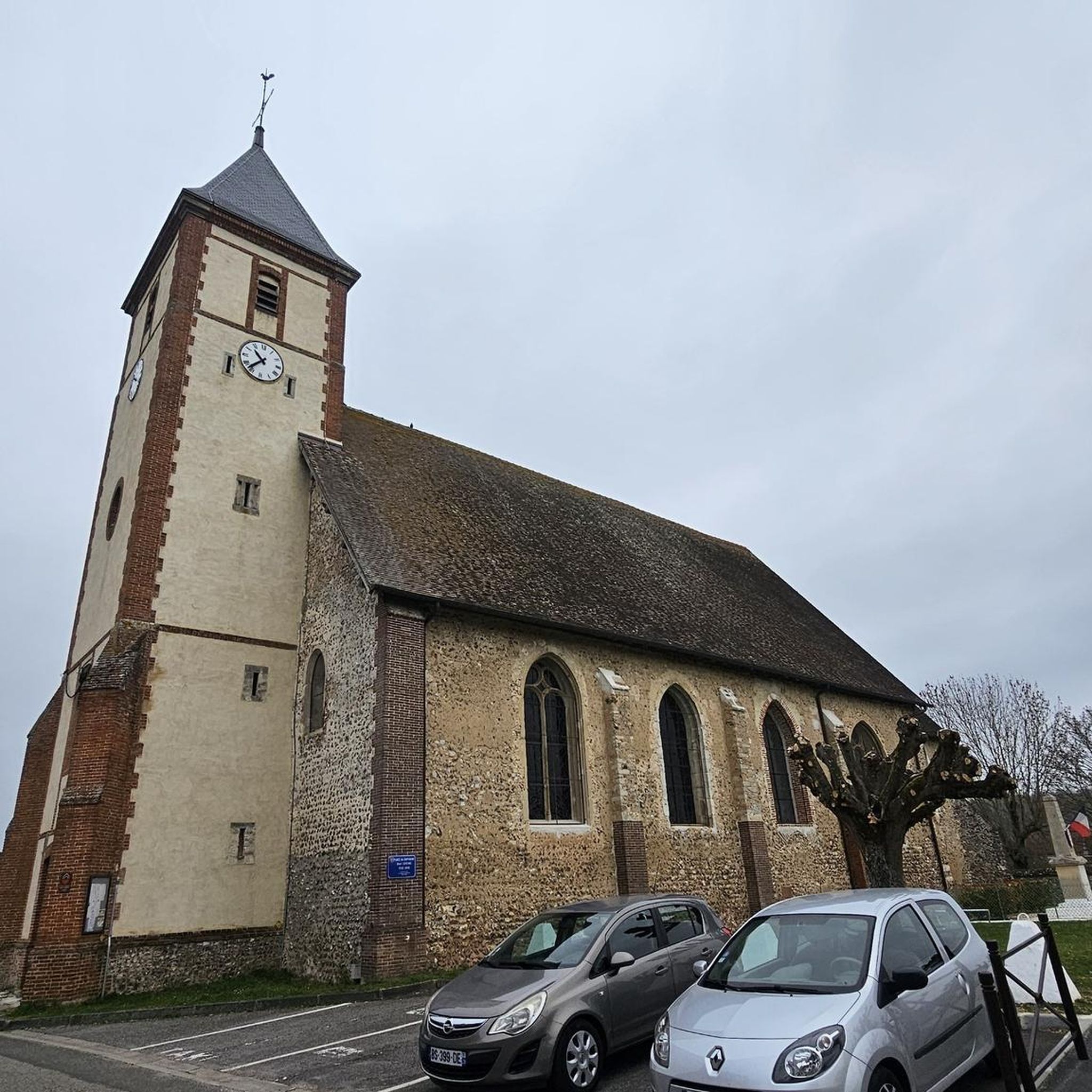
The construction of the original church of Sorel dates back to the 10th century. In 1113, this church was destroyed during the siege of the fortress of Sorel by the troops of Henry VIII of England coming from Normandy. Its identical reconstruction was unfortunately halted by a fire in 1134. The current church was rebuilt starting in the 13th century, with the chevet completed in the 15th century, and the first two bays of the nave and the northern seigneurial chapel in the 16th century. The bell tower was built in the 17th century by blinding a window. The building is constructed of flint, lime, and white stone on a sandstone base. The upper part is made of Vernon stone. The tiled roof is supported by a beautiful rafter frame whose tie beams are decorated with chimera heads, also called "howling devils." In the choir, the 19th-century altar recalls medieval sculptures. An interesting collection of stained-glass windows dating from 1850. After extensive renovations, masses have been celebrated again since 2007.
0
0
The first mention of the existence of the Church of Saint-Martin de Nonancourt is a 12th-century charter, but the original building probably dates back to the 7th or 8th century. The bell tower that now occupies the middle of the façade dates from the reconstructions of 1204. During the Hundred Years' War, the church was largely destroyed, like many buildings in the region. The side aisles, nave, and choir were rebuilt in the 16th century. The Chapel of the Virgin, also known as the Chapel of the Rosary, was also added. The Church of Saint-Martin contains numerous works of art, some of which are listed: neo-Gothic and Renaissance furnishings, including the centerpiece, the pulpit, a veritable wooden lacework; a variety of statuary, a 16th-century organ case and finally an enigmatic fresco discovered during recent works in 2001. The stained-glass windows of the church constitute a truly remarkable collection, both in terms of their number (26 in total) and their quality. The lower windows of the nave are the oldest pieces, dating from the 1500s, while the upper windows date from the 1520s and 1530s.
0
0
The current church was almost entirely rebuilt in 1542 on Gothic foundations. The Gothic church was reportedly destroyed in 1424 by the English. According to legend, Saint Lubin, Bishop of Chartres, came to rest in this place, which housed a recluse inhabited by a monk. A chapel was built there towards the end of the 6th century.
0
0
Dedicated to Saint Blaise, the church of Havelu is oriented and comprises a single nave. Its construction dates back to the 16th century. The choir, older and narrower than the nave, ends in a three-sided chevet. Constructed of flint blocks, the building is erected on a sandstone base. Two-stepped buttresses rise to the cornice. The western door appears to date from the 19th century, based on a Gothic-inspired model. It consists of a pointed arch with two tori exposed by wide grooves resting on prismatic bases. A lowered arch supports the blind tympanum. A shell is carved on the lintel of the south door, now walled up. A pointed octagonal spire rises from the bell tower. The roof is slate. Inside, the roof structure is exposed and retains the original stencilled decoration on the shingles. The name of the clergyman who commissioned it can still be seen: "M[ai]stre Jehan Menere p[re]b[t]re chaplain of this place." The furnishings of Havelu church are remarkable for their uniform 18th-century decoration. A partition altarpiece is located in the choir. Signed and dated by the artist, Pierre Pilastre (1753), it features, in the center, a painting of the Resurrection, inserted between two fluted pilasters flanked by scrolls with floral and fruit motifs and topped with fire pots. At the ends, each of the two doors is surmounted by a painting, one depicting Saint Blaise, the other Saint Barbara. At the choir entrance, the triumphal arch—by the same craftsman—also survives. A work bench, a confessional, and a lectern from the same period complete this decorative ensemble. In 1998, the Sauvegarde de l'Art Français (French Art Protection Association) granted a donation of 60,000 francs to strengthen the bell tower's framework.
0
0

A very beautiful greenway It's an old railway line that has been covered over; it used to go all the way to Dreux. We love going there for cycling, and it's also ideal for walking and rollerblading.
0
0

A village full of character with a rich industrial past. Visit its church and the ruins of its castle. If you're interested in Calvados, a guided tour of the Morin winery is a must.
0
0

Built at the end of the 12th century by the Counts of Montfort and listed as a Historic Monument since 1889, the Houdan Tower was used to watch for enemies and defend the territory. The Keep consists of a 15 m diameter and 21 m high tower, flanked by four turrets of the same height located at the four cardinal points. From the 16th century until the French Revolution, the Keep served as a prison, and executions took place at the foot of the Tower. The first water reservoir was installed in the tower in 1880. The second, built in 1952, is still visible. Tours are available on certain days.
0
0
Frequently Asked Questions
How many road cycling routes are available around Saint-Georges-Motel?
There are over 220 road cycling routes around Saint-Georges-Motel, offering a wide variety of options for different skill levels and preferences.
Are there easy road cycling routes suitable for beginners in Saint-Georges-Motel?
Yes, Saint-Georges-Motel offers a good selection of easy routes. For instance, the Historic Center of Houdan – The Donjon of Houdan loop from Montreuil is an easy 28.5-mile (45.9 km) path that passes through the historic center of Houdan, featuring its medieval donjon.
What are some options for longer road cycling tours in the area?
For a longer ride, consider the Marcilly-sur-Eure – Sorel Castle loop from Carrefour de la Tasse ou du Carré. This moderate route spans 45.6 miles (73.4 km) and explores the countryside around Sorel Castle, typically taking nearly 3 hours to complete.
Can I find circular road cycling routes around Saint-Georges-Motel?
Many of the road cycling routes in the region are designed as loops, allowing you to start and finish at the same point. An example is the Marcilly-sur-Eure – Eure Valley Greenway loop from Saint-Georges-Motel, which is an easy 26.8-mile (43.1 km) ride through scenic landscapes.
What kind of terrain can I expect on road cycling routes in Saint-Georges-Motel?
The region is characterized by gentle rolling terrain, primarily following rural roads and sections along the Eure Valley. You'll find a mix of open countryside and wooded areas, with minimal significant elevation changes, making it generally accessible for road cyclists.
What historical landmarks or attractions can I see along the road cycling routes?
Road cycling routes often pass by historic towns and notable landmarks. You might encounter sites like Sorel Castle or the medieval Donjon of Gilles. The Historic Center of Houdan – The Donjon of Houdan loop from Montreuil specifically highlights the historic center of Houdan and its donjon.
Are there any routes that follow greenways or dedicated cycle paths?
Yes, some routes incorporate sections of dedicated paths. The Marcilly-sur-Eure – Eure Valley Greenway loop from Saint-Georges-Motel, for example, leads through the Eure Valley Greenway, offering a pleasant and often car-free cycling experience.
What do other road cyclists enjoy most about cycling in Saint-Georges-Motel?
The area is highly rated by the komoot community, with an average score of 4.5 stars from over 30 reviews. Reviewers often praise the quiet rural roads, the charming historic villages, and the varied backdrops provided by the Eure Valley.
Are there any routes that pass by castles or châteaux?
Absolutely. The region is dotted with historical castles. For instance, the Marcilly-sur-Eure – Sorel Castle loop from Carrefour de la Tasse ou du Carré takes you near Sorel Castle. Other notable castles in the wider area include Anet Castle and Château de Louye.
What is the best time of year for road cycling around Saint-Georges-Motel?
The spring and autumn months generally offer the most pleasant conditions for road cycling in the region, with mild temperatures and beautiful scenery. Summer can also be enjoyable, though it's advisable to ride earlier in the morning or later in the afternoon to avoid the midday heat.
Are there any routes that offer views of the Avre Aqueduct?
Yes, you can explore routes that feature the Avre Aqueduct. The Avre Aqueduct – Half-timbered Houses of Dreux loop from Montreuil is an easy 15.2-mile (24.4 km) route that allows you to see this impressive structure, along with the charming half-timbered houses of Dreux.
Are there any particularly scenic routes for road cycling?
Many routes offer scenic views of the Eure Valley and its surrounding countryside. The Marcilly-sur-Eure – Eure Valley Greenway loop from Saint-Georges-Motel is highly regarded for its picturesque journey through the greenway and rural landscapes.
Most popular routes around Saint-Georges-Motel
Most popular attractions around Saint-Georges-Motel

Get inspired with the komoot mobile app


Explore more
Browse the best Road cycling routes in other regions.
