Attractions and Places To See around Épinonville - Top 20
Attractions and places to see around Épinonville are primarily found in its surrounding rural landscape within the Meuse department of the Grand-Est region of France. While Épinonville itself is a small commune, it serves as a base for exploring historically significant sites and natural features. The area is characterized by its proximity to the Argonne Forest and the Wood of Cierges, offering opportunities for outdoor activities. Visitors can discover numerous World War I memorials and cemeteries in the vicinity.
Best…
Last updated: July 15, 2026
Meuse-Argonne American Cemetery
Highlight • Other
Translated by Google •
Tip by

World War I memorial
Highlight • Other
Inaugurated in 1922, this impressive monument commemorates the thousands of fallen soldiers of the Argonne during WWI. The ossuary contains the …
Translated by Google •
Tip by
Sign up now to discover places like this
Get recommendations on the best single tracks, peaks, & plenty of other exciting outdoor places.
Sign up for free
Sergeant York trail
Highlight • Other
Tip by

Ravin du Génie Open-Air World War I Museum
Highlight • Historical Site
Translated by Google •
Tip by
War monument
Highlight • Other
Erected in 1927 by the state of Pennsylvania, this neoclassical monument honors the American soldiers from Pennsylvania who helped liberate Varennes in 1918. Designed in …
Translated by Google •
Tip by
Sign up for free to discover even more attractions around Épinonville.
Sign up for free
Already have an account?
Start today with a free account
Your next adventure awaits.
Login or Signup


Tips from the Community

Freely accessible and located along the Route de la Haute Chevauchée. Climb the stairs for an impressive view and to admire the monument up close. Behind the monument is the entrance to the ossuary and a cross of reconciliation.
6
0
A silent tribute in the heart of the Argonne Inaugurated in 1922, this impressive monument commemorates the thousands of fallen soldiers of the Argonne during WWI. The ossuary contains the remains of approximately 10,000 unknown soldiers of various nationalities. The obelisk-shaped structure, topped with a soldier's head and sword, is a powerful symbol of sacrifice. In 2023, the monument was included on the UNESCO World Heritage List.
7
0
Ravin du Génie: Located in the woods of Lachalade, less than 1.2 km from the front line, this ravine was an important logistical camp for the French engineers during WWI. Soldiers found rest there, and equipment was stored for mine warfare in the Argonne. Today it is an open-air museum with the remains of barracks, warehouses and trenches – a tangible reminder of daily life behind the front. Free access with information panels.
7
0
Mémorial de Pennsylvania – Varennes-en-Argonne Erected in 1927 by the state of Pennsylvania, this neoclassical monument honors the American soldiers from Pennsylvania who helped liberate Varennes in 1918. Designed in the Greek style, the monument offers impressive views over the Aire Valley and bears the words of President Wilson: “The right is more precious than peace”.
7
0
The American military cemetery in Romagne-sous-Montfaucon contains the graves of 14,246 soldiers who died during the First World War in northwest France. It is the largest American military cemetery in Europe. The cemetery site is located in the old front line of the Meuse-Argonne offensive that took place between September 26 and November 11, 1918. The plot of land was used as a cemetery on October 14, 1918 after it had been occupied by the American forces just before. 32nd Infantry Division. The site was given on permanent loan to the US by the French government. The 14,246 graves are spread over eight fields. There are lime trees surrounding the fields, the fields themselves are covered with grass. Each grave has its own stone. For Jewish graves, the top of the stone is shaped like a Star of David. The text on each stone states the soldier's name, rank, division, state and date of death. Of the 14,246 graves, 486 soldiers have not been identified. The stones of the unidentified soldiers bear the text: Here rests in honored glory an American soldier known but to god. On the south side of the cemetery is a memorial building, designed by the architectural firm York and Sawyer from New York. The center of the memorial gives access to a chapel containing the flags of the US and the other allied countries. The stained glass windows show the insignia of the various divisions that operated in the region. The two loggias outside the chapel display the names of 954 missing soldiers. The visitors building is located on the north side of the cemetery. There is a book here in which a visit can be registered. The entrance to the cemetery, both on the west and east sides, is 'guarded' by two white towers with the American eagle on top. There is a large pond in the middle of the site. The maintenance and management of the cemetery is the responsibility of the American Battle Monuments Commission.
5
0


Alvin Cullum York (December 13, 1887 – September 2, 1964), also known as Sergeant York, was one of the most decorated United States Army soldiers of World War I.[1] He received the Medal of Honor for leading an attack on a German machine gun nest, gathering 35 machine guns, killing at least 25[2] enemy soldiers and capturing 132 prisoners. York's Medal of Honor action occurred during the United States-led portion of the Meuse-Argonne Offensive in France, which was intended to breach the Hindenburg line and force the Germans to surrender. He earned decorations from several allied countries during WWI, including France, Italy and Montenegro.
0
0

Frequently Asked Questions
What are the main historical attractions near Épinonville?
The area around Épinonville is rich in World War I history. Key sites include the Meuse-Argonne American Cemetery, the largest American military cemetery in Europe, and the World War I memorial, an impressive obelisk commemorating thousands of fallen soldiers, which is also a UNESCO World Heritage site. You can also visit the War monument in Varennes-en-Argonne, honoring American soldiers from Pennsylvania.
Are there any natural features or outdoor areas to explore near Épinonville?
Yes, Épinonville is situated close to the Wood of Cierges and the broader Argonne Forest, offering a rural setting for outdoor activities. The region provides opportunities for hiking and cycling amidst its natural landscapes.
What kind of cycling routes are available around Épinonville?
You can find a variety of cycling routes, including road cycling, gravel biking, and mountain biking trails. For road cycling, explore routes like the 'Foret d'Argonne – Beautiful path loop from Varennes-en-Argonne'. Gravel biking options include loops from Chatel-Chéhéry, while MTB trails offer routes such as the 'Grave Hamilton COOLIDCE loop from Cornay'. You can find more details on these activities on the respective guide pages: Road Cycling Routes around Épinonville, Gravel biking around Épinonville, and MTB Trails around Épinonville.
What is the American Monument of Montfaucon?
The American Monument of Montfaucon is a significant landmark located in Montfaucon-d'Argonne, commemorating the Meuse-Argonne Offensive of World War I. It's a key historical site for those interested in the American involvement in the war.
Can I visit German World War I cemeteries in the area?
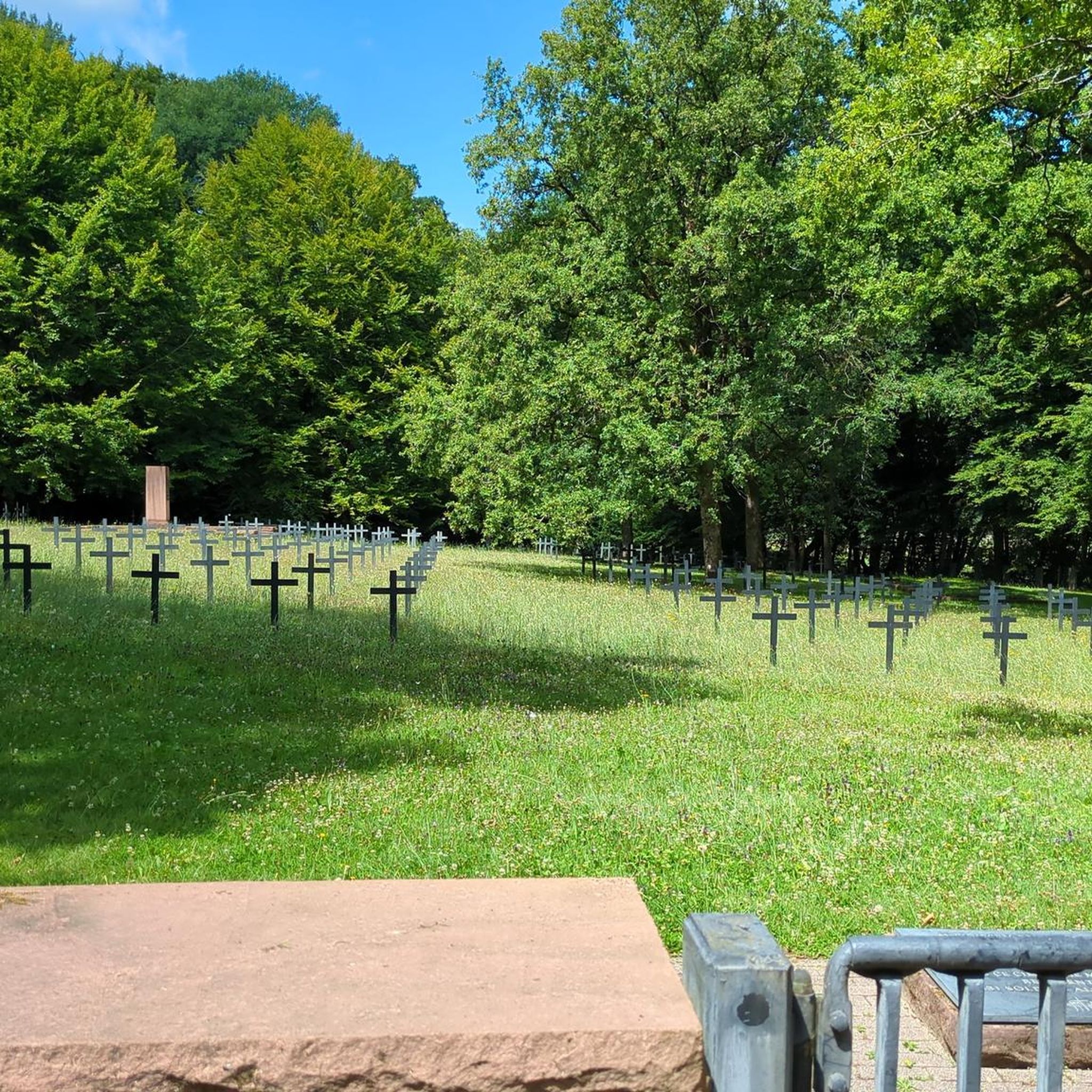
Yes, the Deutscher Soldatenfriedhof is a serene cemetery near Épinonville containing 1,111 individual graves of German soldiers who died in the Argonne Forest during World War I. It has largely preserved its original state since its creation in 1915 and is part of the UNESCO World Heritage list.
Are there any unique or unusual attractions nearby?
Near Exermont, you can find the Viaduc d'Exermont, also known as the Ariéthal Viaduct. This former railway line is now a public leisure spot, notably used for rappelling, pendulum jumps, and is Champagne-Ardenne's only natural base for bungee jumping.
What is the significance of the Meuse-Argonne American Cemetery?
The Meuse-Argonne American Cemetery is the largest American military cemetery in Europe, holding the graves of 14,246 soldiers who died during the First World War. It's located on the old front line of the Meuse-Argonne offensive and features a memorial building with a chapel and walls inscribed with the names of missing soldiers.
What is the 'Sergeant York trail'?
The Sergeant York trail is associated with Alvin Cullum York, one of the most decorated United States Army soldiers of World War I. He received the Medal of Honor for his actions during the Meuse-Argonne Offensive, making this trail a point of interest for those following his historic path.
What kind of views can I expect from the War monument in Varennes-en-Argonne?
The War monument in Varennes-en-Argonne, designed in the Greek style, offers impressive views over the Aire Valley. It's a great spot to appreciate both history and the surrounding landscape.
Are there any towns with markets near Épinonville?
Yes, several nearby towns host weekly markets. You can visit Sainte-Menehould (Mondays, approximately 25 km), Stenay (Fridays, 25 km), Verdun (Fridays, 26 km), Vouziers (Saturdays, 31 km), and Longuyon (Fridays, 42 km) to experience local life and find regional products.
What is the 'World War I memorial' near Épinonville?
The World War I memorial is an impressive obelisk-shaped monument inaugurated in 1922, commemorating thousands of fallen soldiers of the Argonne. It contains the remains of approximately 10,000 unknown soldiers and was included on the UNESCO World Heritage List in 2023. You can climb its stairs for an impressive view.
What is the best way to explore the historical sites around Épinonville?
Many historical sites, particularly the World War I memorials and battlefields, are best explored by car due to their spread-out nature. However, the region also offers numerous hiking and cycling routes that connect some of these historical points, allowing for a more immersive experience.
Most popular routes around Épinonville

Get inspired with the komoot mobile app


Explore more
Still not found the Highlight you’re looking for? See guides of the top attractions in other regions:
