Top 20 Castles around Dunkelsteinerwald
Castles around Dunkelsteinerwald offer a historical journey through Lower Austria, a region characterized by its rich past and diverse landscapes. The area features numerous castles and ruins, many perched on rocky outcrops, providing views of the Danube Valley and the Wachau region. These sites reflect medieval architecture and historical events, making them notable landmarks within the Dunkelsteinerwald. The region's terrain includes river valleys and wooded areas, providing a setting for exploring these historical structures.
Best castles around Dunkelsteinerwald
- The most popular castles is Dürnstein Castle Ruins, a castle that was built above the town of Dürnstein in the 12th century. The castle is known for holding the English King Richard the Lionheart captive from December 1192 to March 1193.
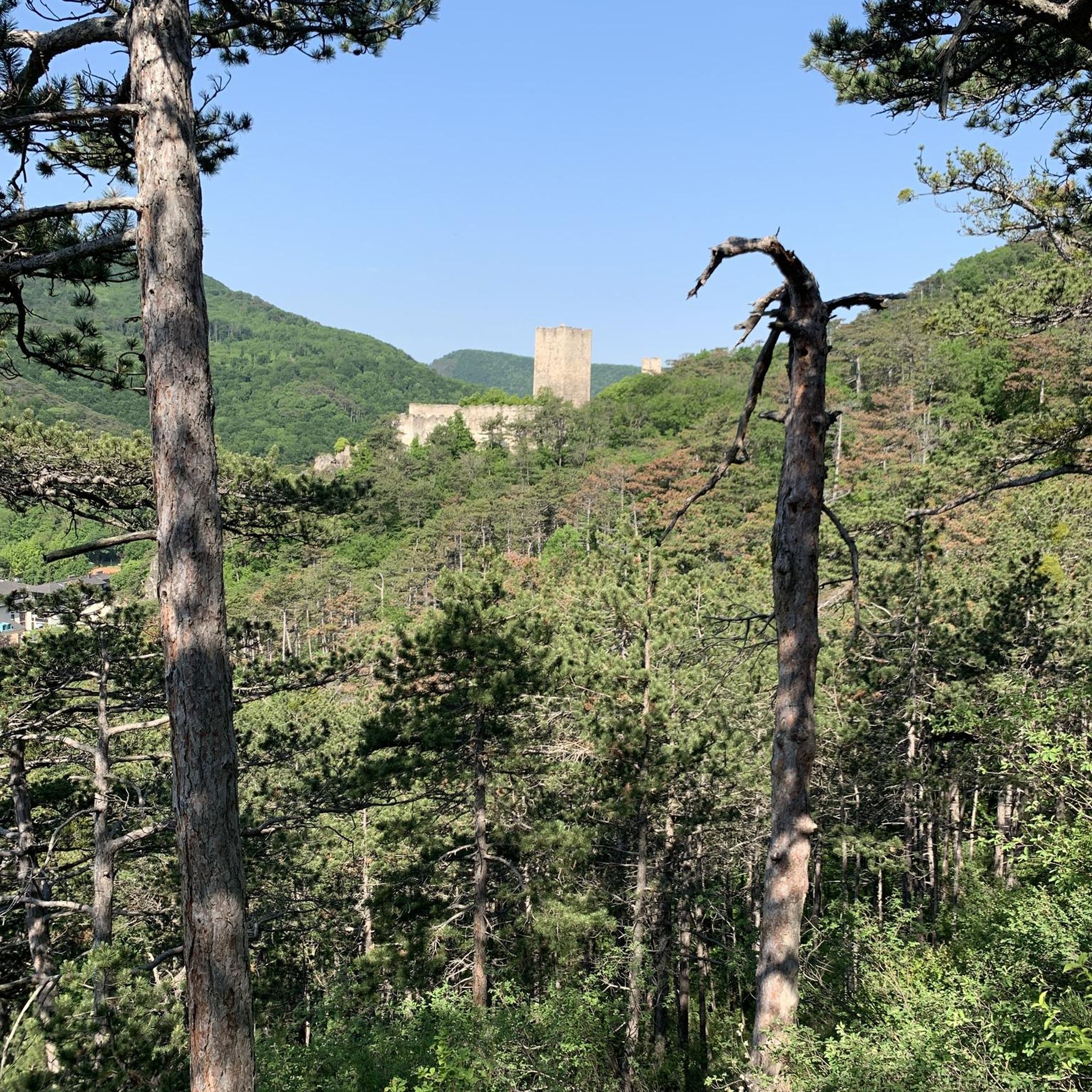
- Another must-see spot is Hinterhaus Castle Ruins, a castle first mentioned in 1243. Visitors can enjoy views of the Danube valley and the "Spitzer Graben" from this well-preserved ruin.
- Visitors also love View of Schönbühel Castle, a castle located below Melk on the right bank of the Danube. It was built at the beginning of the 12th century on a 40-meter-high rock, possibly on the site of a Roman fortress.
- Dunkelsteinerwald is known for its medieval ruins, historical castles, and fortified structures. The region offers a variety of castles to see and explore, from well-preserved sites to extensive ruins.
- The castles around Dunkelsteinerwald are appreciated by the komoot community. More than 1000 upvotes and over 1100 photos have been shared by visitors exploring these historical sites.
Last updated: July 6, 2026
Dürnstein Castle Ruins
Highlight • Castle
Translated by Google •
Tip by

View of historic Dürnstein
Highlight • Historical Site
Translated by Google •
Tip by

Sign up now to discover places like this
Get recommendations on the best single tracks, peaks, & plenty of other exciting outdoor places.
Sign up for free
Hinterhaus Castle Ruins
Highlight • Castle
From here you can enjoy a wonderful view of the Danube valley and the "Spitzer Graben".
Translated by Google •
Tip by

View of Schönbühel Castle
Highlight • Castle
The castle was built at the beginning of the 12th century by Marchwardus de Schoenbuchele as an easy to defend on a rock about 40 meters high, on which there was presumably a Roman fortress. The mighty towers and rondels as well as underground and partly buried passages suggest the existence of castle dungeons and dungeons in the past.
In 1064 the castle was given a church, the entrance of which was to the right of the main entrance of the castle and in which services were held until 1667. A school was also housed in the castle.
When the von Schonpihel family died out after almost 200 years with the death of Ulrich von Schonpihel at the beginning of the 14th century, the castle came into the possession of Conrad von Eisenbag and shortly afterwards to the Melk Abbey. As early as 1396, Abbot Ludwig was forced to sell the property to Caspar and Gundaker von Starhemberg, the later feudal lords of Gallneukirchen. For more than 400 years it remained in the possession of the Starhemberg family, who expanded and further fortified it.
Translated by Google •
Tip by

Luberegg Castle
Highlight • Castle
Source: de.wikipedia.org/wiki/Schloss_Luberegg
Translated by Google •
Tip by

Sign up for free to discover even more castles around Dunkelsteinerwald.
Sign up for free
Already have an account?
Start today with a free account
Your next adventure awaits.
Login or Signup

Tips from the Community

Dürnstein is a small old town with many tourists.
0
0

The view from Dürnstein Castle is breathtakingly beautiful!
8
0


Schönbühel Castle is located below Melk on the right bank of the Danube in the Lower Austrian municipality of Schönbühel-Aggsbach.
5
0

In 1192, Richard the Lionheart was imprisoned in the castle by the Habsburgs because of an insult during the Third Crusade and was released after paying a very high ransom.
3
0

Dürnstein is worth a visit
3
0

Impressive building project on the edge of the Central European lifeline
5
0

beautiful castle ruins with a wonderful view
1
1
Frequently Asked Questions
What historical significance do the castles in the Dunkelsteinerwald region hold?
The castles and ruins in the Dunkelsteinerwald region are steeped in history. For example, the Dürnstein Castle Ruins are famously known as the prison of the English King Richard the Lionheart in the late 12th century. Schönbühel Castle, built on a 40-meter-high rock, is believed to have been the site of a Roman fortress. Many of these structures, like the Aggstein Castle Ruins, date back to medieval times, offering a glimpse into the region's rich past.
Which castles offer the most impressive panoramic views?
For breathtaking panoramic views, the Dürnstein Castle Ruins provide stunning vistas of the Wachau. The Aggstein Castle Ruins, perched on a 300-meter-high rocky outcrop, offer phenomenal views of the Danube Valley. From the Hinterhaus Castle Ruins, you can enjoy a wonderful view of the Danube valley and the "Spitzer Graben." The Hohenegg Castle Ruins also boast a lovely view into the foothills of the Alps.
Are there family-friendly castles to visit in the Dunkelsteinerwald region?
Yes, several castles in the region are considered family-friendly. While many are ruins that require some walking, the historical context and scenic views can be engaging for all ages. Luberegg Castle, which now houses a museum and hotel, offers a more accessible experience. The climb to Dürnstein Castle Ruins is rewarded with history and views, and the themed trail around it can be interesting for families.
What kind of outdoor activities can I do near these castles?
The Dunkelsteinerwald region offers various outdoor activities near its castles. You can find numerous hiking trails, including loop trails around the Hohenegg Castle Ruins. For cyclists, the Danube Cycle Path runs directly past Schönbühel Castle. You can explore a variety of routes for hiking, mountain biking, and touring cycling. For more details, check out guides like Easy hikes around Dunkelsteinerwald, MTB Trails around Dunkelsteinerwald, and Cycling around Dunkelsteinerwald.
What is the best time of year to visit the castles in Dunkelsteinerwald?
The castles in Dunkelsteinerwald can be visited throughout much of the year. Spring and autumn offer pleasant temperatures for exploring the ruins and surrounding trails. Autumn, in particular, can be atmospheric, especially when mist rolls through the Danube Valley, enhancing the dramatic setting of places like Aggstein Castle Ruins. While some sites might be accessible in winter, check specific opening hours and conditions.
Are there any castles that are still inhabited or have modern uses?
Yes, Luberegg Castle, originally built around 1780, has been repurposed. It now houses a museum and parts of the facility operate as a hotel and inn, making it an event hotel. Schönbühel Castle is privately owned and serves as a private residence, meaning interior tours are not possible, but it can be admired from the outside.
Can I find hiking trails directly connected to the castle ruins?
Absolutely. The Hohenegg Castle Ruins, for instance, serve as a starting point for numerous loop hiking trails, including a connection to the Dunkelsteinerwald-Runde. There's also the Raimondosteig, a 1.5-kilometer loop trail around the Hohenegg ruins, featuring information boards about its history. The climb to Dürnstein Castle Ruins is also a popular, albeit sometimes steep, short hike.
What makes Aggstein Castle Ruins a unique place to visit?
Aggstein Castle Ruins are unique for their spectacular location on a 300-meter-high rocky outcrop above the Danube Valley, offering phenomenal panoramic views. It's considered one of Europe's most impressive ruins. A key feature is the "Rosengärtlein" (little rose garden), a narrow rock needle over an abyss, around which intriguing legends of prisoners and the notorious Jörg Scheck von Wald are entwined.
Are there any castles that are particularly well-preserved or offer insights into medieval life?
While many are ruins, they still offer significant insights. The Hinterhaus Castle Ruins are noted for being a well-preserved ruin, clearly divided into three parts: the lower outer bailey, the main castle, and the outer bailey. The mighty towers and rondels of Schönbühel Castle, along with underground passages, hint at its historical defenses and possible dungeons, providing a tangible connection to medieval architecture.
What do visitors enjoy most about exploring the castles in Dunkelsteinerwald?
Visitors frequently highlight the breathtaking views and the rich historical atmosphere. The opportunity to step back in time, imagine medieval life, and enjoy the stunning natural landscapes of the Wachau and Danube Valley are often mentioned. The combination of historical exploration and outdoor activity, such as hiking to the ruins, is a major draw for the komoot community.
Can I visit the castles using public transport?
While specific public transport routes to every castle entrance might vary, the region is generally accessible. For instance, Dürnstein, home to the Dürnstein Castle Ruins, is a picturesque village in the Wachau region with bus connections. Planning your route in advance using local transport information is recommended for specific castle access.
Are there any specific trails or paths around the castles that are easy for beginners?
Many of the castle ruins involve some uphill walking, but some areas offer easier exploration. For example, the Hohenegg Castle Ruins have the Raimondosteig, a 1.5-kilometer loop trail around the castle, which is generally manageable. While the climb to Dürnstein Castle Ruins can be steep, it's relatively short and well-maintained, making it accessible for many beginners.
Most popular routes around Dunkelsteinerwald
Most popular attractions around Dunkelsteinerwald

Get inspired with the komoot mobile app


Explore more
Looking for the best castles somewhere else? Discover other guides around Dunkelsteinerwald:
