Attractions and Places To See around Santeramo In Colle - Top 20
Best attractions and places to see around Santeramo In Colle include a range of historical landmarks and natural features within the Alta Murgia National Park. The region is characterized by its karst landscape, ancient fortifications, and significant cultural sites like the Cammino Materano. Visitors can explore a variety of churches, palaces, and natural caves, offering insights into the area's geology and history.
Best attractions and places to see around Santeramo In Colle
- The most popular attractions is Matera Cathedral (Cathedral…
Last updated: August 31, 2026
Matera Cathedral (Cathedral of the Madonna of the Bruna and Saint Eustace)
Highlight • Religious Site
Translated by Google •
Tip by

Suspension bridge over the Gravina
Highlight • Bridge
Translated by Google •
Tip by

Sign up now to discover places like this
Get recommendations on the best single tracks, peaks, & plenty of other exciting outdoor places.
Sign up for free
Church of Saints Peter and Paul (San Pietro Caveoso), Matera
Highlight • Religious Site
Translated by Google •
Tip by

Church of San Francesco d'Assisi and Dalí sculpture, Matera
Highlight • Religious Site
Translated by Google •
Tip by

Mercadante State Forest
Highlight • Forest
In …
Translated by Google •
Tip by

Sign up for free to discover even more attractions around Santeramo In Colle.
Sign up for free
Already have an account?
Start today with a free account
Your next adventure awaits.
Login or Signup
Popular around Santeramo In Colle

Other adventures around Santeramo In Colle

Tips from the Community

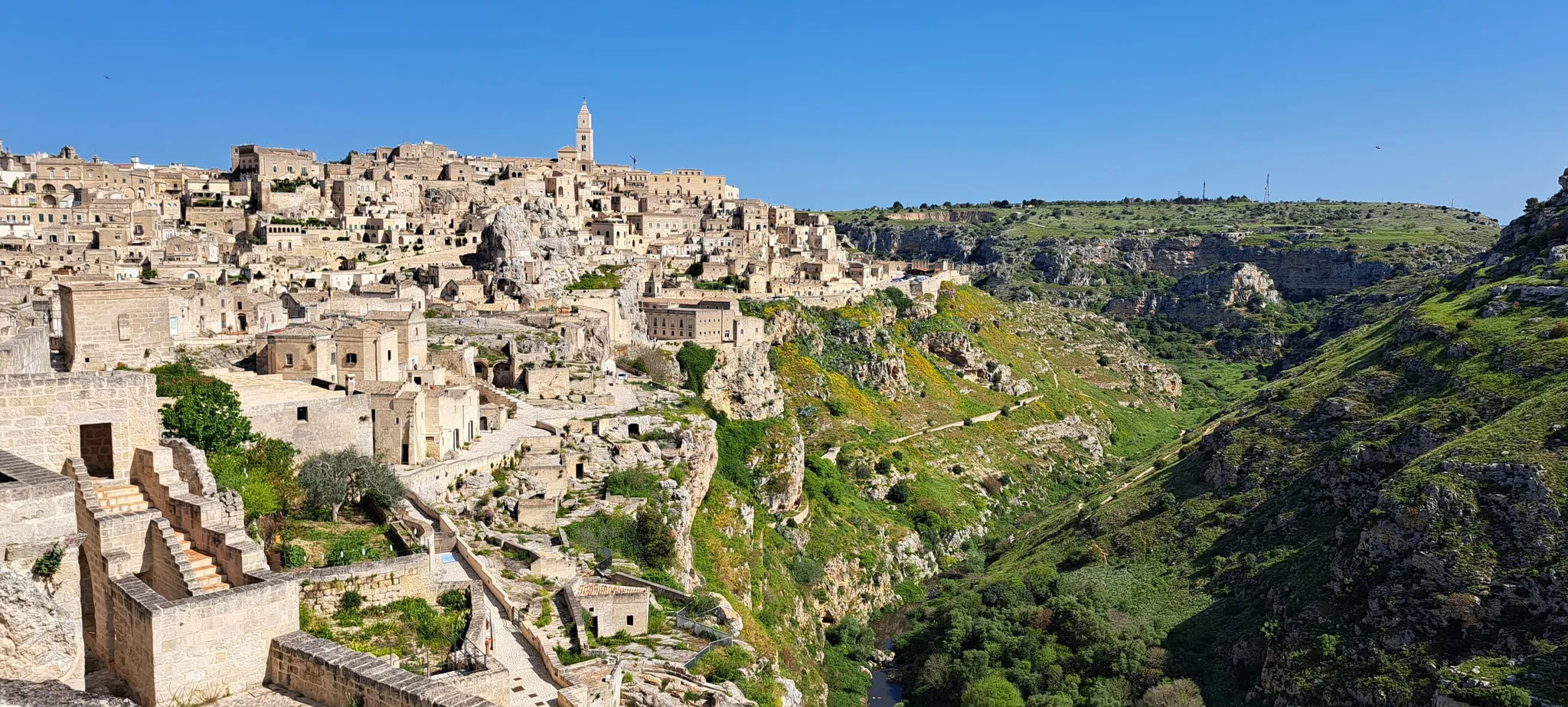
Matera is an Italian city in the Basilicata region, the capital of the province of the same name. It lies on the edge of the Murgia plateau. Its surroundings are home to the most important caveman settlements in the Mediterranean region. Since 1993, the "Sassi di Matera" (Stones of Matera), the oldest part of the city, have been a UNESCO World Heritage Site.
3
0

The Cathedral of Matera (Italian: Cattedrale della Madonna della Bruna e di Sant'Eustachio) is a Roman Catholic church in Matera, Italy. The cathedral of the Archdiocese of Matera-Irsina bears the title of a minor basilica. The church was built in the 13th century in the Apulian Romanesque style and stands on the highest point of the city between the two Sassi. Source and further information can be found at: https://de.m.wikipedia.org/wiki/Kathedrale_von_Matera
1
0

Dreamy Matera 👍 Old town and the caves 👍
2
0
Cathedral of San Pietro Caveoso 👍 Also worth seeing from the inside 👍
1
0

The position of the Duomo allows for a splendid overview of the Sassi valley, to get an idea of the harsh life of Matera.
1
0

Several large squares here
0
0
Be sure to walk down through the valley
0
0
Is open, be sure to walk in and admire the ceiling
1
0
Frequently Asked Questions
What historical landmarks can I explore in Santeramo in Colle?
Santeramo in Colle offers a rich history. You can visit the Palazzo Marchesale Caracciolo - Carafa, a 16th-century palace in Piazza Garibaldi, or the Chiesa Madre dedicated to Saint Erasmus. Other notable sites include the neoclassical Parrocchia di Santissimo Crocifisso and the ancient Domus Federiciana, which was the town's first castle. Remnants of ancient fortifications are also present throughout the town.
Are there natural attractions or parks to visit near Santeramo in Colle?
Yes, Santeramo in Colle is situated within the expansive Alta Murgia National Park, known for its unique karst landscape. Within the park, you can explore the Bosco di Mesola, a large pine forest home to various raptor species and rare orchids. The area also features characteristic 'lame' (karstic depressions) and 'jazzi' (ancient sheepfolds), such as those found at Lamalunga.
What kind of outdoor activities can I do around Santeramo in Colle?
The region around Santeramo in Colle is excellent for outdoor activities. You can find numerous trails for hiking and cycling within the Alta Murgia National Park. For specific routes, consider exploring the hiking trails, cycling routes, or running trails available, which include options like the Via Peuceta Loop or routes through the Mercadante State Forest.
Are there any family-friendly attractions in the area?
For families, the Parco dei Briganti, located 6 km from Santeramo, offers adventure trails among trees and picnic areas. Additionally, the Mercadante State Forest provides easy trails suitable for families to enjoy nature. Many historical sites, like the Matera Cathedral and the Church of Saints Peter and Paul, are also considered family-friendly for cultural exploration.
What are some significant cultural sites or experiences near Santeramo in Colle?
Santeramo in Colle is a significant stop on the Cammino Materano, a walking trail connecting Bari to Matera. You can also visit the Pinetta Galietti and the Tree of Thoughts, a landing stage for the Cammino Materano. The area also hosts archaeological sites with remains of entrenched Neolithic villages and a large Peuceta settlement. For local performances, the Teatro Saltimbanco offers cultural experiences.
What are the most popular religious buildings to visit?
Among the most popular religious buildings, the Matera Cathedral (Cathedral of the Madonna of the Bruna and Saint Eustace) stands out, completed in 1270 and towering over the city. Another must-see is the Church of Saints Peter and Paul (San Pietro Caveoso) in Matera, known for its baroque facade. The Church of San Francesco d'Assisi, also in Matera, is another significant historical church.
Can I find any unique geological features or caves in the area?
Yes, the Alta Murgia National Park, where Santeramo in Colle is located, is rich in karst features. You can find the Grotta di Sant'Angelo, a significant karst cave with ancient graffiti, and the nearby Grotta di Cristo, known for its stalactites. The surrounding countryside also features 'lame' (karstic depressions) like Lamalunga, showcasing caves, sinkholes, and rocky outcrops.
What is the best time of year to visit Santeramo in Colle for sightseeing and outdoor activities?
The region generally enjoys a Mediterranean climate. Spring (April-May) and autumn (September-October) are often ideal for visiting, offering pleasant temperatures for exploring historical sites and engaging in outdoor activities like hiking and cycling in the Alta Murgia National Park. Summers can be hot, while winters are milder but may have cooler temperatures.
What local culinary traditions or specialties should I try in Santeramo in Colle?
Santeramo in Colle is known for its distinctive cuisine. You should try the 'fornello pronto,' which features ready-to-eat grilled meats, often including horse meat. Traditional panzerotti, pizzas, and other authentic Apulian dishes are also popular. Don't miss local specialties like tarallini flavored with wild fennel seeds and exquisite dairy products such as Gioia del Colle DOP mozzarella.
Are there any viewpoints offering scenic panoramas?
Many of the religious buildings, such as the Matera Cathedral, are situated on high points, offering excellent views of the surrounding city and landscape. The Suspension bridge over the Gravina also provides breathtaking views of Matera and the gorge.
What are 'Quites' and where can I see them?
'Quites' are historical agricultural landscapes characteristic of the Murgia region. They feature lots bordered by dry stone walls and haystacks, representing nineteenth-century rural architecture. You can observe these unique formations in the countryside surrounding Santeramo in Colle, offering a glimpse into the region's peasant society and traditional land use.
Most popular routes around Santeramo In Colle
Most popular attractions around Santeramo In Colle

Get inspired with the komoot mobile app


Explore more
Still not found the Highlight you’re looking for? See guides of the top attractions in other regions:
