Attractions and Places To See around Cerreto Grue - Top 20
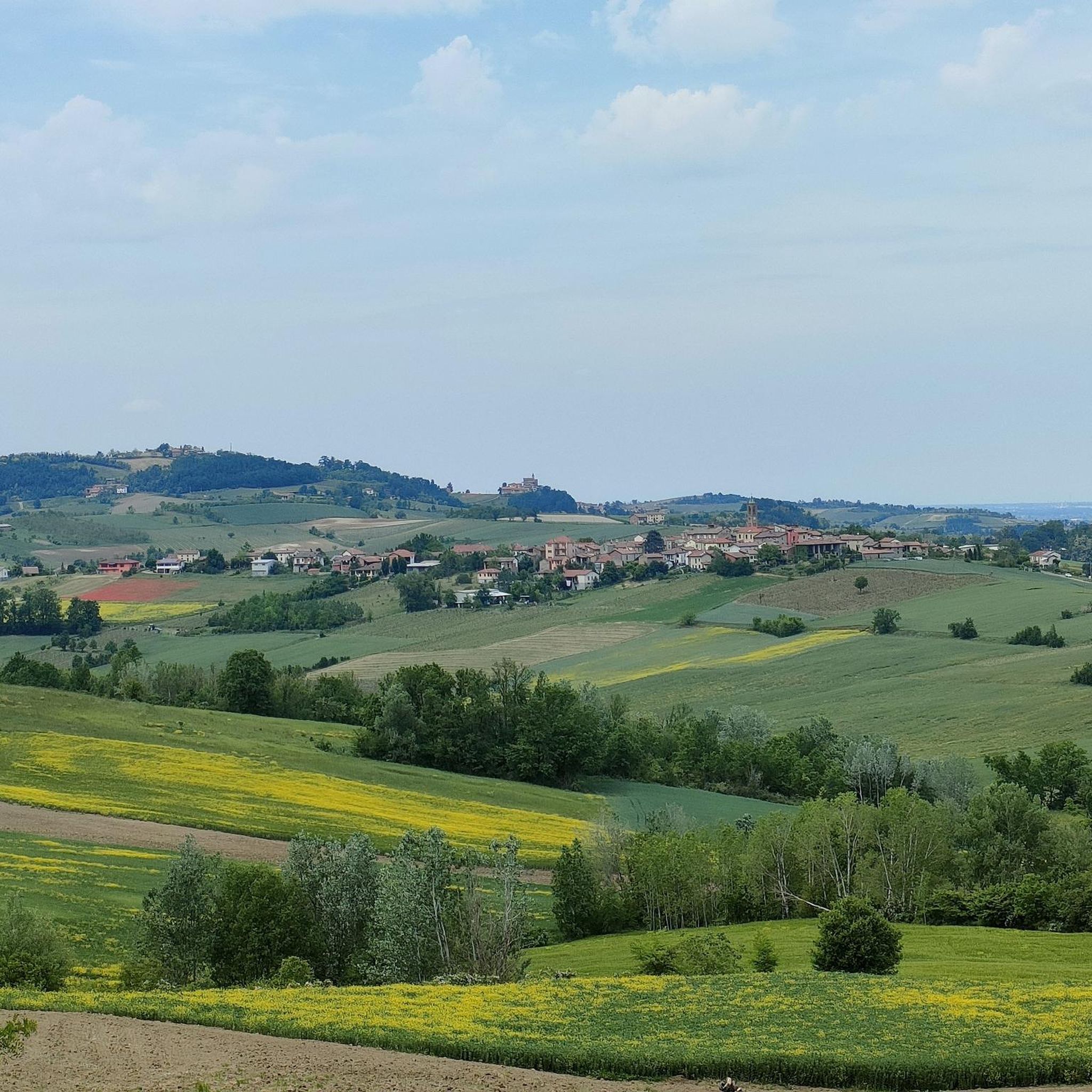
Best attractions and places to see around Cerreto Grue include a tranquil setting within the Province of Alessandria, Piedmont, Italy. The area is characterized by a hilly landscape and deep historical roots, with evidence of Roman settlements and medieval records. Natural features like the Tortona Hills offer scenic viewpoints, while cultural sites provide insights into the region's heritage. Cerreto Grue and its surroundings present a blend of natural beauty and historical significance for exploration.
Best attractions and places to see…
Last updated: May 9, 2026
Mural of Il Quarto Stato by Giuseppe Pellizza da Volpedo
Highlight • Monument
Translated by Google •
Tip by

Piazzetta Quarto Stato (Volpedo)
Highlight • Monument
Translated by Google •
Tip by

Sign up now to discover places like this
Get recommendations on the best single tracks, peaks, & plenty of other exciting outdoor places.
Sign up for free
Monte San Vito Summit
Highlight • Summit
Translated by Google •
Tip by

Medieval Towers of Sant'Alosio
Highlight • Historical Site
Translated by Google •
Tip by
Romanesque Parish Church of Santa Maria Assunta
Highlight • Religious Site
Translated by Google •
Tip by

Sign up for free to discover even more attractions around Cerreto Grue.
Sign up for free
Already have an account?
Start today with a free account
Your next adventure awaits.
Login or Signup

Tips from the Community

"The Fourth Estate" (1901) by Giuseppe Pellizza da Volpedo is a famous oil on canvas depicting a march of laborers, set in Piazza Malaspina in Volpedo (Alessandria). A symbol of workers' struggle, the work combines Pointillist technique and social themes. It is now housed at the Museo del Novecento in Milan.
4
0

Small but evocative, this Romanesque parish church still retains part of its original medieval architectural structure.
0
0

I know this photo from the film "1900" by Bertolucci
0
0

Quarto Stato Volpedo Square
2
0

Piazza Castello (or Piazza del Palazzo, but also Piazza Malaspina in the popular version accepted by Pellizza himself, today Piazza Quarto Stato), is the place where the painter, between 1891 and 1901, places the advance of the workers. The square was born towards the middle of the 19th century with the renovation of the stately building, commissioned by the new owners Malaspina, who created a new access on the western side. Giuseppe Pellizza painted The Fourth Estate between 1898 and 1901; the work was the fruit of a long creative journey inspired by the protest of a group of workers, for which he had farmers and artisans chosen from among his fellow villagers from Volpedo pose.
1
0

Volpedo has been included in the club of the most beautiful villages in Italy. It is famous for being the birthplace of the painter Giuseppe Pellizza, author of the famous The Fourth Estate, which became a symbol of the workers' question, starting from the 19th century onwards with the second industrial revolution.
3
0
Natural-size reproduction of the famous painting by Giuseppe Pellizza da Volpedo. Built between 1898 and 1901 and became a symbol of the workers' question, starting from the 19th century onwards with the second industrial revolution. Since July 2022 it has been preserved in the Gallery of Modern Art in Milan.
3
0
In Volpedo, the nineteenth-century physiognomy is easily recognizable and allows the visitor to follow an itinerary between art and landscape on the Pelzzino places. We therefore start from the Studio built by Pellizza in 1888, after having decided to live and work in his native country, while remaining in contact with the great international artistic currents. The atelier, which was for the artist a place of work but also of study and meeting with friends, when it was not possible for him to paint en plein air, is open to the public and presents itself as a precious container of Pellizza's memories. The painter's places come to life through the large-format reproductions of ten works scattered throughout the village and placed in selected points, in direct comparison with the landscape glimpses that inspired them. In this open-air museum, the continuous comparison between today and yesterday prompts recourse to the power of art, which gradually manifests itself along the way.
18
0
Frequently Asked Questions
What natural attractions can I explore around Cerreto Grue?
The most prominent natural attraction is Monte San Vito Summit, the highest peak of the Tortona Hills. It offers magnificent views from its rocky crags at 684 meters above sea level. The surrounding hilly landscape of the Val Grue also provides scenic beauty and opportunities for outdoor activities.
Are there historical sites to visit in Cerreto Grue and its surroundings?
Yes, the area is rich in history. You can visit the Parish Church of San Giorgio in Cerreto Grue, built in the 18th century on an older site. Remnants of a medieval fortified nucleus, including a 13th-14th century quadrangular stone structure and a 14th-15th century brick tower, can also be found within the village. Further afield, the Dongione of Carbonara Scrivia is a 14th-century fortress, and the Medieval Towers of Sant'Alosio, dating back to the 13th century, offer a glimpse into the region's past.
What cultural landmarks are there near Cerreto Grue?
A significant cultural landmark is the Mural of Il Quarto Stato by Giuseppe Pellizza da Volpedo, located in the nearby village of Volpedo. This full-size copy of the famous oil painting symbolizes the labor struggle. The mural is situated in Piazzetta Quarto Stato (Volpedo), which is the actual setting depicted in the original painting.
Are there family-friendly activities or attractions in the area?
Several attractions are considered family-friendly. The Mural of Il Quarto Stato by Giuseppe Pellizza da Volpedo and Piazzetta Quarto Stato (Volpedo) offer an engaging cultural experience. The Romanesque Parish Church of Santa Maria Assunta, with its well-kept park, can also be a pleasant visit for families, especially during guided tour hours.
What kind of hiking trails are available near Cerreto Grue?
The area around Cerreto Grue offers various hiking opportunities. You can find trails like 'The Route of the Badlands and Vineyards' (easy, 3.7 km) or 'Piedmont vineyards trail from Costa Vescovato' (moderate, 10.6 km). For more options, explore the hiking guide for Cerreto Grue.
Can I go cycling or mountain biking around Cerreto Grue?
Yes, the hilly landscape is popular with cyclists and mountain bikers. Monte San Vito Summit is a crossroads for CAI paths and a network of trails suitable for mountain biking. Cycling routes include challenging options like 'Strette del Borbera – Coppi Climb Mural loop from Castellania Coppi' (93 km). For more details, check the cycling guide and MTB trails guide for Cerreto Grue.
Where can I find scenic viewpoints in the Cerreto Grue area?
The Monte San Vito Summit provides magnificent panoramic views of the Tortona Hills and surrounding valleys. The Medieval Towers of Sant'Alosio also offer a 360° view of the surrounding valleys and hills from their elevated position.
What is the best time of year to visit Cerreto Grue for outdoor activities?
Given the hilly landscape and focus on outdoor activities like hiking and cycling, spring and autumn generally offer the most pleasant weather. Temperatures are milder, and the natural scenery is particularly beautiful with blooming flowers or vibrant fall foliage. Summer can also be suitable, but be prepared for warmer temperatures.
What do visitors particularly enjoy about the attractions near Cerreto Grue?
Visitors appreciate the blend of natural beauty and historical significance. The panoramic views from Monte San Vito Summit are highly praised, especially at sunrise or sunset. The evocative architecture of the Romanesque Parish Church of Santa Maria Assunta and the artistic significance of the Mural of Il Quarto Stato are also frequently highlighted.
Are there any Romanesque churches to visit in the area?
Yes, the Romanesque Parish Church of Santa Maria Assunta is a notable example. This small but evocative church, dating back to the 11th century, retains much of its original medieval architectural structure and is characterized by a mixed use of brick and stone.
Is the Mural of Il Quarto Stato by Giuseppe Pellizza da Volpedo accessible?
Yes, the Mural of Il Quarto Stato by Giuseppe Pellizza da Volpedo is tagged as wheelchair accessible, making it an inclusive cultural site to visit in Volpedo.
What are the specific paths to reach Monte San Vito Summit?
Monte San Vito Summit is accessible via CAI paths 124 and 139 of the province of Alessandria. These paths can sometimes be challenging due to depth and slope, but they lead to the summit's magnificent views.
Most popular routes around Cerreto Grue
Most popular attractions around Cerreto Grue

Get inspired with the komoot mobile app


Explore more
Still not found the Highlight you’re looking for? See guides of the top attractions in other regions:
